Altus Says Now Is the ‘Golden Time’ to Build Integrated Digital-Asset Systems
Summary
- Lee Hyung-yeon, chief executive officer of Altus, said now is the golden time to design an integrated foundation for digital-asset systems.
- Altus said its digital-asset internal-control framework for financial institutions, Altus Foundry, can reduce costs and operational risk.
- Altus said its permission-based design and blockchain-agnostic structure can strengthen internal controls, regulatory compliance and scalability.
Forecast Trend Report by Period



“If financial institutions build separate systems for each digital-asset business, they end up recreating the same functions over and over. With still relatively few systems in place for digital-asset operations, now is the golden time to design an integrated foundation.”
Lee Hyung-yeon, chief executive officer of Altus, explained the need for the company’s recently launched Altus Foundry in an interview with Bloomingbit on Oct. 2. Pursuing new businesses such as asset tokenization, stablecoin payments and digital-asset custody separately could increase costs, complexity and operational risk over the medium to long term.
Altus is a South Korean blockchain company that has spent the past eight years building Layer 1 blockchains, tokenization platforms, stablecoin payment infrastructure and decentralized finance applications, mainly overseas. It also operates validator infrastructure on more than 10 blockchain networks, including Hyperliquid and Chainlink.
Based on the blockchain technology and operational know-how it accumulated through that work, Altus recently launched Altus Foundry, a digital-asset internal-control framework tailored for financial institutions.
A ‘Palantir-style’ approach, with engineers customizing systems one-on-one
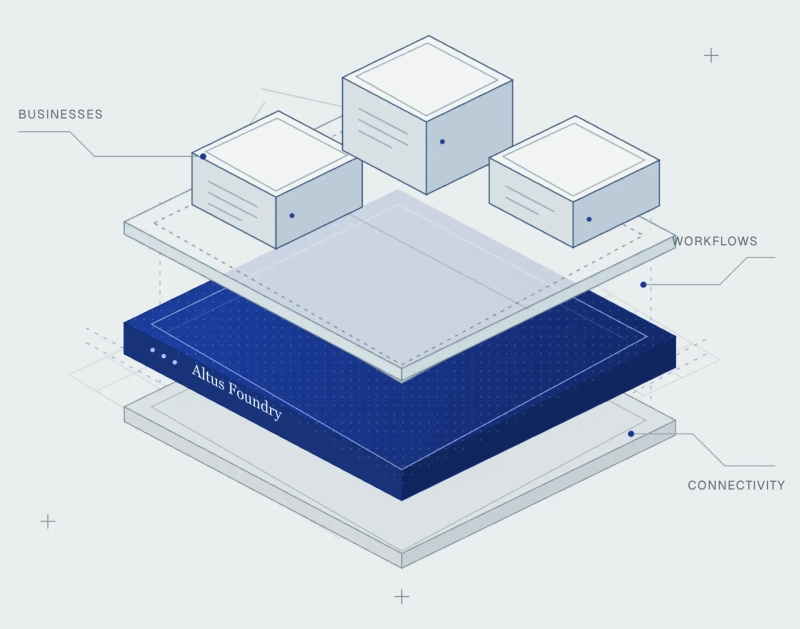
Altus Foundry is not off-the-shelf software. It is a technology framework that provides a single infrastructure for approval policies, blockchain connectivity, know-your-customer and anti-money-laundering solutions, and integration with internal systems that can be shared across multiple digital-asset business units.
As part of implementation, Altus deploys a dedicated Forward Deployed Engineer, or FDE, to each client. The engineer analyzes the client’s business objectives, organizational structure, partners, and regulatory and audit standards, then designs and builds a blockchain system optimized for that environment. Rather than a simple software license, the product is offered as a turnkey package combining the framework with consulting, design and build-out, and operational support.
“Digital-asset businesses require different functions and operating environments from one client to another, so finished software cannot be provided in a one-size-fits-all format,” Lee said. “Altus Foundry is a service that combines software and FDE support to build the functions a client needs on top of a technical framework.”
In terms of service structure, he added, the model is similar to Palantir’s approach of deploying engineers on site to define problems in detail and build systems around them.
Lee said digital-asset businesses, unlike traditional finance operations, do not yet have a standardized blueprint. Even when firms have a business idea, it can be difficult to define the workflow and approval structure required and to determine how regulatory and audit requirements should be reflected in the system.
“The hardest and most important work is the communication and research process that turns a client’s vague requirements into specifications that can actually be implemented,” Lee said. “What makes digital-asset system development distinctive is that you need to understand the business, partners, workflow, regulation and internal-control policies together.”
He described the current period as the right time for adoption. If firms move to integration only after more systems are already in place, they would not only duplicate build-out costs but also have to bear potential service disruptions and data-migration risks when moving live operations. They would also face the burden of modifying separate systems one by one whenever regulations change or a new blockchain or custodian is added.
Built around permissions, not functions, to enforce internal controls through technology
Another feature of Altus Foundry is that it separates systems by permissions rather than by functions. While conventional software is designed around functions such as trading, custody and settlement, Altus Foundry is structured around authority, including work requests, approvals and execution controls.
“It translates the governance principles used by financial institutions, where roles are divided by authority across the front office, middle office and back office, into the architecture of the system,” Lee said.
Each component has its own security boundary, with flexibility restricted to structurally block malfunctions or intentional abuse of authority. The design enforces internal-control principles through technology rather than leaving them only in documents.
Lee also outlined the potential benefits of adoption. Altus estimates that Foundry could replace more than half of the common areas in standalone digital-asset systems. Instead of building multiple businesses separately, institutions that integrate them on top of Altus Foundry could cut both build costs and implementation time by more than 50%. Those gains would accumulate as more businesses are added.
The goal is not only to lower costs. If each business builds its own system, workflow, approval structures, and approaches to audits and regulation are more likely to diverge. System operators would then have to learn different procedures, and as the number of businesses grows, so does the complexity that depends on human judgment.
“System fragmentation increases confusion for managers and frontline staff, and that can eventually lead to operational incidents and failures in internal controls,” Lee said. “In a complex operating environment, small mistakes can become vulnerabilities to insider abuse or external attacks.”
Lee also stressed that the framework is not tied to any specific blockchain. Supporting multiple global clients made clear that underlying infrastructure needs the flexibility and scalability to avoid dependence on any particular technology or vendor, he said. Altus Foundry, he added, emerged naturally from that experience.

JOON HYOUNG LEE
gilson@bloomingbit.ioCrypto Journalist based in Seoul