Semiconductor Dollar Flows Help Keep Korean Won Firm Around 1,360 per Dollar
Summary
- The dollar-won exchange rate has fallen to around 1,360 won, declining rapidly from first-half levels.
- Large dollar supply from semiconductor companies such as Samsung Electronics and SK Hynix, along with about 458 trillion won in won demand next year, is supporting the Korean currency.
- But the won could still weaken because of high U.S. interest rates, a widening Korea-U.S. rate gap, and exporters' forward dollar selling.
Forecast Trend Report by Period


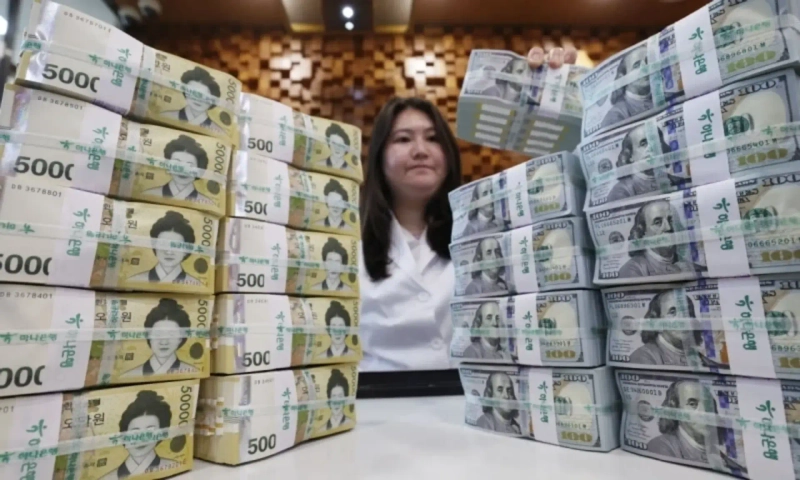
The Korean won has remained firm despite concerns that the Federal Reserve could raise interest rates further. In the market, large-scale dollar supply from semiconductor companies such as Samsung Electronics Co. and SK Hynix Inc. is seen as the main factor driving the exchange rate lower.
According to the foreign-exchange market on October 2, the won was trading at around 1,360 per dollar. The average exchange rate was 1,483 won in the first half of the year and 1,426 won in the third quarter. After rising above 1,500 won at one point in the first half, the dollar-won rate declined rapidly in the second half.
Lee Seung-hoon, an analyst at Meritz Securities Co., said the won's strength despite expectations for faster Fed rate hikes reflects a shift in perceptions that dollar supply could increase in the second half.
One example is dollar conversion demand from chipmakers. Following inflows from SK Hynix's American depositary receipt issuance, spending by major semiconductor companies including Samsung Electronics on capital investment, performance bonuses and shareholder returns has translated into won demand, increasing dollar supply in the foreign-exchange market.
Meritz Securities estimates Samsung Electronics and SK Hynix will need about 458 trillion won ($331.9 billion) in won next year. That is about double this year's level and equivalent to roughly 60% of South Korea's annual current-account surplus.
The high share of overseas sales at semiconductor companies is also cited as a factor supporting the won. Lee Jae-hyung, an analyst at Yuanta Securities Korea Co., said more than 80% of semiconductor sales are generated overseas, leading to sizable foreign-currency inflows. Companies can also obtain the won needed for expanding capital spending directly in the foreign-exchange market.
Still, exchange-rate volatility could increase again. Elevated U.S. interest rates, a widening Korea-U.S. rate gap and exporters' forward dollar selling could all weigh on the won.
Jung Yong-taek, an analyst at IBK Investment & Securities Co., said dollar strength could persist if U.S. market interest rates remain around 5%. The won is currently caught between factors supporting strength and weakness, he added, but external sources of uncertainty may have a greater impact over time.

YM Lee
20min@bloomingbit.ioCrypto Chatterbox_ tlg@Bloomingbit_YMLEE