France Becomes Global Economy’s Weak Link as Fiscal, Political Turmoil Sparks Bond Selloff
Summary
- France’s 10-year government bond yield has surged to its highest since 2002, prompting markets to identify the country as Europe’s weak link.
- France plans a record 340 billion euros of government bond issuance next year, while interest costs of 91.2 billion euros are fueling bond sales and expanding short-selling.
- With political turmoil and a fiscal deficit of 5% persisting, slowing growth and uncertainty ahead of the presidential election are making a recovery in French bond prices more difficult.
Forecast Trend Report by Period


Alarm Bells Grow in France: Could It Trigger a Second European Debt Crisis?
France’s 10-Year Bond Yield Nears 5%
Gap With Germany Widens to Highest Since Debt Crisis
Political Uncertainty Builds Ahead of Presidential Election
Neither Austerity Nor Stimulus Is Possible, Prolonging the Vicious Cycle
Benchmark 10-year government bond yields in France, Italy, Spain and Greece have climbed to their highest levels in more than two decades. France, where fiscal and political instability is deepening, has emerged as the trigger. Hedge funds betting on further increases in French yields, which move inversely to prices, have been selling holdings or adding to short positions. The selling has also spread to southern European bond markets, which are viewed as more fiscally vulnerable.
◇France-Germany Yield Gap Widens
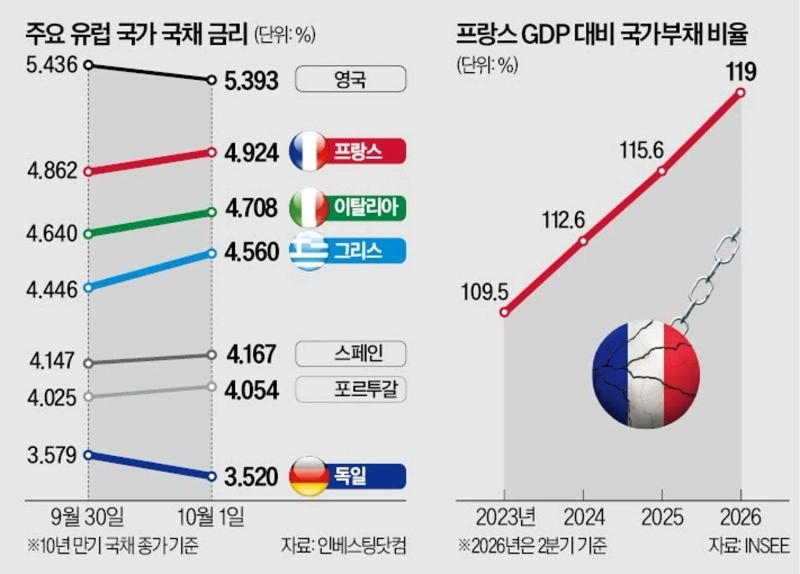
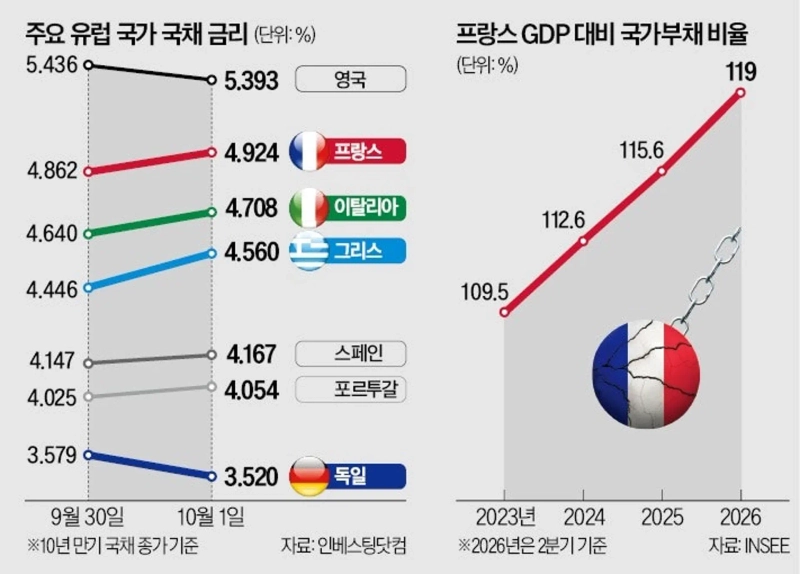
On Oct. 1, the yield on France’s 10-year government bond, or OAT, rose to 4.924%, the highest since 2002. Germany’s 10-year Bund, viewed as a safe-haven asset in Europe, closed at 3.52%, down 0.059 percentage point. The spread between the 10-year OAT and Bund widened to 1.4 percentage points, the largest since the 2011-2012 European debt crisis.
Yields in Italy, Spain and Greece also rose. Italy’s 10-year yield climbed 0.068 percentage point to 4.708%, while Greece’s jumped 0.114 percentage point to 4.56%. In the U.K. gilt market, the 30-year yield rose as high as 6.020% intraday, topping 6% for the first time since 1998. Reuters reported that while this is not yet a euro-zone crisis, markets have begun asking which country is the weak link.
◇French Bonds Slump on Fiscal Concerns
France’s fiscal troubles and political instability are being cited as the main reasons for the sharp rise in yields across parts of the euro zone. Selling in French government bonds has also weighed on neighboring sovereign debt markets.
France’s government debt stood at 119% of gross domestic product as of the second quarter. The country plans to issue 340 billion euros of government bonds next year to fund its budget and repay maturing debt, the largest amount on record. Interest costs are projected to rise to 91.2 billion euros next year from 62.6 billion euros this year.
More supply means higher yields. As the risk of further declines in French bond prices has grown, investors have been selling their holdings or betting on further losses through short-selling. Asked where Europe’s weak link is, Rohan Khanna, Barclays’ head of European rates strategy, pointed to France.
Volatility in the French bond market has also surged, with daily swings reaching 0.16 percentage point. That is prompting hedge funds to unwind leveraged trades. Hedge funds account for about 7% to 8% of global sovereign bond holdings by value, but they handle more than half of trading in Europe’s government bond market. As they pull back, French bond prices may struggle to recover.
◇Weak Politics Hampers the Response
The French government has proposed a budget for next year centered on 43 billion euros of spending cuts and tax reforms aimed at raising additional revenue. The goal is to reduce the fiscal deficit to 5% of GDP next year from 5.4% this year.
The problem is that such measures could weaken growth. France’s economy contracted in the first quarter and was flat in the second. Weaker consumption could also reduce tax revenue, limiting any improvement in public finances.
Political turmoil is also continuing. The ruling coalition lacks a parliamentary majority, and two former prime ministers have already stepped down over disputes tied to budget tightening. Since September, labor unions and students have staged a series of protests against the government’s austerity policies.
Next year’s presidential election is another headwind for resolving the fiscal crisis. Markets are worried about a scenario in which far-right leader Marine Le Pen faces far-left leader Jean-Luc Melenchon. Le Pen has pledged to reduce the deficit but has not laid out how she would do so. Melenchon has shaken market confidence by proposing that French government bonds be converted into zero-interest perpetual debt that would not require repayment of principal.
Hwang Jung-soo, New York correspondent hjs@hankyung.com
Oh Se-song, reporter sesung@hankyung.com

Korea Economic Daily
hankyung@bloomingbit.ioThe Korea Economic Daily Global is a digital media where latest news on Korean companies, industries, and financial markets.