Asia’s Climate Finance Drive Hinges on Building Digital Infrastructure
Summary
- Building infrastructure that combines transition finance, carbon markets, and digital finance — including tokenized securities (STOs) and fractional investing — is essential to accelerate Asia’s push toward carbon neutrality.
- Speakers said blockchain-based data tracking and verification systems and cross-border mutual recognition (interoperability) are central to revitalizing Asia’s carbon markets and improving capital flows.
- Chairman Jung Yoo-shin said the February 2025 implementation of revisions to the Electronic Securities Act and the Capital Markets Act will allow digital financial infrastructure, including tokenized securities and fractional-investment exchanges, to be used in earnest for financing climate and environmental assets.
Forecast Trend Report by Period


Yonsei University Graduate School of Environmental Finance Holds Symposium on ‘Climate Finance Infrastructure in Asia’
Speakers Stress Importance of Building Digital Trust Infrastructure Amid Shifts in Global Finance
“Cross-Border Mutual Recognition Is Essential ... Global Markets Are Already Shifting”
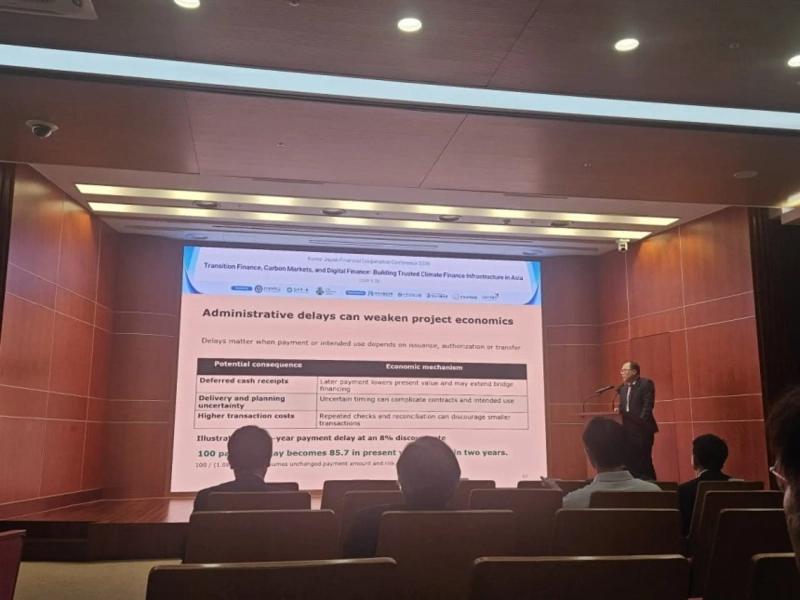
Asia must first build a credible financial infrastructure that integrates transition finance, carbon markets and digital finance — including tokenized securities, or STOs, and fractional investing — to accelerate progress toward carbon neutrality, according to speakers at a recent symposium.
Yonsei University’s Graduate School of Environmental Finance on Sept. 28 held a Korea-Japan cooperation conference under the theme “Transition Finance, Carbon Markets and Digital Finance: Building Trusted Climate Finance Infrastructure in Asia.” Presenters agreed that Asian countries need to move quickly to establish digital trust infrastructure to spur capital flows as traditional capital markets converge with virtual assets and digital markets.
Manufacturing-Heavy Asia Needs Large-Scale Transition Finance and Data Transparency
Hyun Seok, a professor at Yonsei University, said the Asia-Pacific region is a global manufacturing hub with a high share of greenhouse-gas emissions. At the same time, it requires massive funding for the technological shift to a low-carbon economy.
That is why transition finance has become increasingly important. Its role is not limited to so-called dark green companies, but also includes helping high-carbon industries reduce emissions in stages.
Asian markets have long faced criticism that vague standards and evaluation models for transition activities are constraining capital inflows. Hyun said there is an urgent need for consistent transition-finance standards and incentive systems that both investors and companies can trust.
He also proposed introducing data-tracking and verification systems using digital technologies such as blockchain to ease greenwashing concerns. A digital data infrastructure could improve transparency in carbon-credit trading and enable cross-border interoperability in emissions-reduction performance, providing a catalyst for revitalizing Asia’s carbon markets.
Asia needs a regional digital and financial infrastructure alliance that goes beyond individual national efforts if it is to emerge as a leading hub for global climate finance rather than remain on the periphery, Hyun added.
Global Capital Markets Are Already Moving On-Chain
A separate presentation examined the structural changes that the digitalization of finance could bring, including tokenized securities and fractional investing, as well as the current state of South Korea’s capital market.
Jung Yoo-shin, chairman of the AI Digital Finance Economy Forum, said major global financial institutions including Nasdaq have recently adopted blockchain-ledger infrastructure for on-chain stock and bond trading. Markets for tokenized real-world assets, as well as money market fund- and Treasury-based tokens, are also expanding rapidly, he said.
While the US and other advanced financial markets have expanded the STO market around standardized securities such as Treasuries and bonds, South Korea has taken a distinctive approach by opening the market first to non-standardized securities — including beneficiary certificates and investment-contract securities — and to fractional investing through a regulatory sandbox.
That has opened a market for issuing and trading tokenized assets that were previously difficult to securitize, including music copyrights, artwork, real estate, cultural content, and agricultural and livestock assets. Those assets are being structured as beneficiary certificates under non-monetary trusts or as investment-contract securities.
With revisions to the Electronic Securities Act and the Capital Markets Act set to take effect in February 2025, the issuance of tokenized securities using distributed-ledger technology will be formally institutionalized under the law. Over-the-counter fractional-investment exchanges handling non-standardized securities, including NexTchange and KDX, are also set to begin full operations.
Jung said this digital financial infrastructure could also be used effectively to finance a range of climate and environmental assets, including renewable-energy facilities and carbon credits. He added that South Korea should focus on regulatory refinements and securing liquidity so distributed-ledger infrastructure and over-the-counter trading platforms can operate smoothly when the law takes effect in February 2025.
Koo Hyun-hwa, Hankyung.com reporter kuh@hankyung.com

Korea Economic Daily
hankyung@bloomingbit.ioThe Korea Economic Daily Global is a digital media where latest news on Korean companies, industries, and financial markets.