"I Put 80% in Samsung, SK Hynix—Now What?" Don't Rely on Price Targets Alone
Summary
- Brokerages' average target prices for Samsung Electronics and SK Hynix are 80.5% and 78.5%, respectively, above current share prices.
- Experts identified 300,000 won to 320,000 won for Samsung Electronics and 2,200,000 won to 2,400,000 won for SK Hynix as ranges for cutting exposure, and advised reducing the two stocks' combined weighting to 30% to 40%.
- If the two stocks' combined weighting reaches 70% to 80%, portfolio losses can deepen in a downturn, and concentration in semiconductor-related stocks is not true diversification.
Forecast Trend Report by Period


Brokerages' average price targets stand 80.5% above Samsung Electronics' current share price and 78.5% above SK Hynix's
Experts say the two stocks' combined weighting should be cut to 30% to 40%; shifting into related shares is not diversification
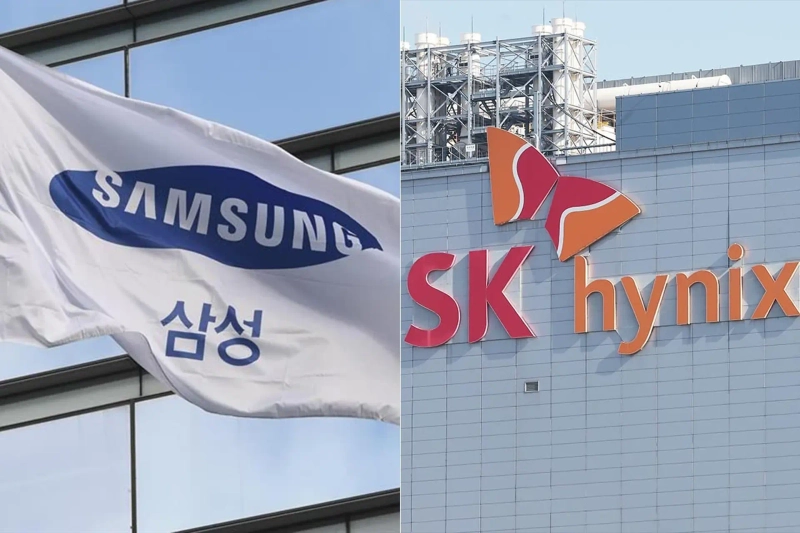
Brokerages are issuing rosy forecasts for Samsung Electronics and SK Hynix. Average price targets imply upside of about 80% from current levels. But target prices vary sharply across firms, prompting warnings against concentrating too much capital in the two stocks based on those figures alone.
An analysis by Hankyung Epic AI of brokerage reports published over the past 150 days found Samsung Electronics' average target price at 498,125 won. That is 80.5% above its Oct. 2 closing price of 276,000 won. Of 24 reports on the stock, 22 rated it buy, one strong buy and one neutral. The median target price was 500,000 won.
Brokerage views differed widely. Korea Investment & Securities set the highest target at 650,000 won, followed by Yuanta Securities at 630,000 won, SK Securities at 610,000 won and KB Securities at 600,000 won. BNK Investment & Securities, by contrast, downgraded the stock to neutral and set a target of 270,000 won. The spread between the highest and lowest targets was 380,000 won.
SK Hynix showed a similar pattern. The average target price from 24 brokerages was 3,286,250 won, or 78.5% above its Oct. 2 close of 1,841,000 won. The median target price was 3,300,000 won.
Korea Investment & Securities set SK Hynix's target at 4,700,000 won. KB Securities and Daol Investment & Securities each put it at 4,200,000 won. Kyobo Securities, SK Securities and IBK Investment & Securities each set a target of 4,000,000 won. The most conservative view came from BNK Investment & Securities, with a target of 1,480,000 won. That leaves a 3,220,000 won gap from Korea Investment & Securities' forecast. The divergence reflects differing views on how long the memory-chip upcycle will last, as well as on the exchange rate and the profitability of high-bandwidth memory, or HBM.
The bullish view on both companies is rooted in surging HBM demand driven by AI servers. Higher prices for conventional memory chips and the expansion of the HBM4 market are also cited as factors that could lift earnings.
For Samsung Electronics, whether it can regain competitiveness in HBM is central to any rerating of the stock. For SK Hynix, its dominance in the HBM market and shareholder returns are seen as pillars of support.
Risks remain. Continued won strength could reduce earnings when export revenue is converted into the local currency. Samsung Electronics also faces pressure from losses in its foundry business and weaker profitability in its consumer electronics and mobile divisions. For SK Hynix, concerns have been raised about HBM4 quality and expanded overseas investment.
Experts say investors should first check how much of their portfolio is tied up in the two stocks rather than focusing on any single target price.
Lee Kwon-hee, chief executive of Wizwave, recently said on the YouTube channel Pyo Young-ho TV that investors may want to trim exposure to Samsung Electronics at 300,000 won to 320,000 won and to SK Hynix at 2,200,000 won to 2,400,000 won. If the two stocks account for 70% to 80% of a portfolio, he said, investors should consider cutting their combined weighting to 30% to 40%.
If a portfolio is valued at 100 million won and the two stocks account for 80 million won, an investor would need to sell 40 million won to 50 million won worth of shares to reduce their combined weighting to 30% to 40%. That is a simple calculation excluding trading costs and share-price moves.
Heavy concentration in a small number of stocks can amplify losses across an entire portfolio in a downturn. If the two names make up 80% of an account and each falls 10%, the overall portfolio return drops 8%. If their combined weighting is 40%, the loss shrinks to 4% under the same conditions.
Simply rotating into semiconductor materials, parts and equipment makers or power-equipment stocks does not amount to meaningful diversification. Those companies' earnings can also hinge on investment in AI data centers and semiconductor capital spending.
Lee Song-ryeol, Hankyung.com reporter yisr0203@hankyung.com

Korea Economic Daily
hankyung@bloomingbit.ioThe Korea Economic Daily Global is a digital media where latest news on Korean companies, industries, and financial markets.