'Blue Wave' in U.S. Midterms Could Boost Korean Clean Energy, Battery Stocks, Stirring Retail Investors
Summary
- Brokerages said a blue wave could benefit renewable energy, secondary batteries and ESS stocks.
- They said a Democratic majority could drive a rebound in renewables and utilities through the restoration of scaled-back clean-energy tax credits and expanded ESS investment.
- Analysts said returns for the Kospi and S&P 500 were generally positive after past U.S. midterm elections, reflecting a recovery in risk appetite as uncertainty eased.
Forecast Trend Report by Period


Democrats to restore clean-energy tax credits, pledge wider ESS investment
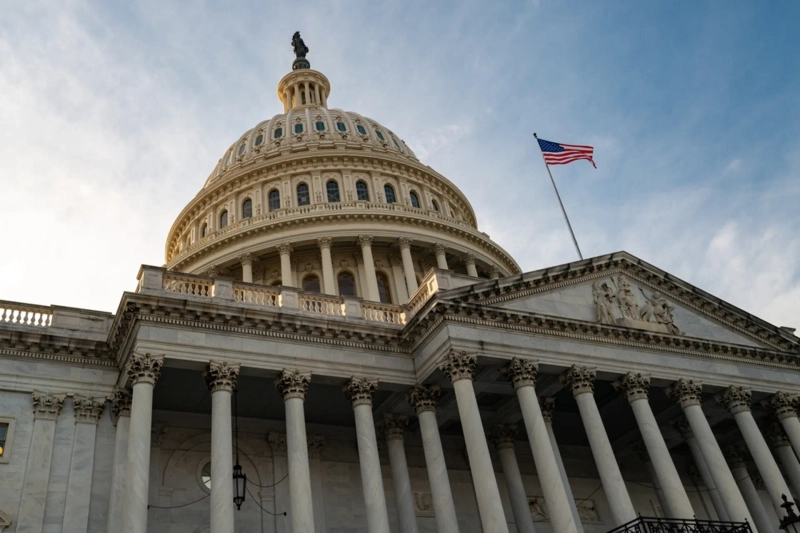
If Democrats pull off a "blue wave" in the U.S. midterm elections in November by winning both chambers of Congress, sectors such as renewable energy, secondary batteries and energy storage systems, or ESS, could benefit in South Korea's stock market, according to brokerage analysis.
Park Hye-ran, an analyst at Samsung Securities, wrote on October 4 that a Democratic victory would add another driver for energy demand. Republican-led policies that have curtailed renewable-energy subsidies and ended investment tax credits could be partly revised, she added.
In the November 3 midterms, all 435 seats in the House of Representatives, whose members serve two-year terms, will be contested. In the Senate, 35 of the 100 seats, or about one-third, will be up for election. Gubernatorial elections will also be held in 36 states.
In the House, Republicans currently hold 218 seats and Democrats 214, excluding one independent seat and two vacancies. Given that narrow gap, Democrats would need to gain four seats in this year's midterms to take control.
The Senate is also closely split, with Republicans holding 53 seats and Democrats 47. Democrats would need to gain four seats there as well to secure a majority.
Prediction market platform Polymarket is assigning a 62% probability to a Democratic sweep of both the House and Senate. That is up sharply from 51% in March, before the U.S.-Iran war broke out, as the election draws nearer.
Samsung Securities named renewables and utilities as the sectors likely to see the strongest rebound if a blue wave materializes. Democratic leaders have said they would restore clean-energy tax credits scaled back under the Trump administration and expand investment in ESS.
Park said that if Democrats win at least the House, some Republican-led policies could be revised, lifting expectations for policy support for renewable energy. Control of the House would also strengthen Democrats' leverage in next year's budget and debt-ceiling talks. The party could use that leverage to seek changes to some renewable-energy subsidy requirements, with Republicans likely to accept them.
One of the biggest issues in the midterms is electricity costs, including those related to data-center construction. Republicans are pushing to expand nuclear power generation and gas turbines to meet surging power demand and strengthen fuel supply-chain security.
Democrats, by contrast, are emphasizing wider deployment of renewable energy to ease inflation pressures.
In the U.S., investment tax credits for solar projects were slated for early termination through revisions to the Inflation Reduction Act, or IRA, last year. Utility-scale solar projects will receive the credit only if they begin operating by the end of next year. Residential solar credits ended at the close of last year.
For onshore wind, installation could also increase sharply if projects scheduled for 2028 through 2030 resume. Those projects had been put on hold after developers judged them less economical once the production tax credit, or PTC, was set to expire earlier than under the IRA under the One Big Beautiful Bill Act, or OBBBA, a tax-and-spending law passed in July last year.
South Korea's secondary-battery sector tumbled last year after passage of the OBBBA and President Donald Trump's signing of an executive order. The administration formally scrapped former President Joe Biden's mandate targeting electric vehicles to make up 50% of sales by 2030. Weak U.S. sales, in a key downstream market for battery makers, also weighed on utilization rates at Korean companies.
Jang Jeong-hoon, an analyst at Samsung Securities, said a blue wave would not necessarily make legislation promoting EV consumption more likely during Trump's term. Still, because Democrats have explicitly called for upgrades to aging power grids and transmission networks, the push to expand grid-linked ESS deployment is likely to remain intact.
Meanwhile, the Kospi has historically tended to rise after U.S. midterm elections.
Han Ji-young, an analyst at Kiwoom Securities, said returns in the six and 12 months after past elections were generally positive. Rebounds from the lows were also similar for the Kospi and the S&P 500, at about 10%. In her view, post-election strength is better understood not as Korea-specific excess returns but as a recovery in risk appetite after uncertainty eases.
Noh Jung-dong, Hankyung.com reporter dong2@hankyung.com

Korea Economic Daily
hankyung@bloomingbit.ioThe Korea Economic Daily Global is a digital media where latest news on Korean companies, industries, and financial markets.