PiCK
South Korea’s Super-Rich Sold $1.2 Billion of Samsung, SK Hynix Stock. What They Bought Instead
Summary
- Ultra-wealthy investors were net sellers of about $1.2 billion worth of Samsung Electronics and SK Hynix, raising cash positions to prepare for fourth-quarter uncertainty.
- They concentrated purchases in preferred shares and covered-call ETFs, aiming to secure income through dividends and monthly distributions while defending returns.
- Investors with more than 3 billion won in assets also increased exposure to risk through an extreme barbell strategy that included leveraged ETFs, AI power infrastructure theme stocks and turnaround names.
Forecast Trend Report by Period


Took profits on $1.2 billion of Samsung and SK Hynix
Also bought covered-call ETFs with monthly payouts
South Korea’s ultra-wealthy investors sold about $1.2 billion worth of Samsung Electronics and SK Hynix shares in the third quarter. As they prepared for fourth-quarter uncertainty, they took profits in short-term winners and shifted to what private bankers described as an extreme barbell strategy, pairing dividend-rich preferred shares with leveraged products that can deliver twice the upside in a rebound.
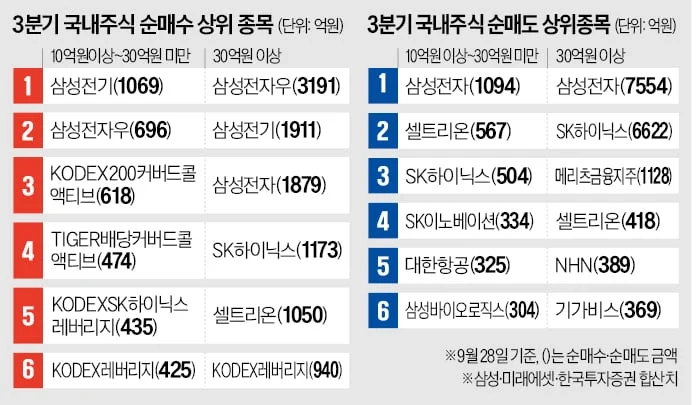
A Korea Economic Daily analysis published on Oct. 4 of third-quarter portfolios at Samsung Securities, Mirae Asset Securities and Korea Investment & Securities showed that clients with at least 1 billion won in financial assets sold Samsung Electronics and SK Hynix more than any other domestic stocks. They were net sellers of 864.8 billion won ($622 million) of Samsung Electronics and 718.9 billion won ($517 million) of SK Hynix. The selling suggests they moved to manage risk as volatility intensified amid debate over whether the stocks had peaked and concerns about an artificial-intelligence bubble.
They also bought heavily into preferred shares offering stable dividends and covered-call exchange-traded funds that make monthly distributions. Investors with more than 3 billion won in financial assets did not limit themselves to defensive holdings. They also increased exposure to higher-risk products, concentrating purchases in leveraged ETFs that track twice the return of the Kospi 200 or the semiconductor sector.
In overseas equities, they bought AI power-infrastructure names including SpaceX and Vertiv Holdings as they positioned for the fourth quarter.
Wealthy investors sold Samsung and SK Hynix and bought covered-call funds
Portfolio analysis of the super-rich shows profit-taking in first-half leaders such as defense and food
South Korea’s stock market swung sharply in the third quarter, from July through September, before settling into a stubborn trading range. How did investors managing billions of won in cash respond? Domestic stock portfolios among the ultra-wealthy showed clear differences by asset bracket. The focus shifted from capital gains to income-generating assets. Investors with 1 billion won to less than 3 billion won in financial assets favored covered-call ETFs, while those with 3 billion won or more chose preferred shares.
Semiconductor heavyweights were cut the most
On Oct. 4, the Korea Economic Daily analyzed portfolios of investors with more than 1 billion won in financial assets at the country’s three biggest brokerages — Samsung Securities, Mirae Asset Securities and Korea Investment & Securities. It found they sold down Samsung Electronics and SK Hynix most aggressively, even though the two names had led the local market in the third quarter. Based on the combined total from the three brokerages, they were net sellers of 864.8 billion won ($622 million) of Samsung Electronics and 716.2 billion won ($516 million) of SK Hynix. Net selling in the two stocks alone topped 1.5 trillion won ($1.08 billion).
Another stock that saw notable profit-taking was Meritz Financial Group, which hit a record high on expectations it would benefit from the government’s corporate value-up program. Investors with more than 3 billion won in assets were net sellers of 112.8 billion won ($81 million). Leading South Korean defense stocks, which had rallied sharply, were also targets for profit-taking. Investors with 1 billion won to less than 3 billion won in assets sold 21.1 billion won ($15.2 million) of Hanwha Aerospace, while the group with 3 billion won or more was a net seller of 34.8 billion won ($25.1 million) of LIG Nex1. They also cut holdings in Alteogen by 27.9 billion won ($20.1 million) and Samyang Foods by 26.9 billion won ($19.4 million).
“One characteristic of wealthy investors is that they look at a sector’s long-term growth potential, but once they have already achieved tenfold returns or market attention becomes excessive and valuation pressure rises, they move quickly to take profits,” a private banker at one brokerage said. The investors sold first-half leaders in semiconductors, value-up plays, defense and food, and raised cash positions ahead of fourth-quarter uncertainty, the banker added.
Preferred shares and covered-call ETFs used to defend returns
What replaced those positions were preferred shares with strong dividend appeal and covered-call ETFs. Investors with 1 billion won to less than 3 billion won in assets mainly bought covered-call ETFs. KODEX 200 Covered Call Active, at 61.8 billion won ($44.5 million), and TIGER Dividend Covered Call Active, at 47.4 billion won ($34.1 million), ranked third and fourth in net purchases. The products are designed to cushion some losses through option premiums when the underlying asset falls while paying monthly distributions. That points to a strategy aimed at securing stable cash flow in a sideways market where direction is hard to predict.
Among investors with more than 3 billion won in assets, Samsung Electronics preferred shares ranked first in net purchases at 319.1 billion won ($230 million). They sold more than 750 billion won ($541 million) of Samsung Electronics common shares while concentrating purchases in the preferred stock. The appeal appears to have been the lower price and higher dividend yield compared with the common shares. A recent decline in the stock also lifted the indicated dividend yield to about 3% annually, adding to its appeal.
Even with the Kospi stuck in a range, net buying of leveraged ETFs was also pronounced. Investors with more than 3 billion won in assets, who had sharply reduced Samsung Electronics and SK Hynix, bought more than 250 billion won ($180 million) combined of KODEX Leverage, at 94 billion won ($67.7 million), TIGER SK Hynix Single Stock Leverage, at 88.4 billion won ($63.7 million), and KODEX SK Hynix Single Stock Leverage, at 70.3 billion won ($50.7 million). The purchases suggest they used the short-term correction as an opportunity to increase leveraged exposure.
Park Jin-young, a private banker at Samsung Securities, said ultra-wealthy investors responded with a barbell strategy that combined preferred shares, covered-call products and leveraged ETFs, unlike retail investors who stayed on the sidelines amid fourth-quarter uncertainty over high oil prices, rising interest rates and the U.S. midterm elections.
Wealthy investors also actively added turnaround names that had lagged in the first-half artificial-intelligence rally, including Samsung Electro-Mechanics, at 191.1 billion won ($138 million), and Celltrion, at 105 billion won ($75.7 million).
Ahn Sang-mi, Korea Economic Daily reporter saramin@hankyung.com

Korea Economic Daily
hankyung@bloomingbit.ioThe Korea Economic Daily Global is a digital media where latest news on Korean companies, industries, and financial markets.