Trump Presses South Korea on Alaska LNG Investment, Threatens to Double Tariffs
Summary
- President Donald Trump said he would double agreed tariff rates if South Korea does not invest in the Alaska LNG investment project.
- Bloomberg data showed that only 15 of 72 instances of Trump's trade retaliation remarks resulted in actual tariffs, or 20.8%.
- The report said Trump could turn to tougher measures, including 300% tariffs, if he falls further behind in the midterm elections.
Forecast Trend Report by Period


"Double the tariff rate if there is no deal"
Only 1 in 5 trade retaliation threats carried out
Some see political messaging as midterm pressure mounts
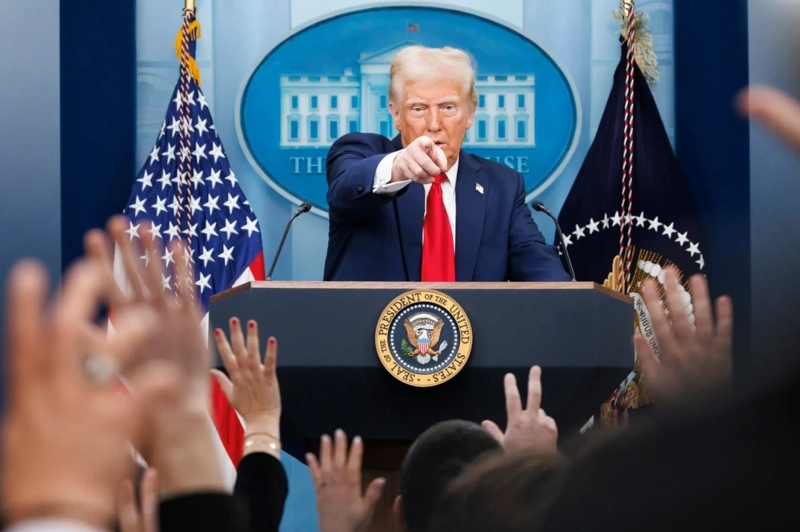
Views are divided over President Donald Trump's threat to double agreed tariff rates if South Korea does not invest in the Alaska liquefied natural gas project, which the U.S. announced unilaterally. Some see the remarks as political rhetoric aimed at shoring up support in battleground areas ahead of the November midterm elections, while others think he could act on them.
At the White House on October 2, Trump said the Alaska LNG investment project was not announced hastily. Referring to South Korea, he said, "If they don't want to do it, then we just make them pay more." When told Seoul's position differed, Trump added: "Tell them that if they don't sign soon, I'm going to double it." The Guardian reported that Trump had threatened to double tariffs on South Korea.
The prevailing view in the U.S. is that the comments reflect Trump's negotiating style. They are also being read as an attempt to reverse Republican slippage against Democrats in places such as Alaska, a traditional Republican stronghold, before the November midterms.
Trump's remarks also contrast with the tone of the U.S. government. Asked the same day about differences between Washington and Seoul over the Alaska project, Tommy Pigott, a U.S. State Department spokesman, said the important point was the positive side of the agreement and the fact that a deal had been reached. The response was seen as closer to the South Korean government's position.
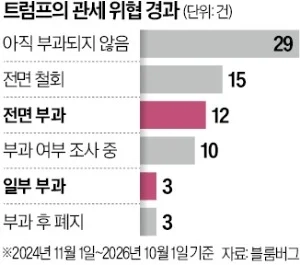
Only about one in five of Trump's trade retaliation threats has actually materialized.
Bloomberg tracked the outcome of 72 trade-related threats made by Trump from November 2024 through October 1. Tariffs were imposed, at least in part, in 15 cases, or 20.8%. Of the remaining 57, 10 are under investigation as officials consider whether to impose tariffs, and 29 involved threatened duties that were never carried out. Three were imposed and later scrapped, while 15 tariff threats were withdrawn altogether.
Still, some argue it is too early to relax. The concern is that the more Trump trails during the midterm campaign, the more inclined he may be to take a harder line.
During a visit that day to Ohio, another battleground state, Trump kept up the pressure on foreign companies. "We're giving them a little chance, about a year and a half, to build a factory," he said. "If they don't do that, then we're putting on 150%, 200%, 250%, 300% tariffs."
Hwang Jung-soo, New York correspondent, and Lee Hye-in, reporter hjs@hankyung.com

Korea Economic Daily
hankyung@bloomingbit.ioThe Korea Economic Daily Global is a digital media where latest news on Korean companies, industries, and financial markets.