PiCK
‘Thought Nvidia Was Enough’? Wall Street Sees Earnings Season Broadening Beyond the M7
Summary
- Wall Street says the M7 continues to be viewed as an AI trade and a defensive investment during a period of rising bond yields, while the S&P 493 remains weak.
- As third-quarter earnings season gets underway, health care, financials, small caps and the S&P 493 may draw attention because their net income growth is projected to top that of the M7, highlighting their valuation appeal.
- Some strategists also struck a cautious note, saying companies with weak fundamentals and financial health could come under pressure from rate hikes, the bond selloff and a surge in borrowing costs.
Forecast Trend Report by Period


Earnings Season Opens as the S&P 493 Eyes a Challenge to M7 Dominance
S&P 493 Profit Growth Seen at 27.7%, Outpacing M7
Split Market Persists in a Rising-Rate Environment
Health Care, Financials and Small Caps Have Lagged
Wall Street Stays Positive on Third-Quarter Earnings
Surging Borrowing Costs Also Prompt Caution

US stocks remain sharply divided, with the so-called Magnificent Seven — the group of seven megacap technology and AI-linked companies including Nvidia and Meta Platforms — continuing to climb while the rest of the market lags. Investors have embraced the M7 both as an AI-driven growth trade and as a defensive haven during a period of rising bond yields. Still, some on Wall Street say the tone could shift as third-quarter earnings season gets into full swing this week. The argument is that health-care stocks and small- and mid-cap shares, which have struggled recently, are poised to deliver faster earnings growth than the M7, potentially making their valuations look more attractive.
More Stocks Fall Below the 200-Day Moving Average
The S&P 500 and Nasdaq Composite closed at record highs on October 6. The S&P 500 rose 0.58% to 7,818.93, while the Nasdaq Composite gained 0.45% to 27,599.79.
Large-cap AI stocks grouped under the M7 have led the advance. Nvidia has gained 5.99% over the past month, pushing its market capitalization closer to $6 trillion. Meta has jumped 20.44% over the same period on momentum from the launch of its AI agent, Muse. The Roundhill Magnificent Seven ETF, which tracks the group, has climbed 6.99% in the past month.
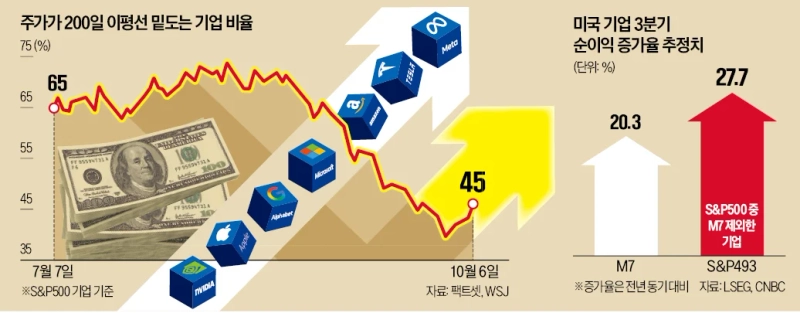
The rest of the S&P 500 — referred to here as the S&P 493 and spanning sectors such as financials, health care and consumer staples — has broadly underperformed. CNBC reported that 75% of S&P 500 constituents posted negative returns last month. Dow Jones Market Data showed that only 45% of the index's members closed above their 200-day moving average, a long-term trend gauge, on October 6. The Wall Street Journal said that share has been declining steadily since August, a sign the gap between the M7 and the rest of the market is widening.
Rising bond yields are one reason the market has become so polarized. Investors see the M7 as better equipped to withstand a hostile backdrop for equities because those companies tend to hold more cash and carry less debt. That leaves them better positioned to keep growing even as higher rates drive up borrowing costs. Keith Lerner, co-chief investment officer at Truist Advisory Services, described large technology stocks as a defensive place to invest during a high-rate period.
Earnings Season Puts the Spotlight on Non-M7 Stocks
Some investors expect that dynamic to shift as third-quarter earnings season accelerates. PepsiCo reports on October 8, followed by Delta Air Lines on October 9, with major financial firms including JPMorgan Chase due to report next week. Among the M7, Tesla is expected to report on October 21; Microsoft, Alphabet and Meta on October 28; and Amazon and Apple on October 29. Nvidia is expected to report in mid-November.
The earnings outlook is broadly positive. Goldman Sachs estimates that S&P 500 companies posted net income growth of more than 25% for a third straight quarter through the third quarter. But the comparison may favor the S&P 493 over the M7. NBC, citing Russell Investments data, reported that the M7's third-quarter net income growth is projected at 20.3% from a year earlier, trailing the 27.7% forecast for the S&P 493.
BeiChen Lin, head of investment strategy at Russell Investments, told CNBC that valuations outside big tech remain somewhat discounted relative to the M7. Strong earnings would make it reasonable to expect gains to broaden across the market, he added. Art Hogan, chief market strategist at B. Riley Wealth, said sectors hit hardest in recent months, including small caps and health care, could be rewarded this earnings season. He was particularly constructive on financial stocks, which fell 7% last month.
Caution remains. Marija Veitmane, head of global equities strategy at State Street, said companies with weak fundamentals could buckle under higher rates. Bond-market selling has started to affect US companies as well, and borrowing costs are surging, especially for businesses with weaker balance sheets.
Hwang Jung-soo, New York correspondent, Korea Economic Daily, hjs@hankyung.com

Korea Economic Daily
hankyung@bloomingbit.ioThe Korea Economic Daily Global is a digital media where latest news on Korean companies, industries, and financial markets.