Samsung Electronics Falls 1.29% After Buyback Ends, but Outperforms Broader Market
Summary
- Samsung Electronics posted a smaller decline than the Kospi and SK Hynix despite the end of its share buyback program and weaker investor sentiment toward memory-chip stocks.
- Brokerages said third-quarter earnings, next year’s operating profit growth, higher DRAM and NAND selling prices, and a rise in HBM4 average selling prices (ASP) point to stronger earnings and substantial upside for the stock.
- They added that rebalancing by seven semiconductor ETFs, the possibility of mechanical selling, the timing and structure of additional share buybacks, and 110 trillion won in shareholder-return capacity, including cash dividends and treasury-share cancellation, remain key drivers of stock-price volatility.
Forecast Trend Report by Period


Samsung Holds Up on First Day Without Buybacks; Short-Term Volatility in Focus
Down 1%; Investors Stay on Sidelines Ahead of Third-Quarter Earnings
Despite Loss of Buyer That Had Been Purchasing $360 Million a Day
Smaller Decline Than Kospi and SK Hynix
Third-Quarter Earnings Seen Strong on Higher Selling Prices
Seven Semiconductor ETFs’ Rebalancing Adds Another Variable
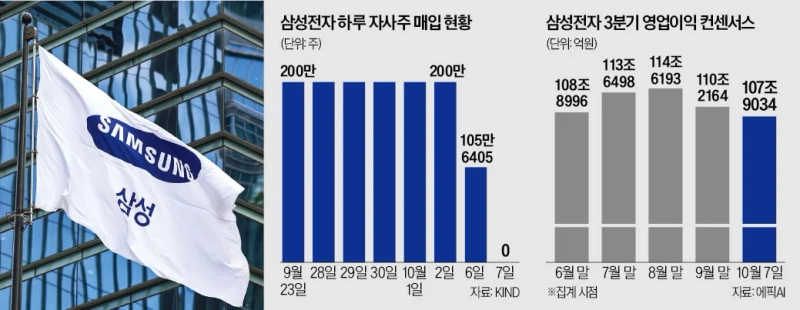
Samsung Electronics shares fell a little more than 1% even as the Kospi tumbled nearly 2%. The company’s buyback program has ended, removing a buyer that had been purchasing more than 500 billion won, or about $360 million, of shares a day on average. Even so, expectations for third-quarter earnings and a wait-and-see mood ahead of the results helped limit the decline.
Some on Wall Street and in Seoul say volatility could rise in the near term as the end of the buyback coincides with exchange-traded fund rebalancing.
Buyback Program Ends
Samsung Electronics closed at 268,500 won on Oct. 7, down 1.29% from the previous session, on South Korea’s benchmark stock market. The Kospi fell 1.98% to 6,803.90, while the Kosdaq slid 2.24% to 898.43.
Selling pressure built after SK Hynix’s American depositary receipts fell 6.39% overnight in the U.S. and Micron Technology dropped 1.37%, hurting sentiment toward memory-chip stocks. Samsung also did not conduct buybacks that day.
Samsung completed a 15 trillion won share repurchase program for employee compensation on Oct. 6. With the program now over, the market lost a buyer that had been net buying more than 500 billion won of Samsung stock each day. Foreign investors were net sellers of 24 billion won worth of Samsung shares on Oct. 7.
Even so, Samsung’s decline was milder than the Kospi’s 1.98% drop and SK Hynix’s 2.82% fall. The sharper overnight selloff in the U.S. was concentrated in SK Hynix ADRs, while investors also stayed cautious ahead of Samsung’s third-quarter earnings release on Oct. 8.
Brokerages broadly view Samsung’s third-quarter results as solid. Meritz Securities estimated operating profit at 10.61 trillion won in a report on Oct. 7. That compares with market expectations, which have recently slipped to the 10.4 trillion won range. Kim Sun-woo of Meritz wrote that DRAM and NAND shipments may come in slightly below estimates, but selling prices likely rose 20% from the previous quarter and drove the earnings improvement.
Confidence in Earnings Stays Firm
Expectations for next year’s earnings are rising further. Meritz Securities forecast Samsung’s 2027 operating profit at 63.2 trillion won, 13% above its previous estimate of 56.2 trillion won.
Kim wrote that mobile memory prices are poised to rise more than 50% from the previous quarter starting in the first quarter of next year. Major customers producing flagship smartphones for a 20th-anniversary launch next year will have to absorb the jump in prices. The key customer is understood to be Apple, which is set to mark the 20th anniversary of the iPhone next year.
KB Securities projected a 100% increase in Samsung’s high-bandwidth memory, or HBM, prices next year. Kim Dong-won, head of research at KB Securities, wrote that Samsung’s HBM4 products could be contracted at the highest prices among the three DRAM makers, lifting average selling prices. HBM4 is projected to account for 80% of Samsung’s HBM sales next year, up from 40% this year.
Given the earnings growth, brokerages argue Samsung shares still have room to rise. Han Dong-hee of SK Securities wrote on Oct. 6 that the stock remains significantly undervalued and set a target price of 610,000 won.
Still, volatility could increase after the earnings release. Goldman Sachs wrote in a report on Oct. 6 that seven semiconductor ETFs with combined assets under management of about 19 trillion won will rebalance on Oct. 8, the same day Samsung reports earnings. Because Samsung’s weighting in those ETFs is close to the upper limit, mechanical selling could emerge.
Another variable is when and how additional share buybacks will take shape. KB Securities recently estimated that if Samsung has 110 trillion won in remaining resources for shareholder returns over the three years from 2024 to 2026, it could return 70 trillion won to 80 trillion won through cash dividends and 30 trillion won to 40 trillion won through treasury-share cancellation.
Kang Jin-gyu, Hankyung.com reporter josep@hankyung.com

Korea Economic Daily
hankyung@bloomingbit.ioThe Korea Economic Daily Global is a digital media where latest news on Korean companies, industries, and financial markets.