DigitalX Says Prediction Markets Excelled on Rates, but Errors Grew on Geopolitics
Summary
- DigitalX said prediction markets were relatively stable for interest rates and elections, but errors grew over longer time frames for geopolitical events.
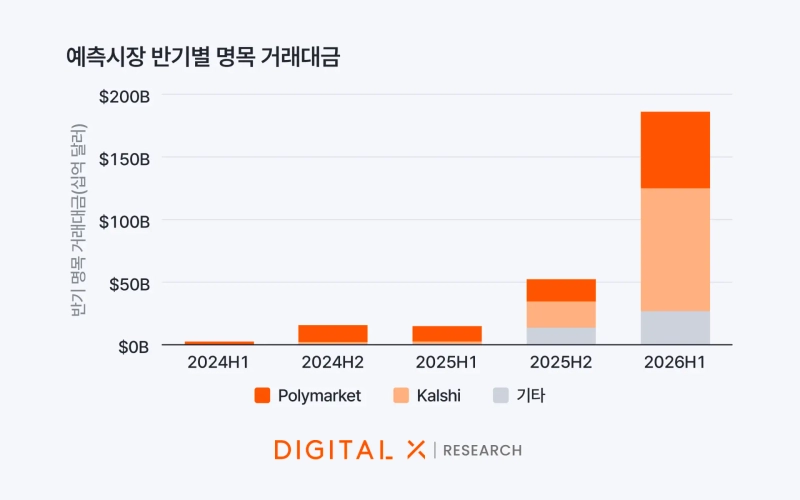
- The report said an analysis of data collected from Polymarket and other platforms showed the market expanded from $800 million in the first half of 2024 to $187 billion in the first half of 2026.
- The report said interest-rate and economic-indicator contracts could fall under derivatives regulation, while sports contracts may be folded into gambling licensing frameworks, meaning investment decisions could vary depending on the regulatory direction.
Forecast Trend Report by Period


DigitalX, Mirae Asset’s digital-asset investment platform, said the reliability of prediction-market probabilities varies depending on the type of event and when the market is observed. It found relatively stable forecasting performance for interest-rate decisions and elections, while errors widened for geopolitical events as the forecast horizon lengthened.
DigitalX’s research center said on Oct. 8 that it had published a report titled “Prediction Markets: Between Gambling and Finance.” The study collected about 2,870 prices from Polymarket’s public API across markets tied to interest rates, economic indicators, elections and Iran-related geopolitical events, then compared prices one day, seven days and 30 days before expiration with actual settlement outcomes.
Across 22 meetings of the Federal Open Market Committee, or FOMC, the option with the highest probability on the day before the meeting matched the actual decision every time. Election markets also showed little change in Brier scores, a measure of forecast error, at 0.069 one day before expiration and 0.073 30 days earlier. Lower scores indicate greater accuracy.
By contrast, the score for Iran-related geopolitical markets rose to 0.113 30 days before expiration from 0.061 one day before. Errors increased the farther the market was from the event date. The study also found a tendency to overestimate the probability that an event would occur within a set deadline.
The report stressed that forecasting accuracy does not guarantee fair trading or reliable settlement. Even if insider trading makes prices closer to the eventual outcome, that may still be unfair to other participants. Payment may also depend on how contract language is interpreted, how settlement procedures are handled and how disputes are resolved, even when the underlying event is correctly predicted.
The market is growing quickly. According to the report, nominal half-year trading volume on major platforms including Polymarket and Kalshi increased to $187 billion in the first half of 2026 from $800 million in the first half of 2024. Probability data is also being supplied to institutional clients through Bloomberg terminals and ICE data feeds.
The report said the regulatory path will likely diverge by contract type. In the US, event contracts are listed on exchanges authorized by the Commodity Futures Trading Commission. In South Korea, the Korea Communications Standards Commission voted in August to block access to Polymarket over gambling concerns. The report said interest-rate and economic-indicator contracts could eventually fall under derivatives rules, while sports contracts may be absorbed into existing gambling-licensing frameworks.
Jeong Ji-seong, a research fellow at DigitalX Research, said prediction markets can only be assessed properly by first identifying what is being traded, what information prices contain and when that information breaks down. Anyone citing real-time probabilities from prediction markets should also consider the event type, the observation point and whether public information has already been reflected in prices, he added.

YM Lee
20min@bloomingbit.ioCrypto Chatterbox_ tlg@Bloomingbit_YMLEE