[Exclusive] Samsung Locks Up Nearly 80% of Next Year’s Memory Output Under Long-Term Deals as Big Tech Lines Up
Summary
- Samsung Electronics said it has secured 80% of next year’s memory and HBM output through long-term supply agreements (LTAs), as global Big Tech companies have been placing orders covering more than five years of supply.
- The report said LTAs are spreading beyond memory to a broad range of AI infrastructure components including MLCCs, FC-BGAs, power equipment and cooling systems, as the industry shifts toward a more stable order-based model.
- The report said market power has shifted to suppliers, making tough terms such as 20%-25% prepayments and mandatory purchases more common, though some warn that LTAs could become a risk if the semiconductor market turns down.
Forecast Trend Report by Period


Memory, Components Shift to an Order-Driven Industry
Samsung Electronics has secured nearly 80% of next year’s output of memory semiconductors, including high-bandwidth memory, under long-term supply agreements, according to industry officials. Global technology companies including Nvidia, Google and Microsoft have lined up to place orders with Samsung covering more than five years of chip supply. The long-term agreement trend is spreading beyond semiconductors to the broader artificial intelligence components industry. The AI parts business is shifting from a short-term transaction model to a more stable order-based industry, according to market participants.
According to industry officials on Oct. 9, about 80% of Samsung Electronics’ memory production for next year already has designated buyers. Big Tech companies that have yet to sign contracts with Samsung will have to compete behind the scenes for the remaining roughly 20% of output. Other chipmakers, including SK Hynix and US-based Micron Technology, have also signed large long-term supply agreements with key customers.
The shift is no longer limited to memory. It is spreading across AI infrastructure components including multilayer ceramic capacitors, or MLCCs, flip-chip ball grid array substrates, or FC-BGAs, test sockets, transformers and other power equipment, as well as cooling systems. Samsung Electro-Mechanics is preparing to sign an MLCC long-term supply agreement worth 700 billion won ($507 million) with Taiwan’s Delta Electronics. It would be the company’s seventh such agreement this year. Long-term contracts have also picked up recently in power infrastructure and cooling equipment.
The growing use of LTAs reflects aligned interests between Big Tech companies seeking stable supply chains and suppliers trying to reduce risks tied to capital spending, industry officials said.
Big Tech Rushes to Lock In AI Parts and Power Equipment Beyond Memory With Five-Year Deals
Data Center Expansion Fuels Demand Surge, With 25%-Advance Payments and Mandatory Purchase Terms
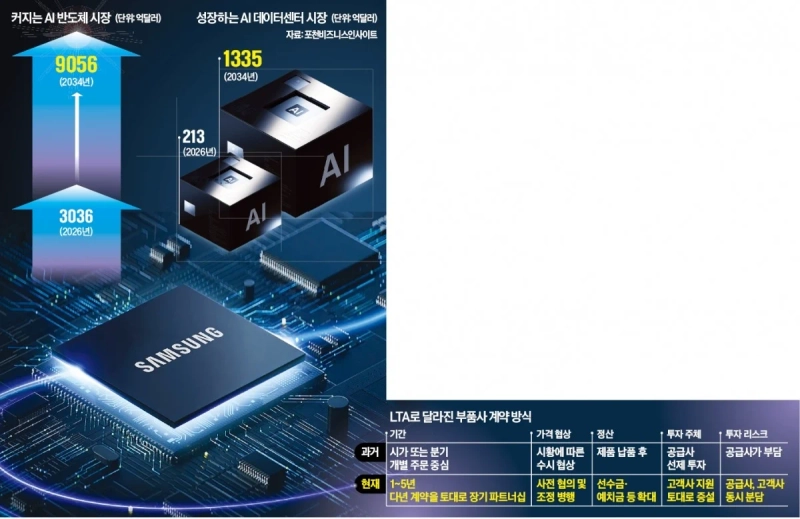
Quarterly contracts or spot-price deals had long been standard practice in semiconductor and parts transactions. That made it difficult for chipmakers to predict future pricing and demand. The decades-old practice began to change this year as global technology companies stepped up investment in AI data centers, leading to chip shortages. Securing a stable supply of memory semiconductors has become a top priority for Big Tech. That is why companies have increasingly turned to long-term supply agreements.
The LTA trend has spread beyond memory into the broader components industry tied directly to AI infrastructure, including MLCCs, FC-BGAs, transformers and other power equipment, test sockets and cooling systems. The shift is driving an evolution beyond one-sided buyer-supplier dynamics toward longer-term partnerships between major technology companies and parts makers, industry officials said.
The memory industry has moved fastest. According to industry officials on Oct. 9, Samsung Electronics had tied up nearly 80% of next year’s memory supply under LTAs. Big Tech companies that have not yet signed contracts are now competing behind the scenes for the remaining supply. Samsung said on its second-quarter earnings conference call that "nearly all major customers are requesting LTAs" and that "it is difficult to respond to all of those requests."
SK Hynix has also completed LTAs with major customers. Micron increased the number of strategic customer agreements, which function like LTAs, to 26 in the third quarter from 16 in the second quarter. NAND flash maker SanDisk has also signed LTAs with eight customers, including major technology companies.
LTAs are now becoming standard across the AI parts sector as well. Samsung Electro-Mechanics is set to soon sign an MLCC supply LTA worth 700 billion won ($507 million) with Taiwan power company Delta Electronics. Samsung Electro-Mechanics has completed six MLCC LTAs so far this year. Its cumulative orders this year are projected to reach 4.6 trillion won ($3.33 billion). LG Innotek is also negotiating an LTA for FC-BGA supply.
The AI infrastructure industry is seeing a similar pattern. Power equipment is essential for building AI data centers, which consume large amounts of electricity, while cooling systems are needed to control heat inside those facilities. LS Cable & System has signed five-year busduct LTAs with US technology companies including Meta and Google. HD Hyundai Electric is also pursuing LTAs for transformers used in data centers. LG Electronics signed a chiller supply contract worth 5 trillion won ($3.62 billion) with US AI data center infrastructure company Air. An industry official said Big Tech is going all out to secure supply, even accepting unfavorable terms, as shortages of AI-related components are expected to persist.
Need to Prepare for the Risk of an AI Boom Slowdown
Industry participants say bargaining power has shifted decisively to suppliers. Supply-demand imbalances have widened because manufacturers have been unable to expand production capacity quickly. In memory, five years has become the standard base contract term, with rolling one-year extensions negotiated annually. To strengthen those contracts, hefty advance payments of 20% to 25% have become standard, along with strict clauses requiring customers to pay even if they do not take the contracted volume. Suppliers sometimes use those prepayments to help fund large-scale fab construction.
Still, LTAs do not eliminate every risk. If the semiconductor market turns sharply lower, customers may decide to cancel contracts and absorb penalty costs. In that case, parts makers that expanded facilities aggressively on the back of LTAs could face a severe hit. "If the memory market falls into a slump and customers demand renegotiation, suppliers will have little choice but to ease the existing terms," Choi Woo-young, a professor in the Department of Electrical and Computer Engineering at Seoul National University, said.
Kim Chae-yeon, Won Jong-hwan and Noh Yoo-jung, Hankyung.com reporters why29@hankyung.com

Korea Economic Daily
hankyung@bloomingbit.ioThe Korea Economic Daily Global is a digital media where latest news on Korean companies, industries, and financial markets.