BOK Governor Rhee Says AI Boom Is Driving 3.3% Growth, Vows Tight Policy Until Inflation Hits Target
Summary
- Governor Rhee said the AI-cycle boom is driving South Korea’s 3.3% growth, but is also stoking inflation, so the Bank of Korea will maintain a restrictive monetary policy stance.
- He said massive AI infrastructure investment and hyperscalers’ issuance of long-term corporate bonds could lead to higher long-term interest rates and a rise in the neutral rate.
- Rhee said won appreciation helps ease K-shaped polarization and supports financial stability, adding that further gains in the currency would be desirable and that both considerations call for restrictive monetary policy.
Forecast Trend Report by Period


Expanded AI Investment May Lift Productivity and the Neutral Rate
Won Appreciation Could Ease K-Shaped Polarization; Further Gains Desirable
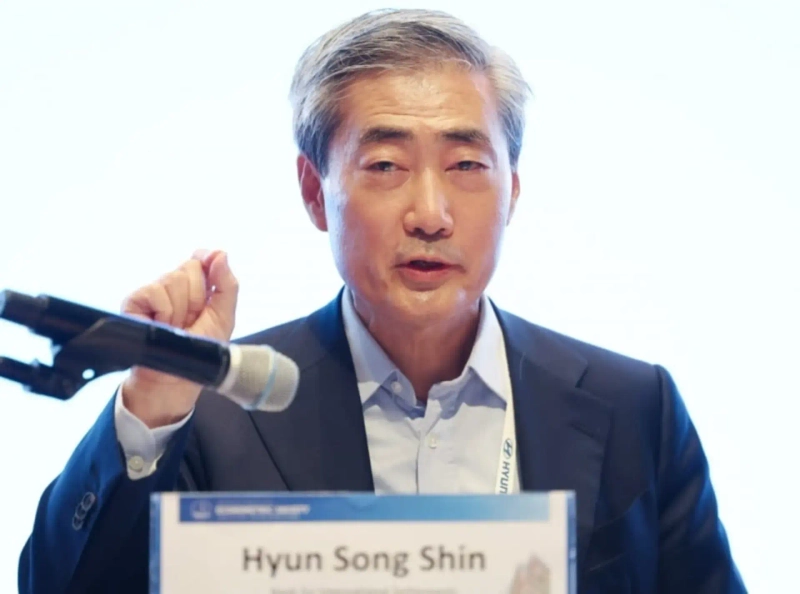
Bank of Korea Governor Rhee Chang-yong said the artificial intelligence boom is driving South Korea’s 3.3% growth this year, but is also fueling both demand-led and cost-push inflation. He said the central bank would hold to a restrictive monetary-policy stance until it is confident inflation will converge on its 2% target. He also signaled that massive AI infrastructure investment could raise productivity and, over the longer term, push up the neutral rate. Rhee made the remarks during a conversation with Krishna Srinivasan, director of the International Monetary Fund’s Asia and Pacific Department, at the IMF annual meetings in Washington, D.C., on Oct. 13.
○Hyperscalers’ Ultra-Long Bonds Are Driving Up Long-Term Yields
Rhee said the South Korean economy is at the intersection of two powerful forces: an AI upswing and war in the Middle East. In Korea, the AI cycle is outweighing the negative effects of the Middle East conflict and supporting solid growth of 3.3% this year, he said. On inflation, however, the two forces are combining to worsen the picture. He added that the Bank of Korea’s two consecutive rate increases last summer came against that backdrop.
Both headline and core inflation are projected to remain above the 2% target for some time, Rhee said. The Bank of Korea has made it very clear to markets that it will keep a restrictive policy stance until it is confident inflation will return to target within an appropriate time frame.
On the “K-dot plot” introduced in February to strengthen monetary-policy communication, Rhee said it provided an excellent snapshot of the policy thinking of individual Monetary Policy Board members. Nothing is more specific than a published dot plot, he said. Still, he added that the K-dot plot carries the potential drawback of tying policymakers’ hands, and said the central bank would review the system closely.
Asked how AI could affect monetary policy, specifically the neutral rate, Rhee said the issue is especially important because Korea sits at the center of the AI supply chain. He said global hyperscalers, or large technology companies, will be investing more than $1 trillion a year by 2030, with that demand concentrated in Korea. The increase in investment and funding demand is contributing to higher long-term interest rates.
Higher productivity and faster growth will lead to more investment, and greater investment will translate directly into larger funding needs, Rhee said. He added that hyperscalers are issuing large amounts of very long-dated corporate bonds, contributing to upward pressure on rates. While the nominal amount may be small, the share could become substantial when measured by duration, he said.
Any simple economic growth model leads to the conclusion that higher growth is accompanied by higher interest rates, Rhee said. Taken together, those pieces raise very important questions about long-term yields.
○Exchange-Rate Stability Helps K-Shaped Polarization
Asked about the “K-shaped economy,” in which weakness persists in industries that have not benefited from spillover effects from the semiconductor boom, Rhee said companies in the IT sector have enjoyed the upswing while a broad range of other industries has not. The gap is wide across both regions and sectors, producing a K-shaped pattern across the broader economy.
Rhee stressed that households in the bottom 20% of the income distribution spend 32% of their income on food and energy. That makes inflation control the most effective way to help vulnerable groups.
He also gave a positive assessment of the recent appreciation of the won. The stronger currency has boosted households’ real purchasing power and helped rebalance the economy between the export sector and domestic demand, he said. Given the need to ease K-shaped polarization and preserve financial stability, further won appreciation would be desirable.
In conclusion, the central bank can affect inflation and, to some extent, the exchange rate, Rhee said. Both considerations call for restrictive monetary policy.
○Popping the Balloon Is Risky
On asset markets and household debt, Rhee reaffirmed the principle of acting preemptively. He said the Financial Vulnerability Index, with the period just before the Asian financial crisis set at 100, is currently hovering around its long-term average of 46. He said he expects monetary tightening to help slow the index’s rise.
He also stressed that monetary policy and macroprudential policy are complements, not substitutes. Trying to clean up imbalances after they have become too large is like pricking a balloon with a needle and is highly risky, he said. Policymakers should not give in to the temptation to place the entire burden on the central bank while easing macroprudential regulations, he added, underscoring the importance of policy coordination with the government.
Shim Sung-mi, Hankyung.com reporter smshim@hankyung.com

Korea Economic Daily
hankyung@bloomingbit.ioThe Korea Economic Daily Global is a digital media where latest news on Korean companies, industries, and financial markets.