Foreigners Dump 4.53 Trillion Won of Kospi Stocks as CXMT's Next-Gen DRAM Plan Sparks Semiconductor Slump Fears
Summary
- Foreign investors were net sellers of 4.5259 trillion won as the Kospi tumbled 5.46%, pushing Kospi market capitalization below 5,000 trillion won.
- CXMT’s announcement on next-generation DRAM and 4F² technology triggered a global selloff in memory chip stocks, with Samsung Electronics down 6.59% and SK Hynix losing 8.54%.
- Experts said debate is intensifying over whether the semiconductor rally has peaked as strains tied to foreign investor flows, semiconductor concentration risk and South Korea’s fragile market demand structure have come into view.
Forecast Trend Report by Period


Foreigners net sell 4.5259 trillion won as Kospi plunges 5.46%
CXMT signals launch of next-generation DRAM
Samsung Electronics falls 6.59%; SK Hynix drops 8.54%
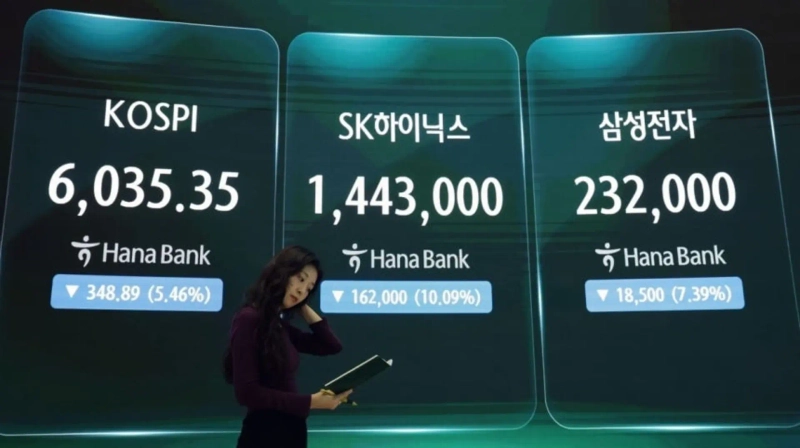
Foreign investors staged a one-day exodus from South Korea’s main stock market, dumping more than 4.5 trillion won of shares. The selloff came after prospects emerged that China’s ChangXin Memory Technologies, or CXMT, could threaten the dominance of Samsung Electronics and SK Hynix. The move suggests foreign investors who had bet on South Korean equities through the semiconductor boom unleashed a wave of selling as caution mounted.
Some market participants are also raising concerns that the semiconductor rally underpinning the domestic market may be nearing its end.
According to EpicAI, an AI-based investment information platform, the Kospi closed at 6,035.35 on Oct. 13, down 348.89 points, or 5.46%, from the previous session. That is 36% below the record intraday high of 9,385.59 reached on June 19. The decline was the steepest since Aug. 19, when the index fell 5.80%. The Kospi opened at 6,186.08, down 198.16 points, or 3.10%, and extended losses before slipping below the 6,000 level intraday.
A sell-side sidecar, a temporary curb on program sell quotes, was briefly triggered early in the session in the Kospi market. It was the first such measure in about two months, after one was triggered in August. The benchmark has now fallen back to levels seen during the sharp July-August selloff. The Kospi also dropped below 6,000 during trading for the first time since July 31, roughly 10 weeks ago. Kospi market capitalization also shrank below 5,000 trillion won.
The VKOSPI, the Kospi 200 volatility index known as South Korea’s fear gauge, jumped 19.15% to 48.53. It climbed as high as 51.57 during the session. The gauge had fallen almost daily this month from the low 40s to the upper 30s, then moved back above 40 a day earlier before surging again on Oct. 13.
Foreign investors extended their selling streak in the main board to six straight sessions, dragging the index lower. By the close of regular trading, they had net sold 4.5259 trillion won worth of shares. That was the largest foreign net sale since July 28, when they sold 4.5261 trillion won. Retail and institutional investors were net buyers of 2.2271 trillion won and 1.6902 trillion won, respectively, helping prevent a deeper slide.
The biggest driver of the Kospi’s plunge was news that CXMT said it had made a new advance in DRAM technology and plans to roll out next-generation server products using it later this year. Bloomberg reported that CXMT President Zhao Kanyu told an industry conference in Shanghai over the weekend that the company would launch data-center server products using 4F², a next-generation DRAM design technology, before year-end.
The 4F² design reduces memory-cell area versus the conventional 6F² structure, boosting density. Samsung Electronics and SK Hynix have also spent years developing the next-generation design. If CXMT’s claim proves correct, the Chinese company would be the first to implement the new structure ahead of its key South Korean rivals. Jing Zhewei, an analyst at market research firm Morningstar, said CXMT’s competitiveness would improve significantly if it successfully applies the 4F² structure to DRAM production before competitors.
CXMT’s announcement also sparked selling across global memory chip stocks. In New York trading a day earlier, Intel fell 3.20%, Micron Technology lost 3.88% and Broadcom dropped 1.88%. SK Hynix American depositary receipts also declined 4.02%. The Philadelphia Semiconductor Index fell 2.67%.
The selloff hammered South Korea’s major memory stocks as well. Samsung Electronics closed at 234,000 won, down 6.59% from the previous session, bringing its five-day loss to 44,000 won, or 16%. SK Hynix tumbled 8.54% to end at 1.468 million won, wiping out 398,000 won, or 22%, over the same five-session period. The two companies, whose market capitalizations had each topped 2,000 trillion won during this year’s semiconductor boom, ended the day in the 1,000 trillion won range.
Analysts said any recovery in the market will depend on foreign investor flows. Huh Jae-hwan, an analyst at Eugene Investment & Securities, said the key question is not foreign selling itself but whether domestic demand for stocks is strong enough to offset it. With the market’s demand base weak, each round of foreign-led selling has caused outsized swings, raising the risk of a vicious cycle that pushes investors further away from South Korean equities.
Lee Kyung-min, an analyst at Daishin Securities, said the same amount of selling caused the index to break because the buffer from corporate share buybacks has disappeared. In August and September, foreign investors sold 31.7 trillion won, yet the Kospi still rose 3.7% because the two semiconductor companies absorbed 1.61 trillion won of buying in a single day, he said.
A securities industry executive said the market had focused on explosive growth in AI memory and improving earnings, but has now begun to assess more coldly how long those profits can be defended. The one-day foreign selloff of more than 4.5 trillion won exposed both the fragile demand structure of South Korea’s stock market and the risk of heavy concentration in semiconductor shares.
The executive added that structural problems overlooked during the earnings upswing are surfacing all at once as share prices wobble. The broader market is now confronting a more fundamental question: whether the era of semiconductors driving South Korean equities higher has already passed its peak.
Kang Kyung-ju, Hankyung.com reporter memory@hankyung.com

Korea Economic Daily
hankyung@bloomingbit.ioThe Korea Economic Daily Global is a digital media where latest news on Korean companies, industries, and financial markets.