China’s Memory Drive Nears Samsung, SK Hynix as YMTC, CXMT Raise Pressure: Techlog
Summary
- YMTC has risen to No. 3 globally in NAND shipments and is moving through the listing process, while expanding its revenue share, a trend that could pressure the profitability of Samsung Electronics and SK Hynix.
- YMTC and CXMT are developing higher-value products such as enterprise SSDs and server DRAM, as well as next-generation 4F² architecture technology, a move that could threaten Korean companies’ pricing power.
- The Sejong Institute said China has already entered a stage where it can affect the global market in NAND and commodity DRAM, and that Korean companies’ pricing power and profitability could weaken even before China closes the technology gap.
Forecast Trend Report by Period


No longer just a question of the technology gap — China’s memory drive is threatening Samsung and SK Hynix profitability
CXMT, YMTC target next-generation and enterprise memory
YMTC ranks No. 3 in NAND shipments, No. 5 by revenue
China could undermine Korean profitability even before it catches up technologically
China’s ChangXin Memory Technologies Inc. (CXMT) has thrown down a challenge to the global memory market with next-generation DRAM development, while Yangtze Memory Technologies Co. (YMTC) has climbed to No. 3 in global NAND flash shipments, accelerating China’s advance. Chinese companies, once centered on consumer products, are moving into advanced processes and enterprise offerings. That could squeeze the pricing power and profitability of Samsung Electronics Co. and SK Hynix Inc.
YMTC Reaches No. 3 in NAND Shipments, Eyes DRAM Too
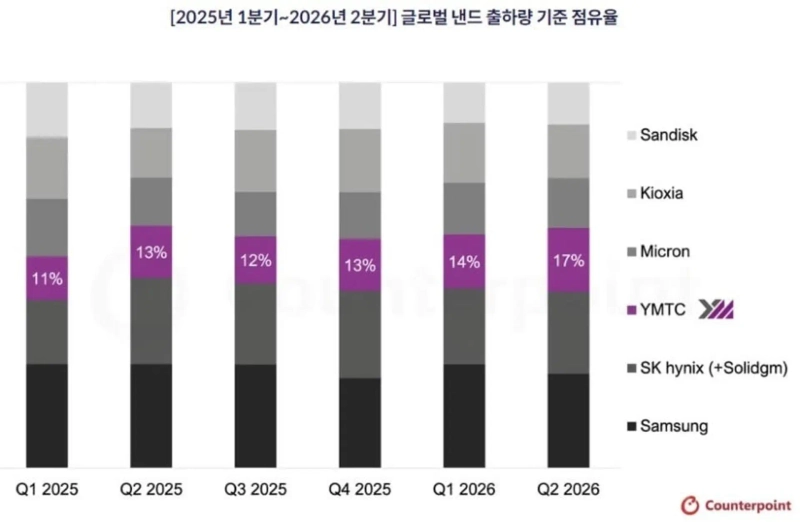
Counterpoint Research said on Oct. 15 that YMTC ranked third globally in second-quarter NAND shipments on a bit basis, behind Samsung Electronics and SK Hynix. It overtook Japan’s Kioxia Holdings Corp. and US-based Micron Technology Inc. If volumes from Solidigm, SK Hynix’s subsidiary, are counted separately, YMTC would rise to No. 2, ahead of SK Hynix.
By revenue, YMTC ranked fifth, trailing Kioxia and Micron. Counterpoint attributed that to the company’s focus on consumer products, which leaves it with a smaller share of higher-priced enterprise solid-state drives for data centers. Even so, its revenue share rose to 14% in the first quarter from 9% a year earlier.
YMTC filed for a listing on Shanghai’s STAR Market in August. The company had already completed pre-listing guidance registration and a first-stage progress report, and is now moving through the listing process. The filing came about a month after CXMT listed on the same market in July. YMTC’s valuation and offering price have not yet been set.
YMTC is also expanding beyond smartphone and PC products into enterprise SSDs. Counterpoint said the move targets demand from artificial intelligence data centers, and projected that server-related revenue will make up a larger share going forward.
The company is also pushing into DRAM. YMTC has been researching and testing LPDDR5 for mobile devices and is developing products based on a 4F² architecture using vertical-channel transistors, according to reports. The effort would extend its wafer-bonding technology, known as Xtacking, from NAND into DRAM. Its longer-term technology roadmap points to 3D DRAM, in which memory cells are stacked vertically.
CXMT Gains Ground in DRAM
CXMT is also preparing server products based on a next-generation DRAM structure. China Business Network and other Chinese media reported that CXMT President Zhao Kanyu outlined progress in 4F² development at a semiconductor event in Shanghai on Oct. 10. The company plans to introduce a server DDR5 RDIMM using the structure later this year. RDIMM is a memory module used in servers and other systems.
4F² refers to the area occupied by a single DRAM cell. Compared with the 6F² structure now widely used at the same minimum line width, it reduces cell size and allows more data to be stored in the same space. Zhao said the company has developed a technology that uses vertical transistors to reduce leakage current and problems tied to miniaturization.
CXMT built its business around memory used in consumer electronics, but it has recently expanded into server products as well. On Sept. 20, the company announced mass production of its fifth-generation DRAM technology platform, G5. It also unveiled LPDDR5X products for mobile devices based on the platform, advancing both process technology and product offerings.
‘It’s Not Enough to Ask How Many Years Behind China Is’
As Chinese companies scale up shipments and develop next-generation products, the implications for Korean companies are becoming harder to judge solely through the lens of the technology gap. In a report published last month, the Sejong Institute, a South Korean policy think tank, said China still trails significantly in high-bandwidth memory and advanced server DRAM. But in NAND and commodity DRAM, it has already reached a stage where it can influence the global market.
The institute said that if Chinese companies secure volume and customers in the commodity market, they could create a virtuous cycle of accumulating production experience, lowering costs and reinvesting. Demand for AI memory is strong enough for now that the market is absorbing additional Chinese output. If demand slows, however, the increased supply could put downward pressure on prices.
Lee Byung-chul, a visiting research fellow at the Sejong Institute, wrote in the report that it is no longer enough to assess the threat from China’s semiconductor industry by asking how many years the technology gap amounts to. Even before China overtakes Korea technologically, the pricing power and profitability of Korean companies could weaken sharply.
Hong Min-sung, Hankyung.com reporter mshong@hankyung.com

Korea Economic Daily
hankyung@bloomingbit.ioThe Korea Economic Daily Global is a digital media where latest news on Korean companies, industries, and financial markets.