Apple Becomes Second Company After Nvidia to Close Above $5 Trillion in Market Value
Summary
- Apple surpassed a $5 trillion market capitalization on a closing basis for the first time and hit a record high even as the Nasdaq plunged.
- Apple said its strategy of holding back on large-scale AI capital spending and focusing on hardware and its services business helped it deliver strong earnings and maintain momentum.
- Analysts said Wall Street is reassessing Apple’s hardware capabilities and device ecosystem as the foundation for benefiting from the AI boom.
Forecast Trend Report by Period


Apple’s restrained AI capital-spending strategy
A driver of gains amid peak-AI concerns
Wall Street says hardware strengths are being reassessed
Apple on Oct. 14 became only the second company in history, after Nvidia, to finish a trading session with a market capitalization above $5 trillion. Investors are increasingly viewing Apple’s decision to avoid the heavy artificial-intelligence infrastructure spending embraced by rivals as a benefit rather than a drawback, as concerns grow that the AI buildout may be peaking. The view is that Apple’s strategy of focusing on hardware sales such as the iPhone and on its high-margin services business, instead of directly competing in proprietary AI models, is paying off.
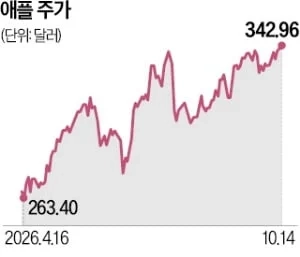
Apple rose 0.50% to close at $342.96 in New York trading. The stock set a fresh record even as the tech-heavy Nasdaq Composite plunged 1.88%. Apple’s market value reached $5.005 trillion, topping the $5 trillion mark for the first time on a closing basis. The company first crossed $5 trillion intraday on July 28 but ended that session lower. It moved above $5 trillion several times after that, but this was the first time it held the level at the close.
Apple has continued to post strong results this year despite sharp increases in semiconductor prices, including memory used in iPhones, Macs and iPads. The company responded by raising sticker prices across its lineup, including older iPhone models, as component costs climbed. As a result, Apple’s revenue for the second quarter rose 16% from a year earlier to $109.4 billion. There were also recent reports that Apple held talks related to chip supplies with China’s Changxin Memory Technologies, or CXMT, despite strong opposition from the U.S. Congress.
Since John Ternus became Apple’s chief executive officer last month, the company has moved to strengthen its lineup, including by launching the foldable “iPhone Duo” after Samsung Electronics. Wamsi Mohan, an analyst at Bank of America, said Apple customers appear willing to pay higher prices for its devices. Even if margins decline, Apple would be able to preserve overall profit or generate more, he added.
Wall Street is also turning its attention back to Apple’s hardware capabilities. Even when AI companies release their latest models, consumers still need to access them through Apple’s device ecosystem. Lu Zhang, founder of venture capital firm Fusion Fund, said Apple is benefiting from AI without taking on the risks tied to the massive infrastructure spending its rivals are making.
Apple’s still-vague in-house AI strategy remains a concern compared with competitors. The company has fallen behind in developing advanced AI models and is seeking outside partnerships, including cooperation with Google to improve its AI assistant Siri.
During the 15-year tenure of former CEO Tim Cook, who stepped down on Sept. 1, Apple’s market capitalization expanded about 13-fold. Under Cook, annual iPhone sales increased about fourfold, while annual revenue from services, including subscriptions and digital offerings, grew tenfold from $10 billion to more than $100 billion.
Bae Seong-su, Hankyung.com reporter baebae@hankyung.com

Korea Economic Daily
hankyung@bloomingbit.ioThe Korea Economic Daily Global is a digital media where latest news on Korean companies, industries, and financial markets.