‘Too Scared to Open an Account’: Kospi Sinks 7.6%, Wiping Out 1,193.5 Trillion Won in Seven Days
Summary
- The Kospi fell for seven straight trading days, wiping out 1,193.5328 trillion won in market value and deepening a selloff led by large-cap semiconductor shares.
- Concerns over AI investment profitability and funding costs pushed CoreWeave’s corporate bonds into distressed territory, while CDS premiums and bond yields surged, putting the brakes on further investment expansion.
- Analysts said a V-shaped rebound in the Kospi looks difficult amid high inflation, high interest rates and the risk of slower AI infrastructure investment, with Big Tech earnings and corporate bond spreads the key indicators to watch.
Forecast Trend Report by Period


Kospi drops 7.5%
US AI bubble fears, inflation shock
1,200 trillion won wiped out in seven days
Index back to six months ago
South Korea’s Kospi fell for a seventh straight trading day, retreating to the 5,000 range. Doubts over returns on artificial intelligence investment hammered the country’s memory chip-heavy stock market, sending it back to levels last seen in April. Analysts said it may be difficult to find a catalyst for a rebound anytime soon.
The Kospi closed down 7.57% at 5,554.22 on October 15. That was the lowest closing level since April 7, when it ended at 5,494.78. The benchmark, which had climbed as high as 9,000, has now fallen back to where it was 127 trading days ago, slipping past the level of the July rout. During the seven-session slide, market capitalization shrank by 1,193.5328 trillion won, or 20.67%.
The index broke below 6,000 at the open and extended losses through the session, at one point falling into the 5,500 range. The Kosdaq closed down 7.65% at 760.82. Both the main board and the Kosdaq market triggered sell-side sidecars that temporarily halted program sell orders, followed by circuit breakers that suspended trading for 20 minutes.
The selloff in Korean stocks was driven by an overnight flare-up in the US over the profitability of AI investment. In US trading, bonds of CoreWeave, the neocloud company that builds data centers and leases computing capacity, tumbled and the stock sank 15.46%, rattling broader markets. The trigger was a report published the same day by research firm Gartner, which projected that more than 80% of neocloud companies would not survive past 2030 if spending on AI infrastructure continues at the current pace. As CoreWeave shares slid, Micron fell 4.08% and Nvidia lost 3.16%. In Seoul, semiconductor heavyweights led the decline, with Samsung Electronics down 9.48% and SK Hynix off 11.06%.
A stronger-than-expected US consumer price index reading for September added to the concerns. Inflation rose 3.7% from a year earlier, above the market forecast of 3.6%. Third-quarter results from Anthropic, released before trading began in Korea, also showed slowing revenue growth, further hurting sentiment.
Analysts said the Kospi is unlikely to stage a V-shaped rebound anytime soon. Kim Hak-kyun, head of research at Shin Young Securities, said it would be difficult for the Kospi to reclaim its previous high within six months.
Can AI Investment Continue With High Funding Costs? Retail Investors Hit by Big Tech Debt Bets
Kospi Falls for a Seventh Straight Session
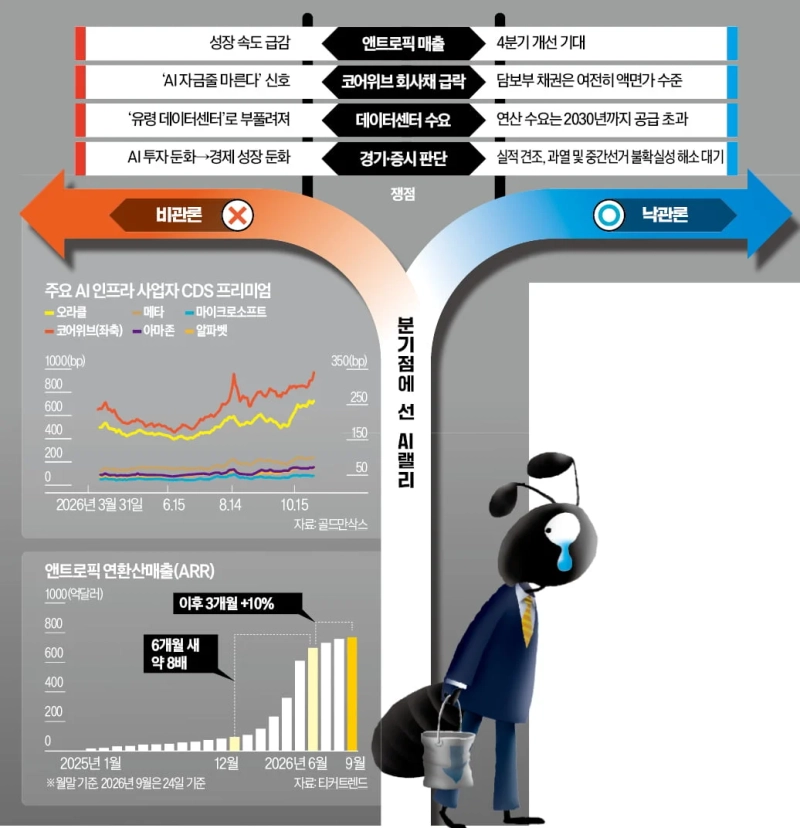
South Korea’s stock market plunged into panic on October 15 as the Kospi tumbled more than 7% in a single day, triggering a circuit breaker. The shock originated in the US, where skepticism flared overnight over AI investment profitability and funding conditions. The immediate trigger was Anthropic’s third-quarter earnings. Revenue rose 45% from three months earlier to $16.8 billion in the quarter. Even so, investors were deeply disappointed because growth had slowed to roughly one-third of the more than 140% pace seen in the previous quarter.
Funding Becomes as Important as Growth
Goldman Sachs distilled the market’s core concern to financing. More than persistent inflation and high interest rates themselves, investors are now focused on the growing burden on credit markets that have underpinned the AI investment cycle. Goldman Sachs said the need to keep borrowing huge sums for AI investment has raised doubts about whether companies can secure funding under existing plans as financing costs rise.
CoreWeave, the largest listed neocloud company, was hit directly by those concerns. Its unsecured notes due in 2032 fell below 78 cents on the dollar overnight, entering distressed territory. Yields on the bonds, which carry a 9.6% coupon, jumped to around 15%. If investors demand those returns on future borrowing and refinancing, expanding investment could become difficult. CoreWeave and Oracle, both carrying heavy debt burdens relative to equity, led the stock-market decline as their credit-default swap premiums surged.
Rich Privorotsky of Goldman Sachs said high capital costs could prevent demand from translating into actual capital spending. In a worst-case scenario, the semiconductor supply chain could face an “order vacuum” in 2027 and 2028. Korea’s market fell more sharply than its global peers because its industrial structure is more exposed to those risks through memory and hardware. The Kospi sank 7.6% on the day, far steeper than the S&P 500’s 1.1% drop, Japan’s Nikkei 225 decline of 4.9%, and Taiwan’s Taiex, which fell 3.4%.
Bubble Burst or Speed Bump
Confidence in demand forecasts is also being tested. The Wall Street Journal reported that only 23% of requests submitted to US power companies for data-center electricity supply appeared likely to materialize. Because grid connections can take five to six years, many applications included duplicate requests across regions. Wood Mackenzie said that does not mean all the demand is illusory, but requests for power supply should not be treated as confirmed investment.
Slowing revenue growth at AI companies and a shakeout of inflated demand do not necessarily mean the AI investment cycle is over. Gil Luria, a director at D.A. Davidson, said more expensive capital is helping weed out lower-return projects and duplication while curbing excessive bubble expansion. Capital bottlenecks could keep AI growth on a more sustainable long-term path.
If investment in AI infrastructure, the only meaningful growth engine for the US and global economy, stalls, recession fears could spread quickly. BlackRock Chief Executive Officer Larry Fink said a significant share of the US economy now depends on large-scale investment in AI infrastructure. If data-center construction stops, that could lead to a recession.
Big Tech’s third-quarter earnings reports later this month will be the next major test. Mirae Asset Securities said funding conditions will improve meaningfully only if Big Tech’s cash flow and investment plans beat market expectations. Investors will also be watching whether CDS premiums and corporate bond spreads, both gauges of funding stress and default risk, begin to ease. For that to happen, diesel and logistics costs, inflation indicators and interest-rate volatility will need to stabilize.
Yoon Seok-mo, head of research at Samsung Securities, said there is no problem with the earnings fundamentals of AI-related companies, including profit growth. If US interest rates stabilize, market concerns over the durability of AI investment should ease, and foreign selling is also likely to slow.
Kang Jin-kyu / Bin Nan-sae, Hankyung reporters josep@hankyung.com

Korea Economic Daily
hankyung@bloomingbit.ioThe Korea Economic Daily Global is a digital media where latest news on Korean companies, industries, and financial markets.