China’s AI Chip Shortage Becomes Reality as DeepSeek Outage Exposes Compute Drought
Summary
- China’s AI company DeepSeek has suffered repeated service disruptions, exposing AI chip shortages and limits in computing infrastructure as bottlenecks to industry growth.
- China’s AI semiconductor demand is set to exceed 5 million units this year, while supply may reach only about 3.5 million, making the shortage of computing power a reality.
- China’s government and companies are accelerating efforts to secure Nvidia GPUs and advance domestic chip production while expanding data center investment, but total spending on computing infrastructure still stands at only about 21% of the U.S. level.
Forecast Trend Report by Period


More than 5 million chips needed this year
Supply may be capped at 3.5 million
U.S. export curbs spur drive for domestic chips
DeepSeek, one of China’s leading artificial intelligence companies, suffered a service disruption that lasted nearly five hours, fueling concerns that computing infrastructure is failing to keep pace with the industry’s growth because of U.S. restrictions on AI chip exports and other factors.
According to the South China Morning Post and other media reports on October 16, DeepSeek’s chatbot and application programming interface services were disrupted for 4 hours and 50 minutes the previous day. Users around the world received error messages saying the servers were temporarily unavailable.
It was not the first major outage for DeepSeek. Service was also suspended for about 12 hours in March. The company said it would improve system stability but did not disclose the cause of the disruption. It added that users would receive refunds for 8 to 14 days of API charges in the form of service credits.
Industry participants say the company’s computing capacity may have failed to keep up with demand for AI models, raising concerns that chip shortages are becoming a real constraint on computing power. DeepSeek is pursuing a plan to build an AI data center with capacity of about 1 gigawatt in China’s Inner Mongolia Autonomous Region to meet surging demand for compute.
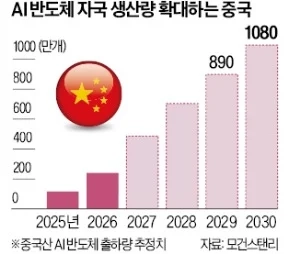
China’s demand for AI semiconductors this year is estimated to be well above 5 million units, the Financial Times reported. Supply is projected to reach no more than 3.5 million units, including about 1 million produced overseas. Demand is forecast to exceed 10 million units next year.
Morgan Stanley projects China’s total spending on computing infrastructure will reach $193 billion this year. While substantial, that amounts to only about 21% of the U.S. level. Even if China catches up with the U.S. in AI model performance, the gap created by insufficient computing capacity is likely to remain.
With imports of Nvidia’s AI chips blocked, the Chinese government and companies are accelerating efforts to localize production. They are also actively seeking alternative channels to secure Nvidia chips. The Financial Times reported that Chinese technology companies bought more than 1 million of Nvidia’s gaming and workstation graphics processing units this year. They are also deploying general-purpose GPUs in data centers instead of chips designed specifically for computing tasks.
Kim Eun-jung, Beijing correspondent, Korea Economic Daily, kej@hankyung.com

Korea Economic Daily
hankyung@bloomingbit.ioThe Korea Economic Daily Global is a digital media where latest news on Korean companies, industries, and financial markets.