Foreigners Dumped $8.3 Billion in Korean Stocks, but Samsung and SK Hynix Outlook Surprises Despite China Fears
Summary
- Yuanta Securities said investors should be cautious about panic dumping in Samsung Electronics and SK Hynix as foreign investors sold a net 11.5 trillion won ($8.3 billion), share buybacks ended, and pension-fund buying weakened.
- Despite concerns over supply competition from China’s CXMT, the firm said there is still no confirmed damage to earnings, and that Samsung’s PER of 3.27 and an RSI of 23.2 point to oversold conditions, suggesting the stock-price decline has been excessive relative to earnings.
- Yuanta Securities said its top strategy is staged buying of large-cap semiconductor shares on weakness, adding that a combined approach using secondary batteries (ESS) and semiconductor materials, parts and equipment also remains valid.
Forecast Trend Report by Period


Yuanta Securities: A strategy combining semiconductor stocks with chip materials, parts and equipment remains valid
With few buyers left to absorb foreign selling, caution is warranted against panic dumping in Samsung and SK Hynix
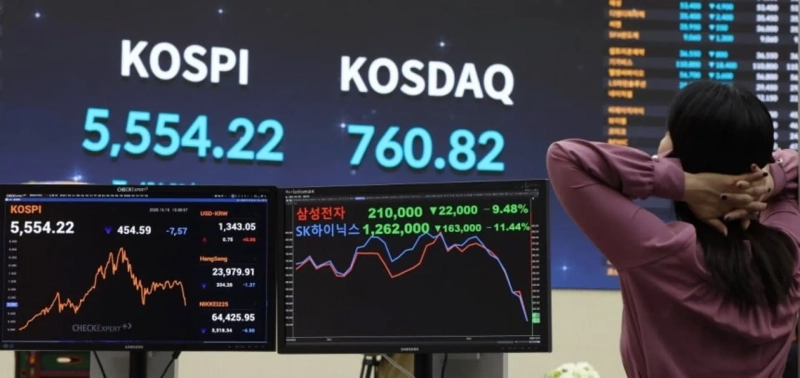
A sharp selloff in South Korean stocks reflects less of a deterioration in corporate earnings than a shortage of buyers able to absorb heavy foreign selling, according to brokerage analysis that warned against panic dumping in large-cap semiconductor names. Foreign investors were net sellers of 11.5 trillion won ($8.3 billion), while share buybacks and pension-fund buying also weakened, adding to downward pressure on the market. Concerns over supply competition from China’s ChangXin Memory Technologies, or CXMT, have intensified, but with no confirmed damage to earnings yet, the report argued investors should respond based on fundamentals and fund flows rather than fear.
Lee Jae-won, an analyst at Yuanta Securities, wrote in an Oct. 16 report that foreign selling had been concentrated in Samsung Electronics Co. and SK Hynix Inc., while share buybacks that had supported the index were also fading. Samsung’s buyback program ended on Oct. 7. Growth in retail investors’ customer deposits has also stalled, and pension funds have limited capacity to keep buying.
With few buyers left to absorb the selling, falling share prices are prompting more selling, Lee wrote. The Kospi dropped 16.2% from Oct. 8 through Oct. 15. Over the same period, foreign investors were net sellers of 11.5 trillion won ($8.3 billion) on the Kospi. Even on Oct. 15, when a circuit breaker was triggered, pension funds were net buyers of just 35.1 billion won ($25.4 million).
The selloff was also compounded by worries about the semiconductor cycle. Credit risk at AI infrastructure company CoreWeave and CXMT’s plan to launch server-memory products simultaneously raised fears of slower AI investment and tougher competition in memory supply. Lee added, however, that no actual reduction in capital spending or large-scale mass production by CXMT has yet been confirmed. In his view, it is too early to conclude those concerns have become reality.
Wall Street has also pushed back against what some view as excessive fear over CXMT. Kevin Cassidy, an analyst at Rosenblatt, wrote in a report cited by Yahoo Finance on Oct. 15 that the market was placing too much weight on CXMT’s architecture announcement. Developing a prototype is different from mass-producing reliable chips at a competitive cost, he wrote.
Jordan Klein, a technology, media and telecommunications specialist at Mizuho, also questioned the comparison, according to Investing.com. He cited CXMT’s failure to disclose full specifications and validated yields in arguing that a product unveiling later this year cannot be directly compared with Samsung’s 2028 mass-production target. Ben Barringer, global head of technology research at U.K. asset manager Quilter Cheviot, told CNBC that making chips is one thing, but yields are the real challenge. If yields are 50%, half the chips are effectively discarded, he said.
The stock-price drop may also have been excessive relative to earnings. Samsung’s preliminary third-quarter operating profit rose 20% from the previous quarter. Yet its 12-month forward price-to-earnings ratio fell to 3.27 as of Oct. 15. The Kospi’s 14-day relative strength index also entered oversold territory at 23.2. Lee wrote that those indicators suggest the decline in share prices has been steeper than changes in earnings would justify.
Lee stressed that a short-term rebound should not be confused with a recovery in the broader trend. In 12 past cases when the Kospi fell more than 10% over seven trading days, the index rose a week later 83% of the time. But among the five instances when the decline exceeded 15%, the share of cases in which the market was higher a month later was just 20%. That suggests that when losses are this deep, even a short-term rebound is less likely to develop into a sustained recovery.
A slowdown in foreign selling and a return of buying demand to absorb it are the first conditions for stabilizing the rout, Lee wrote. For any rebound to continue, AI-related credit risk must ease, semiconductor earnings forecasts must hold, and shareholder-return plans due in late October must be clarified and then implemented.
As an investment strategy, Lee put top priority on staged buying of large-cap semiconductor shares on weakness. He added that a strategy combining those names with secondary batteries tied to energy storage systems, or ESS, and semiconductor materials, parts and equipment remains valid. The advice is to spread out purchases when share-price declines outpace earnings deterioration while diversifying across sectors to reduce risk.
Kang Kyung-ju, Hankyung.com reporter memory@hankyung.com

Korea Economic Daily
hankyung@bloomingbit.ioThe Korea Economic Daily Global is a digital media where latest news on Korean companies, industries, and financial markets.