Neither Cash Nor Cards: Stablecoin Payment Trials Reach Convenience Stores
Summary
- Pilots for stablecoin payments are spreading across convenience stores, department stores and airports around the world, as companies test direct payments that bypass card networks.
- Cases are emerging in Japan, the UAE and Switzerland where USDT, USDC, JPYC and DDSC are used to cut merchant fees and pass along payment-cost savings to customers.
- In South Korea, KB Kookmin Card and BC Card are conducting stablecoin payment pilots at CU convenience stores and elsewhere, and commercialization will depend on how quickly related rules and consumer protection standards are clarified.
Forecast Trend Report by Period


Stablecoins push deeper into daily life
Payments tested at Japanese convenience stores and a Swiss airport
Offline retail payment trials spread around the world
Consumers and merchants transfer funds directly
No card settlement or currency exchange needed
KB Kookmin Card runs pilot at CU convenience stores
"Commercial rollout hinges on clearer rules"
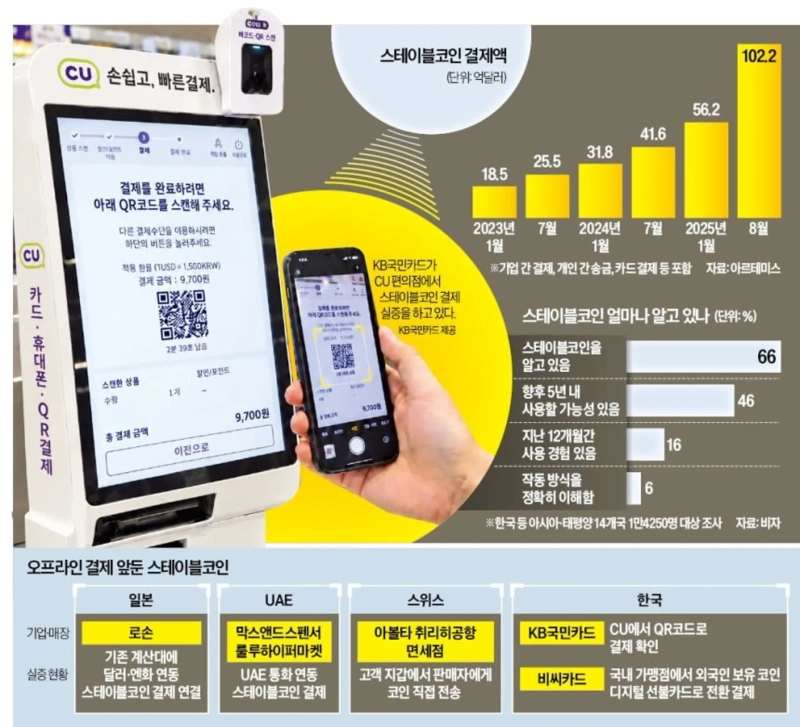
Trials of paying for goods with stablecoins are spreading across offline retail channels worldwide, including convenience stores, department stores and airport duty-free shops. In these setups, consumers pay in stablecoins through QR codes or similar methods, and merchants receive the funds directly. The tests remain limited to some locations, but efforts to let customers and sellers exchange stablecoins without going through card networks are gaining ground.
◇Stablecoin payments spread
According to the crypto industry on October 18, Japanese payments company Netstars completed a stablecoin payment pilot at Lawson convenience stores in August. The trial used dollar-pegged Tether (USDT) and USD Coin (USDC), along with yen-linked JPYC. Payments were made through the digital wallet MetaMask. The service was connected to existing point-of-sale systems that manage products and sales records.
In Japan, the number of places accepting the yen stablecoin JPYC has already surpassed 150, including convenience stores, restaurants and online malls. The issuer says customers send coins directly to stores over a blockchain, while merchants are not charged separate merchant fees. Some stores are using the lower payment costs to offer discounts or free shipping to customers who pay with JPYC.
In the United Arab Emirates, department stores and hypermarkets have joined the trials. Network International, a payments company focused on the Middle East and Africa, tested stablecoin payments last month at a Marks & Spencer department store in Dubai and at Lulu Hypermarket in Abu Dhabi. The stablecoin used was DDSC, which is pegged to the UAE dirham. Consumers scan a QR code shown on the checkout terminal to pay. Once the payment is confirmed, the store receives a notification through its existing payment system. Merchants can receive DDSC in a wallet or settle in dirhams. Network International has said it plans to expand the service to merchants across the UAE after the trial.
In Switzerland, stablecoin payments were tested at Zurich Airport. Avolta, the duty-free operator, ran a pilot last month that allowed travelers to pay for purchases with digital wallets at an airport duty-free store. When customers scanned a QR code, funds moved directly between the customer and Avolta over a blockchain.
◇South Korean card companies begin pilots
The string of trials across countries reflects a growing number of companies trying to apply stablecoins to everyday commerce. Stablecoin payments allow merchants to secure funds without waiting for the settlement cycle of card networks. Foreign customers can also spend the stablecoins they already hold without exchanging them into local currency.
Whether stablecoin payments gain traction will depend on how convenient they prove to be for both consumers and merchants. Moving fiat currency into a wallet as stablecoins and paying transfer fees could be burdensome for consumers. Refund procedures also matter when money is sent to the wrong address or a purchase is canceled. An industry official said merchants may also hesitate if accepting stablecoins requires extra costs or effort, such as converting them into cash.
South Korean card issuers are also starting payment trials. KB Kookmin Card conducted a stablecoin payment pilot last month at CU convenience stores with BGF Retail, NICE Information & Telecommunication and AhnLab Blockchain Company. BC Card also completed a pilot last year that converted stablecoins held by foreign users into digital prepaid cards, allowing QR payments at domestic convenience stores, cafes and supermarkets.
A card industry official said the sector is still verifying whether existing merchants can process stablecoin payments and support cancellations and refunds. A full rollout will depend on how quickly related regulations and consumer protection standards are defined.
Cho Mi-hyun, Korea Economic Daily reporter mwise@hankyung.com

Korea Economic Daily
hankyung@bloomingbit.ioThe Korea Economic Daily Global is a digital media where latest news on Korean companies, industries, and financial markets.