KOSDAQ Delisting Fear Grows as Even $144 Million-Revenue Firms Consider M&A
Summary
- Starting in July next year, the KOSDAQ market-cap threshold for delisting will be raised to 30 billion won ($21.6 million), and companies with market capitalizations below that level are reviewing M&A deals to avoid being delisted.
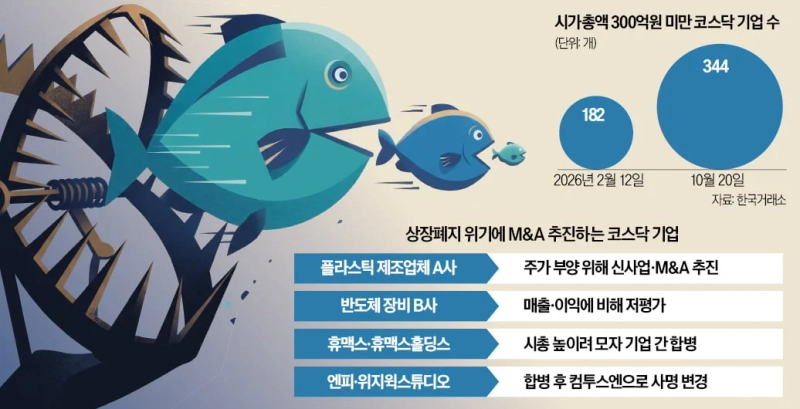
- As the KOSDAQ index tumbled, the number of KOSDAQ-listed companies with market caps below 30 billion won ($21.6 million) rose about 90% from 182 to 344, making it difficult for companies to lift their share prices and market value through their own efforts alone.
- With the government's tougher delisting requirements set to drive more M&A among KOSDAQ companies in the first half of next year, concerns are also being raised over deals that merely make companies bigger without increasing corporate value.
Forecast Trend Report by Period


'Must Avoid Delisting'... KOSDAQ M&A Market Bustles
Takeovers to Boost Market Value
Smaller Companies Below $21.6 Million in Market Cap
Tighter Delisting Rules From Next July
'Hard to Lift Shares as KOSDAQ Falls'
Concern M&A Could Extend Weak Companies' Lives

The chief executive of semiconductor equipment maker A has recently been fielding a steady stream of M&A pitches from accounting firms and boutique advisory houses. Delisting risk is rising ahead of tighter market-cap rules due to take effect in July next year, when the threshold will increase to 30 billion won ($21.6 million) from 20 billion won ($14.4 million).
A posts annual revenue of about 200 billion won ($144.1 million) and operating profit of around 10 billion won ($7.2 million), but its market capitalization remains in the 20 billion-won range. Investors have assigned it a weak valuation because the company operates in OLED as well as semiconductors.
"The mood on the KOSDAQ market is so poor that even when we disclose several new orders, the stock doesn't budge," the CEO said. "At this point, we may have to pursue M&A just to avoid delisting."
Most Companies Below 30 Billion Won Reviewing M&A
The government's delisting reform package announced in February has driven smaller and mid-sized KOSDAQ-listed companies into the M&A market. The plan centered on a new rule to force out penny stocks and stricter market-cap requirements. Even profitable, fundamentally sound companies are actively reviewing deals to avoid losing their listings. The government hopes such consolidation can improve innovation and efficiency. Some market participants, however, say mergers between zombie companies could blunt those policy gains.
As of Oct. 21, most KOSDAQ companies with market capitalizations below 30 billion won are reviewing M&A options, according to industry officials. The rush follows the delisting reform package announced in February by the Financial Services Commission. The stricter standards are due to take effect in July next year.
According to the Korea Exchange, the number of KOSDAQ-listed companies with market capitalizations below 30 billion won rose to 344 on Oct. 20 from 182 on Feb. 12, when the reform plan was announced. That was an increase of about 90%. The jump reflects a plunge in the KOSDAQ index to 781.97 from 1,125.99 over the same period. An industry official said it is difficult for individual companies to lift their market value through their own efforts when the broader KOSDAQ market is falling.
Many small KOSDAQ-listed companies are looking to the M&A market for a way forward. Plastic manufacturer B has revised its medium- to long-term strategy toward growth through acquisitions instead of seeking a new growth engine in a new business. The CEO of A said he has recently been receiving M&A-related calls every week. The challenge, he added, is finding a target with genuine synergies at the right price.
M&A May Accelerate in First Half of Next Year
Some companies have already completed deals. Stainless steel pipe maker Erem acquired a 100% stake in solar power plant engineering, procurement and construction specialist Onepick ENC in August for about 2.5 billion won ($1.8 million). Humax Holdings expanded its scale through a merger with subsidiary Humax in July. Recent deals involving RFTech and Ecovolt, Digii and Green, Hanjoo ART and Bits, and NP and WYSIWYG Studios are also widely believed to have been aimed at avoiding delisting.
Industry participants say M&A activity among KOSDAQ companies is likely to become more active in the first half of next year. A substantial number of deals are already being discussed behind the scenes.
The government expects tougher delisting rules to reduce weak companies and curb problems caused by duplicate listings. But critics say M&A could become a workaround for companies trying to avoid delisting. "Quite a few companies are trying to dodge the rules by simply getting bigger without improving corporate value," an M&A industry official said. "More detailed policy measures are needed."
Seong Sang-hoon, Hankyung.com reporter uphoon@hankyung.com

Korea Economic Daily
hankyung@bloomingbit.ioThe Korea Economic Daily Global is a digital media where latest news on Korean companies, industries, and financial markets.