[Exclusive] Kosdaq Promotion-Relegation System to Use Absolute Criteria for Select Tier
Summary
- The government and financial authorities said they will adopt an absolute-evaluation method for the Kosdaq promotion-relegation system, allowing companies to move into Select without a cap on the number of promotions if they meet the criteria.
- Financial authorities said they are reviewing a plan to reflect not only market capitalization, but also sales, profit growth, and technological competitiveness in Kosdaq segment classifications and promotion-relegation standards.
- The government and Korea Exchange said they aim to use an expansion of Kosdaq Select to strengthen institutional investors’ incentives to invest in high-quality companies and expand value-up opportunities for Kosdaq-listed firms.
Forecast Trend Report by Period


Move to top-tier Select segment if market cap and financial thresholds are met
No cap on the number of companies promoted

South Korea will adopt an absolute-evaluation model for the Kosdaq promotion-relegation system, a key capital-markets reform initiative. The move means companies will be promoted to Select, the top tier for high-quality listings, whenever they meet requirements such as financial standards and market capitalization.
A senior Korea Exchange official said on October 22 that the Kosdaq system would not use a relative-ranking method that fixes the number of Select companies at 50 or 70. Instead, it will use absolute criteria.
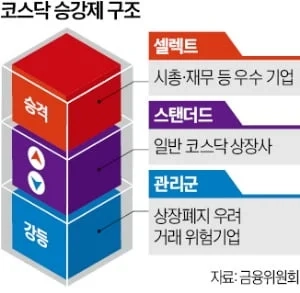
The Kosdaq promotion-relegation system would divide listed companies into three groups: Select for high-quality companies, Standard for general companies and a management group for troubled firms. Companies in Standard would be eligible for promotion to Select if they meet set requirements.
The government had initially considered using relative rankings to sort listed companies and then determine how many should be included in Select. But many experts argued that, rather than setting a fixed number, strong companies that meet the promotion criteria should be allowed to move into Select at any time.
Financial authorities are reviewing a framework that would classify companies not only by market capitalization, but also by sales, profit growth and technological competitiveness.
No quota as on Nasdaq; top-tier roster could grow to 200 to 300 companies
Aiming to erase the “Kospi second division” label, but promotion standards remain unresolved
When the Financial Services Commission announced in March that it would introduce the Kosdaq promotion-relegation system, also known as a segmented structure, it had been considering setting the number of companies admitted to the blue-chip Select group in advance. Regulators later decided to allow the roster to expand at any time, judging that fixed quotas would make it harder to grow Select and could undercut efforts to differentiate the Kosdaq market.
Financial authorities had initially discussed narrowing the Select group to fewer than 100 companies based on market capitalization, according to a person familiar with the talks. Early on, officials indicated that only several dozen companies would be included in Select, the person said, implying a shortlist based on market-cap rankings. There was also a view that Select would be run as a tightly screened group to meet demand from institutional investors seeking exposure to high-quality Kosdaq companies.
But financial authorities and Korea Exchange have now decided not to run the system with a fixed number of Select constituents. If more companies meet the inclusion criteria over time, the number in Select could expand to 200 or 300, a senior exchange official said. There is also hope that the Select pool will grow overall as more companies post strong performance.
A larger Select tier could help erase the stigma that Kosdaq is merely a “second division” version of the Kospi. One of the main reasons authorities pushed the system was a view that Kosdaq’s original identity as a market for high-quality technology stocks had faded. The government is seeking a chain reaction in which successful differentiation of Select boosts institutional demand for strong companies and broadens value-up opportunities for Kosdaq firms.
Nasdaq, which financial authorities are using as a key reference in designing the system, also uses absolute criteria. Nasdaq operates a tiered structure of the Nasdaq Global Select Market, Nasdaq Global Market and Nasdaq Capital Market. It does not impose a separate quota for each segment. Companies can move up after applying and being reviewed for whether they meet the requirements.
A financial investment industry official said many more companies moved from the New York Stock Exchange to Nasdaq after Nasdaq introduced its segment system in 2006. The person added that there is broad agreement in and around the government that Kosdaq should be designed to produce a similar effect.
The key question is how to set the promotion and relegation criteria for Kosdaq. Market participants say the standards should reflect a range of variables, including financial growth, market capitalization and technological competitiveness. Korea Exchange is also conducting a research study on the issue. Financial authorities, however, have yet to reach a conclusion on the final criteria.
The exchange has also not finalized the schedule for a public hearing on the Kosdaq promotion-relegation system, which it had said would be held in the fourth quarter of this year. An investment-industry official said a recent court ruling that blocked a delisting tied to failure to meet market-capitalization requirements has forced the exchange to focus on that issue. As a result, the exchange has not yet decided when to hold the hearing.
Shim Woo-il, Hankyung.com reporter goodwill@hankyung.com

Korea Economic Daily
hankyung@bloomingbit.ioThe Korea Economic Daily Global is a digital media where latest news on Korean companies, industries, and financial markets.