AI Earnings Ease Bubble Fears, Setting Up Cloud Big Three as Next Test
Summary
- Meta, Super Micro and Lam Research reported earnings above consensus, helping ease concerns about AI demand that had weighed on New York stocks.
- The Wall Street Journal and Ken Griffin said risks tied to an AI bubble and rate hikes mean investor anxiety remains elevated.
- In upcoming earnings from Alphabet, Microsoft and Amazon, the key question is whether large-scale AI investment is driving gains in revenue and operating profit.
Forecast Trend Report by Period


Server and Chip Companies Post Earnings Gains
Meta, Super Micro, Lam Research
Strong Results Help US Stocks Clear a Hurdle
Investor Anxiety Over Rate Hikes Still Lingers
Alphabet, Amazon Earnings Loom
Profitability of Massive AI Spending Is the Key Question
U.S. stocks have cleared an immediate hurdle after worries about artificial intelligence profitability, sparked by neocloud companies, rattled the market. SpaceX was followed by Meta and Super Micro, as well as AI chip-equipment maker Lam Research, all posting third-quarter results that beat expectations. The earnings supported the view that AI demand remains resilient.
Investor unease, however, has not gone away. Comments from prominent Wall Street figures about an AI bubble continue to weigh on sentiment. With Alphabet, Microsoft and Amazon due to report on Oct. 28 and Oct. 29, investors are looking to the three giants to determine the market's next direction.
AI Companies Hold Up in Earnings
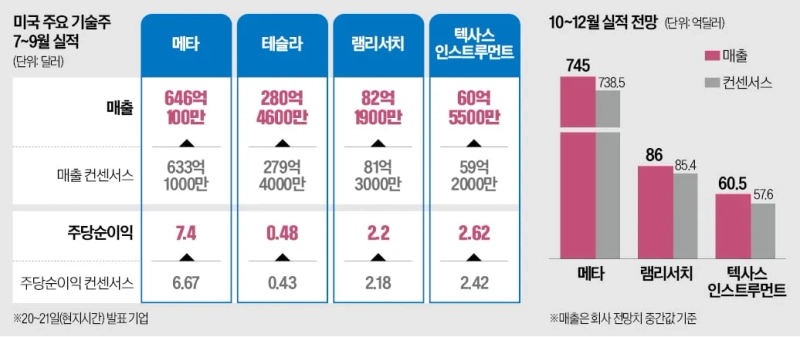
Major AI and semiconductor companies including Meta, Tesla, Super Micro and Lam Research released third-quarter earnings on Oct. 20 and Oct. 21. The overall verdict was that they held up well.
Meta, which reported on Oct. 21, posted third-quarter revenue of $64.601 billion, up 26% from a year earlier. That topped the consensus estimate of $63.31 billion. Revenue from its Family of Apps segment, including advertising, rose 26.4% to $64.16 billion. Higher ad impressions and a rise in the average price per ad drove the increase. Users of the AI agent Muse surpassed 10 million.
Third-quarter free cash flow swung to a deficit of $2.12 billion. Meta also raised the lower end of its forecast for this year's capital expenditures by $5 billion, to $135 billion from $130 billion. Investors backed Chief Executive Officer Mark Zuckerberg's view that the spending is bearing fruit, the core business remains solid and the broader effort is gaining momentum. Jesse Cohen, a senior analyst at Investing.com, said the market has shifted away from criticizing Meta's heavy spending and toward backing what it sees as a credible product strategy.
AI infrastructure companies also delivered stronger-than-expected results. Super Micro, which specializes in AI servers, said a day earlier that it expects revenue of $18.5 billion to $19.5 billion for the first quarter of fiscal 2027, covering July through September. That marked a 27% increase from its previous outlook. The company cited stronger server demand from major big-tech customers.
Lam Research, a chip-equipment maker, and industrial semiconductor company Texas Instruments also posted results on Oct. 21 that beat consensus estimates, adding to evidence of demand for AI semiconductors. Tesla, despite heavy spending on AI investment, reported third-quarter revenue of $28.046 billion, above market expectations. Earnings per share came to 48 cents, exceeding the 43-cent consensus.
Cloud Big Three Including Google Await Earnings
The S&P 500 rose 0.58% to close at 7,757.17 on Oct. 21, while the Nasdaq gained 1.05% to 26,702.86. SpaceX climbed 7.8% and Nvidia advanced 2.5%. After SpaceX, firms including Meta also posted solid results, easing some of the concern over AI spending that had weighed on New York stocks following worries tied to CoreWeave.
Anxiety remains in parts of the market. The Wall Street Journal reported on Oct. 21 that the AI bubble could burst and said Federal Reserve rate hikes could make funding more burdensome for technology companies. A day earlier, Citadel founder Ken Griffin said the market could be in the middle of an AI bubble.
CoreWeave's volatility on Oct. 21 was also seen as reflecting those concerns. The stock rose nearly 4% during the session before turning lower. Chief Executive Officer Arvind Krishna said companies are scrutinizing the actual returns on AI investments more closely. Some are concerned that AI spending could spiral without generating meaningful returns.
The market's direction will hinge on earnings from Alphabet and Microsoft on Oct. 28 and Amazon on Oct. 29. The key issue is whether massive AI investment is translating into revenue growth and rising operating profit.
Hwang Jung-soo, New York correspondent, Hankyung.com, hjs@hankyung.com

Korea Economic Daily
hankyung@bloomingbit.ioThe Korea Economic Daily Global is a digital media where latest news on Korean companies, industries, and financial markets.