PiCK
US Crypto Tax Overhaul Push Offers Clues for Korea’s Debate on Delaying Digital-Asset Taxes
Summary
- The Blockchain Association told Congress that digital-asset tax rules should be overhauled, especially by shifting taxation of mining and staking rewards to the point of disposal.
- The group said tax exemptions for small transactions, treating stablecoins as cash-equivalent assets, and separating non-taxable transactions based on economic substance would ease both the tax burden and the administrative burden.
- In South Korea, debate has intensified ahead of next year’s digital-asset taxation, with calls for a tax delay, a higher basic deduction, and concerns that weak tax infrastructure could trigger an overseas outflow of investment funds and a drop in exchanges’ annual trading volume.
Forecast Trend Report by Period


The US blockchain industry is urging Congress to revamp digital-asset tax rules, arguing the current framework does not properly reflect the characteristics of cryptocurrencies and is adding to uncertainty. The push also offers implications for South Korea, where debate is intensifying over whether to delay crypto taxation ahead of its planned introduction next year.
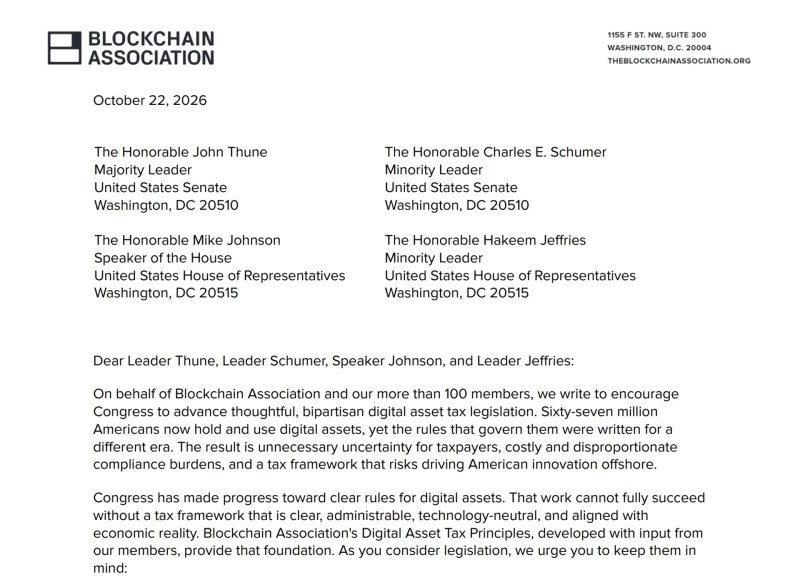
According to the industry on October 22, the Blockchain Association sent a letter that day to congressional leaders including Senate Republican Leader John Thune, Senate Democratic Leader Chuck Schumer and House Speaker Mike Johnson, calling for an overhaul of digital-asset taxation.
In the letter, the group said about 67 million Americans own and use digital assets, but the tax rules governing them were created for a completely different era. As a result, taxpayers face unnecessary uncertainty and excessive, disproportionate tax burdens.
The Blockchain Association is one of the industry’s leading lobbying groups based in Washington, DC. Its members include more than 100 companies such as Coinbase, Kraken, Circle, the issuer of USDC, Ripple, Uniswap and Ondo Finance.
Digital-Asset Tax Rules Need Modernization
The group’s core demand is what it calls tax modernization. Because US taxation of digital assets has been in place since 2014, the association said the system should be updated to reflect changes in technology. Doing so would reduce uncertainty for taxpayers and ease the administrative burden on tax authorities.
Without a tax framework that is clear, enforceable, technology-neutral and aligned with economic reality, congressional efforts to establish clear rules for digital assets cannot fully succeed, the association wrote.
A key part of the proposal is to tax mining and staking rewards when the assets are disposed of, rather than when they are received. The group argues that even if someone receives a staking reward, a tax liability can arise before any income has actually been realized if the tokens have not been sold. It says taxing unrealized mining and staking rewards at the point of disposal is more reasonable.
The letter also calls for taxation based on economic substance rather than technical form. In particular, the association said transactions that do not involve a change in beneficial ownership should be excluded from taxation, such as moving assets from an exchange to a personal wallet or transferring assets across blockchain networks.
It also proposed exempting small transactions from tax to improve the usefulness of digital assets as a payment method. Stablecoins, it added, should be treated as cash-equivalent assets.
Implications for Korea
Some say South Korea should consider the Blockchain Association’s proposals as it builds its own digital-asset tax regime. One of the main arguments behind the renewed push to delay taxation is that standards still have not been properly established for different types of transactions, including staking and airdrops.
That issue also helps explain why the Ministry of Economy and Finance and the National Tax Service have yet to properly calculate the expected tax revenue effect and collection costs tied to next year’s planned rollout of digital-asset taxation.
The association’s argument that stablecoins should be treated as cash-equivalent assets also carries implications for South Korea. The legal status of stablecoins remains unclear because the proposed Digital Asset Basic Act, first taken up in legislative discussions last year, has yet to be enacted.
The US group argues that taxing every use of stablecoins for payments or collateral would excessively increase both transaction costs and administrative burdens.
The same applies to tax exemptions for small transactions. In South Korea, there have been persistent calls to raise the basic deduction for digital-asset income from the current 2.5 million won a year.
In a report commissioned by the National Tax Service in the first half of this year, Changwon National University’s industry-academic cooperation foundation said keeping the deduction at 2.5 million won would mean tax revenue collected may not be significant relative to the administrative cost of enforcement. The Korea Institute of Public Finance, a state-run think tank, also proposed raising the basic deduction at a symposium last month as a way to improve fairness in digital-asset taxation.
The Blockchain Association’s warning about a possible exodus caused by inadequate tax infrastructure also stands out. In the letter, the group said the current US digital-asset tax regime risks driving American innovation overseas.
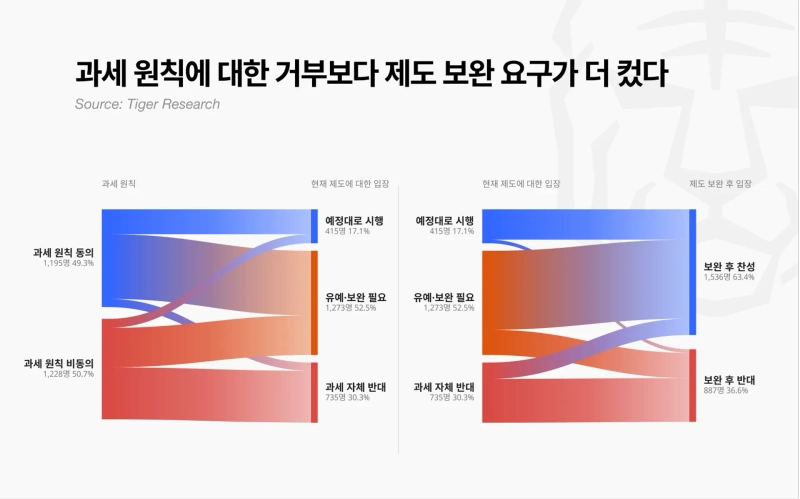
In South Korea, Web3 research firm Tiger Research estimated that if crypto taxation takes effect, annual trading volume at the country’s three largest exchanges — Upbit, Bithumb and Coinone — could shrink by nearly 30% next year to about 602 trillion won from about 860 trillion won this year, as investor funds move abroad.

JOON HYOUNG LEE
gilson@bloomingbit.ioCrypto Journalist based in Seoul