Foreigners Keep Selling Korean Stocks, but Forced-Liquidation Fade Fuels Kospi Bottom Calls
Summary
- Analysts said forced liquidations and short-selling positions in Korea and abroad are showing signs of peaking, suggesting panic selling is easing.
- The market’s PER of around 4 times, a 34% increase in earnings forecasts, and past cases where a 30% plunge was followed by a 60% rebound over 12 months were cited as reasons why risk-reward at current levels remains attractive.
- A restart in US share buybacks, the midterm elections, and Samsung Electronics’ and SK Hynix’s earnings and shareholder returns are being watched as catalysts for a technical rebound and a turn in investor sentiment.
Forecast Trend Report by Period


Forced-selling ratio drops from 6.6% to 1%, signaling easing liquidations
Earnings are rising, but the PER is just 4 times, pointing to a record valuation discount
US buyback restart and midterm elections seen as rebound catalysts
Samsung, SK Hynix earnings and shareholder returns face first test
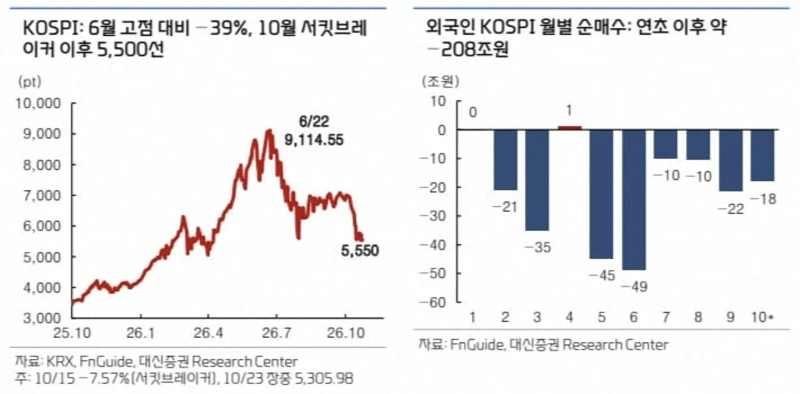
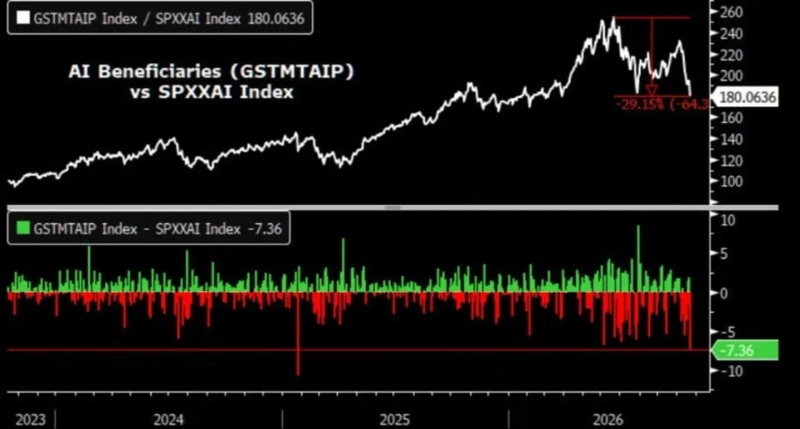
The Kospi has retreated to about 40% below its June peak. Foreign investors have continued to sell as doubts linger over the durability and profitability of artificial intelligence spending, while military tensions in the Middle East ahead of Israel’s general election and the outcome of Brazil’s election added pressure.
Even with negative headlines piling up, calls that the Kospi is nearing a bottom are gaining traction among South Korean brokerages. The argument is that margin-call pressure is easing as fewer investors are being forced to dump stocks. If the selloff subsides alongside earnings and shareholder-return plans from heavyweight chipmakers, a restart in US share buybacks and fading political uncertainty, analysts say a floor could begin to form.
On Oct. 26, the Kospi closed down 1.46% at 5,469.47. That left the benchmark 40% below its June 22 closing high of 9,114.55.
The index opened down nearly 1% and briefly tried to turn higher, rising to the 5,565 level early in the session. It later gave up those gains after foreigners resumed heavy selling. Institutions bought a net 611 billion won, but that was outweighed by foreign net sales of 695.5 billion won. The Kosdaq also fell 3.26% to 727.21.
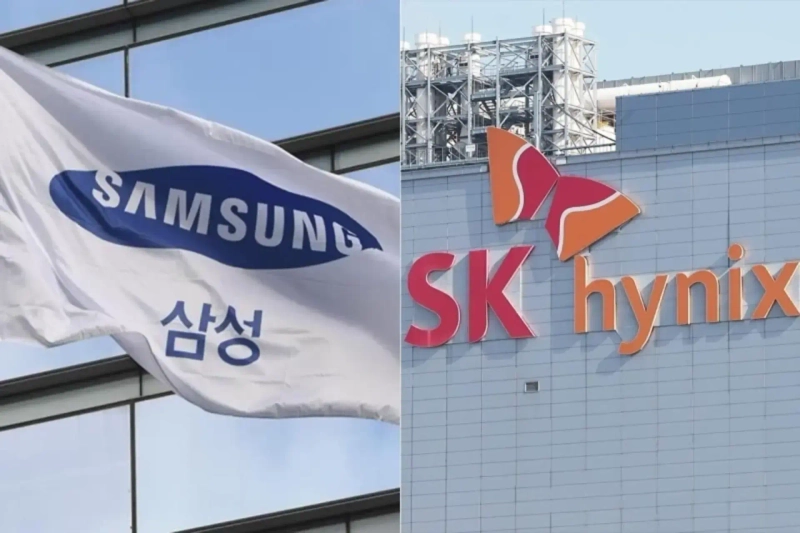
Samsung Electronics fell 1.16% to 213,000 won, while SK Hynix slipped 0.16% to 1.275 million won. SK Hynix briefly rose more than 2% after the market floated the possibility of a 16 trillion won special dividend, but caution ahead of earnings proved stronger. Decliners outnumbered advancers by about eight to one on the main board, underscoring weak sentiment across the market.
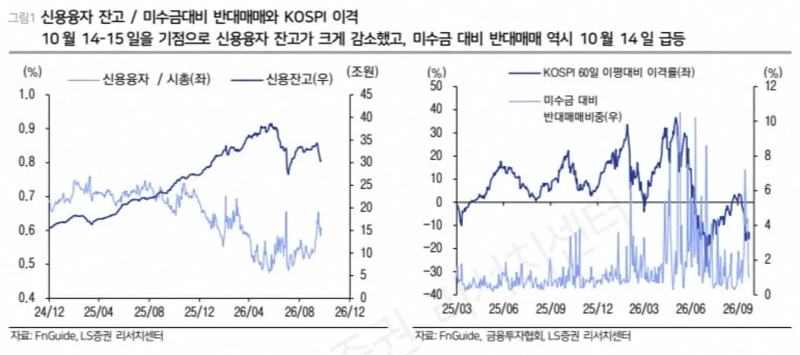
Forced-selling ratio falls from 6.6% to 1%
Even so, brokerages said on Oct. 26 that the market may be nearing the peak of capitulation. Jung Da-woon, an analyst at LS Securities, said bottoms are formed when there is no one left to sell and flagged the possibility that the Kospi may already have passed this week’s low.
His evidence is the unwinding of leveraged positions. Outstanding margin loans in South Korea fell by 3.9 trillion won over 10 days, from 34.3 trillion won on Oct. 12 to 30.4 trillion won on Oct. 22. The ratio of forced liquidations to unpaid margin balances surged to 6.6% on Oct. 14 before dropping to 1% on Oct. 22. Forced liquidation refers to brokerages selling shares held by investors who fail to repay stock purchases made on credit. Absolute margin balances are not low, Jung said, but the forced unwinding of marginal supply appears to have moved past its peak.
Similar signals are emerging in the US. Goldman Sachs said returns for equity hedge funds’ fundamental, systematic and multi-strategy books all fell more than 1% on Oct. 22. It was the first time since the Covid-19 shock that all three strategies posted losses of more than 1% on the same day. Hedge funds’ short positions have also climbed to the highest level in five years.
LS Securities said speculative net short positions in S&P 500 futures compiled by the US Commodity Futures Trading Commission have expanded to about 7% of total open interest. Against that backdrop, the resumption of corporate share buybacks in November, after blackout periods tied to earnings, could trigger short covering. US companies have authorized $1.3 trillion in buybacks this year, the most since 2006.
Jung said uncertainty tied to the Middle East and the Federal Reserve’s rate-setting Federal Open Market Committee remains in place. At current index levels, though, investors may want to watch for easing selling pressure and the possibility of a technical rebound driven by short covering rather than join the panic.
US midterm elections seen as rebound catalyst
Daishin Securities cited the US midterm elections as a possible catalyst for a rebound in South Korean stocks. The brokerage said the recent plunge was driven less by the election itself than by rising US long-term Treasury yields, credit concerns around AI investment and a spike in oil prices. Lee Kyung-min, an analyst at Daishin, said the gap between Korean companies’ earnings and share prices could narrow once the election is over, political uncertainty eases and rates stabilize.
Daishin’s data show the S&P 500 rose in both the six months and 12 months after all 19 US midterm elections since 1950. The average gain over 12 months was 15.1%. The same pattern has been weaker in Korea. In the nine US midterm cycles since 1990, the Kospi rose over the following 12 months in six cases, and the median return was just 2.6%. Daishin said domestic growth and corporate earnings, rather than the composition of the US Congress, determined outcomes for Korean stocks.
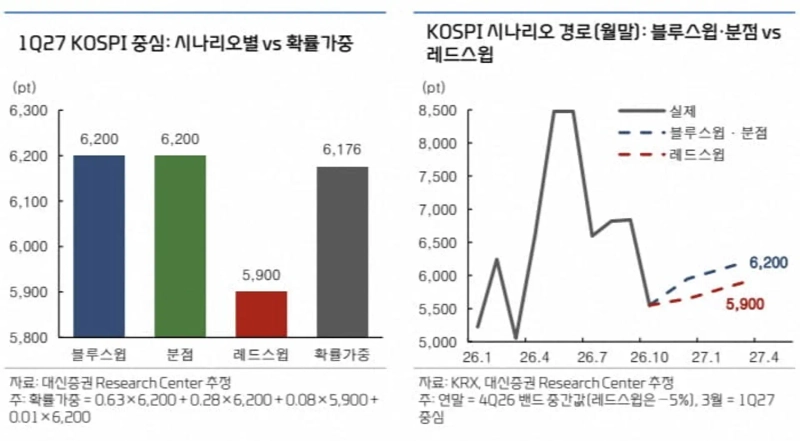
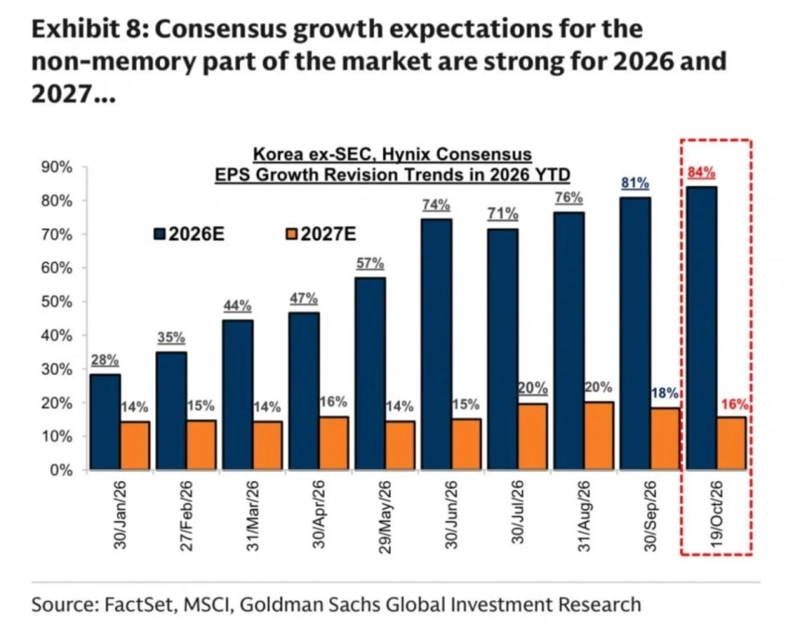
Ultimately, the bullish case for the Kospi rests on earnings. The market is trading at just 4.2 to 4.3 times forward 12-month earnings, even as next year’s expected earnings per share are forecast to rise 34% from this year. That discount relative to earnings is the widest since 2006.
Goldman Sachs, which cut its 12-month target for the Kospi by 25% to 9,000 from 12,000 on Oct. 26, said the lower target reflects more conservative assumptions about how the market will value fundamentals. Even so, it said expected returns relative to risk remain attractive at current levels.
Daishin said that in 10 past cases when the Kospi plunged more than 30%, the index rebounded 31% over the following three months and 60% over the following 12 months. Lee expects the Kospi to bottom in the fourth quarter and rebound to 6,500 to 7,500 in the first quarter of next year. His expected range for the fourth quarter is 5,200 to 6,700. He recommended staggered buying below 5,600.
Recovery in buying hinges on clearing a triple hurdle
For the bottoming view to turn into real buying, several external risks still need to clear. In the Middle East, fears of a military clash between the US and Iran are colliding with mediation efforts by Qatar. Israeli Prime Minister Benjamin Netanyahu, ahead of the general election on Oct. 27, has asked President Donald Trump for additional public backing while pressing Trump’s hardline stance on Iran.
If high oil prices push inflation and interest rates back up, financing costs for AI companies could rise again and valuation pressure on growth stocks could deepen. The FOMC meeting on Oct. 28 and the US midterm elections on Nov. 3 are also keeping investors cautious.
Investors are also watching whether the post-election plunge in Brazilian asset prices will further weigh on risk appetite. After President Luiz Inacio Lula da Silva secured re-election, Brazil equity ETFs traded in Asia and real futures both fell by double digits. Some investors may reallocate emerging-market money leaving Brazil into Korea. But if sentiment toward emerging markets broadly deteriorates, South Korean equities may also come under pressure.
This week’s earnings from Samsung Electronics and SK Hynix will be an early test of whether sentiment can turn. SK Hynix is set to report third-quarter results on Oct. 28, followed by Samsung on Oct. 29. Investors are looking beyond the headline profit figures from the previous quarter. They want clarity on the durability of the memory-chip boom, the companies’ cash generation and the scale of shareholder returns. A brokerage official said investors will want to see something bigger than the proposed 16 trillion won special dividend linked to gains from the Kioxia investment reported earlier in the day. For dividend expectations to become a real catalyst for a rebound, the earnings releases will need to include concrete plans.
Han Ji-young, an analyst at Kiwoom Securities, said earnings and conference calls from the two companies could become the key event that shifts the market mood. Non-chip sectors have also undergone stock-price corrections alongside semiconductors, she said, so stock sensitivity and fund flows across sectors may change during the week depending on individual earnings results.
Sam Stovall, CFRA Research’s chief investment strategist, said high oil prices and high interest rates have acted as catalysts for bear markets before, but corporate earnings ultimately offset those headwinds. Stimulus measures and the fading of policy uncertainty after the US midterm elections could also support a bullish backdrop, he added.
Bin Nan-sae, Hankyung.com reporter binthere@hankyung.com

Korea Economic Daily
hankyung@bloomingbit.ioThe Korea Economic Daily Global is a digital media where latest news on Korean companies, industries, and financial markets.