[Exclusive] Samsung Electronics, SK Hynix to Launch Record $152 Billion-Plus Shareholder Return
Summary
- Samsung Electronics and SK Hynix said they will launch a record shareholder return program worth more than a combined $152 billion.
- SK Hynix said it will carry out nearly $72.3 billion in total returns through an additional $43.4 billion in shareholder return measures, including share buybacks and cancellations and cash dividends.
- Samsung Electronics said it is pursuing a shareholder return plan worth as much as $79.5 billion, including a $21.7 billion cash dividend, and will unveil future share buyback and cancellation plans early next year.
Forecast Trend Report by Period


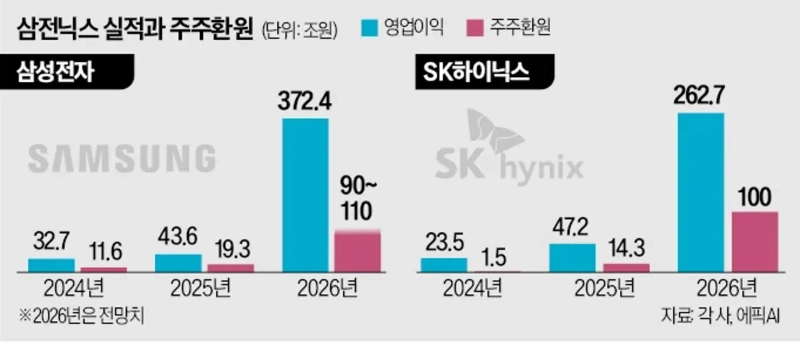
Samsung Electronics Co. and SK Hynix Inc. are preparing a record shareholder return program worth more than $152 billion. The move comes as the two companies’ combined operating profit this year is projected to reach a record $470 billion, driven by the artificial-intelligence chip boom. Both companies plan to use their strong profitability to return cash to shareholders, boost corporate value and support their stock prices.
According to industry officials on October 27, SK Hynix plans to announce additional shareholder return measures when it reports third-quarter earnings on October 28. The market expects the package to total about $43.4 billion, with roughly $21.7 billion earmarked for share buybacks and $21.7 billion for cash dividends. Including the $28.9 billion in share repurchases and cancellations the company carried out earlier, SK Hynix’s total shareholder return package is set to approach $72.3 billion. With annual operating profit projected to exceed $188 billion, the company would be returning about seven times last year’s $10.3 billion payout to shareholders. Separately, SK Hynix is also expected to buy an additional $7.2 billion of treasury shares to fund employee bonuses.
SK Hynix’s decision to unveil an aggressive return package reflects a judgment that supporting the stock and rebuilding shareholder trust have become urgent, according to industry observers. The company’s shares have come under pressure after controversy over a push to list its sub-subsidiary Solidigm in the U.S. Market participants view the latest plan as an attempt to deliver a stronger-than-expected catalyst.
Samsung Electronics is also pursuing a shareholder return plan worth as much as $79.5 billion. That would mark the largest such program by a listed South Korean company, more than five times the previous record of $14.7 billion set in 2020. Samsung is set to have its board approve a $21.7 billion cash dividend proposal on October 29, when it releases final third-quarter results. The rest of the shareholder return plan will be disclosed alongside first-quarter earnings next year.
Flush With Cash, Samsung and SK Expand Dividends and Buybacks to Appease Retail Investors
SK to Tap Kioxia Sale Gains; Samsung to Unveil Additional Return Plan Early Next Year
Samsung Electronics and SK Hynix were able to put forward outsized shareholder return plans because the AI semiconductor boom has sharply lifted their cash generation. Surging sales of high-value products including high-bandwidth memory, or HBM, are projected to lift the companies’ combined operating profit this year to about $470 billion.
That has created ideal conditions for both companies to pursue large cash dividends alongside share buybacks and cancellations, backed by ample cash on hand.
A key funding source for SK Hynix’s shareholder return is the sharp increase in free cash flow this year. The company previously said it would use more than 50% of free cash flow for shareholder returns. Brokerages estimate SK Hynix’s free cash flow this year at $130.1 billion to as much as $173.5 billion. It also plans to use gains from selling its stake in Japanese chipmaker Kioxia to fund cash dividends. SK Hynix earned close to $14.5 billion in pretax investment gains by gradually selling the Kioxia stake it acquired through a Bain Capital consortium in 2018.
Samsung Electronics is also relying on free cash flow to fund its shareholder return. Annual operating profit is forecast to reach $267.5 billion, which would likely produce the largest free cash flow in the company’s history. Brokerages estimate annual free cash flow at $190.2 billion this year. The market’s main focus is how Samsung will allocate the remaining $57.9 billion after the $21.7 billion cash dividend announced in August. Industry officials expect a large share of that remainder to be directed to share buybacks and cancellations. Large-scale buybacks are widely seen as the strongest tool for supporting a stock price, and Samsung may use them to confront concerns that its shares are undervalued. Samsung plans to disclose a detailed plan in January next year, when it reports fourth-quarter earnings.
There is also growing speculation that Samsung could strengthen the shareholder return framework itself. The company’s current three-year shareholder return plan for 2024 to 2026 expires this year. With SK Hynix having raised its benchmark from within 50% of cumulative free cash flow to more than 50%, Samsung may also lift its current 50% free-cash-flow guideline to above 50%.
“Despite record earnings growth, concerns in the market mean the two companies’ share prices are still failing to reflect their corporate value properly,” an industry official said. “This full-scale shareholder return push could become a decisive turning point in restoring market trust and prompting a rerating.”
Kim Chae-yeon, Noh Yoo-jung and Won Jong-hwan, Hankyung reporters why29@hankyung.com

Korea Economic Daily
hankyung@bloomingbit.ioThe Korea Economic Daily Global is a digital media where latest news on Korean companies, industries, and financial markets.