SK Hynix Says Three Years of DRAM, HBM Output Sold Out After Q3 Operating Profit Tops $60 Billion
Summary
- SK Hynix said it posted record results for a sixth straight quarter in the third quarter, with revenue of 104.6155 trillion won, operating profit of 83.3338 trillion won, and an operating margin of 79.7%.
- SK Hynix said demand growth centered on HBM, DRAM, NAND, and eSSD, along with long-term supply agreements (LTAs) with 14 customers, has effectively sold out its DRAM and HBM volumes for the three years through 2029.
- SK Hynix said it will pursue a shareholder return program worth 100 trillion won as prospects improve for achieving 300 trillion won in operating profit this year, including more than 30 trillion won in cash dividends and more than 60 trillion won in share buybacks and retirements.
Forecast Trend Report by Period


Q3 operating profit reaches 83.3338 trillion won ($60.4 billion), margin nears 80%
Long-term contracts with 14 big tech customers ease semiconductor peak-out concerns
Path clears for 300 trillion won ($217.2 billion) in annual profit; quarterly dividend set at 20,000 won a share
SK Hynix posted record quarterly results after third-quarter operating profit rose above 83 trillion won on surging demand for artificial intelligence memory chips such as high-bandwidth memory, or HBM. Quarterly revenue topped 100 trillion won for the first time. The company also said its HBM supply for the next three years is effectively sold out, pushing back against market concerns about a post-peak slowdown.
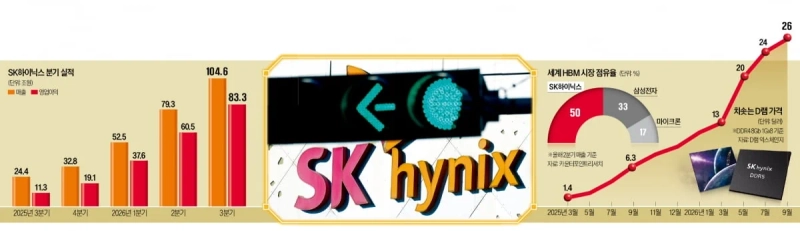
SK Hynix said on Oct. 28 that third-quarter consolidated revenue reached 104.6155 trillion won ($75.8 billion) and operating profit came to 83.3338 trillion won ($60.4 billion). Revenue jumped 327.9% from a year earlier, while operating profit surged 632.1%. Operating profit beat the market estimate of 77 trillion won ($55.8 billion). The operating margin rose to a record 79.7%, topping its previous high of 76.3% in the second quarter. Through the first nine months of the year, cumulative revenue was 236.5105 trillion won ($171.4 billion) and operating profit was 181.4867 trillion won ($131.5 billion). At that pace, annual operating profit could reach 300 trillion won ($217.2 billion).
HBM and enterprise solid-state drives, or eSSDs, were the main drivers of earnings. Rising AI investment by big tech companies lifted DRAM prices and expanded sales of higher-value products.
Mid- to long-term orders also increased. SK Hynix signed long-term supply agreements, or LTAs, with 14 major customers including big tech companies in the third quarter. Those contracts account for more than 50% of total production capacity for 2027 and 2028. The company said on Oct. 28 that its DRAM and HBM volumes for the three years through 2029 are effectively sold out.
In line with the record performance, SK Hynix said it will pursue shareholder returns worth 100 trillion won ($72.4 billion), including more than 30 trillion won ($21.7 billion) in cash dividends and more than 60 trillion won ($43.4 billion) in share buybacks and retirements.
Kwak Noh-jung, president of SK Hynix, said the company withdrew the planned listing of its U.S. subsidiary Solidigm because market volatility made it difficult to achieve the expected benefits. He added that SK Hynix will secure investment resources that support higher corporate value and shareholder returns.
SK Hynix Uses Numbers to Rebut AI Peak Fears, Says HBM Demand Is Twice Capacity
Q3 Revenue of 104 Trillion Won, Operating Profit of 83 Trillion Won Set Record
“There is talk that AI investment may be a bubble, but actual business results are coming through and the range of investors is broadening, so growth will continue.”
SK Hynix dismissed market concerns over an AI peak on an earnings conference call held on Oct. 28 after posting record quarterly results. The company also disclosed that it has signed five-year long-term supply agreements with 14 major customers, including big tech companies. It signaled that shortages in AI memory supply will continue through 2030. Based on firm medium- and long-term demand, SK Hynix plans to sharply increase investment next year to cement its lead in the global AI memory market.
Record Results for a Sixth Straight Quarter
SK Hynix said it posted third-quarter revenue of 104.6155 trillion won ($75.8 billion) and operating profit of 83.3338 trillion won ($60.4 billion). That was up 328% and 632% from a year earlier, respectively. It marked a sixth straight quarter of record results. Quarterly revenue exceeded 100 trillion won for the first time. The operating margin also hit a record 79.7%. That topped Nvidia’s 66.2% and Samsung Electronics’ 55.1%.
HBM was the biggest contributor to the strong performance. On the conference call, SK Hynix said profitability improved after it began full-scale shipments of sixth-generation HBM4 in the third quarter. As supply shortages deepened, HBM4 pricing was set higher than the previous-generation HBM3E.
AI server demand also lifted sales of conventional DRAM and NAND. Sales volume of server DDR5 rose more than 40% from the second quarter, making it a key driver of DRAM revenue. In NAND, the company improved profitability by focusing on higher-value products such as 321-layer triple-level cell, or TLC, enterprise SSDs used in AI servers. SK Hynix said third-quarter average selling prices rose by the high-20% range for DRAM and the mid-20% range for NAND from the previous quarter.
SK Hynix stressed that AI-driven memory demand remains strong. Park Jun-deok, head of DRAM marketing and a vice president at SK Hynix, said the company’s DRAM and HBM volumes for the three years through 2029 are effectively sold out. He added that customer requests for HBM exceed the company’s supply volume by more than two times.
The sellout reflects a rise in LTAs signed on five-year terms. As of the third quarter, SK Hynix had signed LTAs with 14 customers, including big tech companies. More than half of total production capacity for 2027 and 2028 is tied to LTA volumes. The company is also discussing longer contract terms with some LTA customers. It said the LTA portion will remain around half going forward.
The company also spent time addressing market concern over AI data-center investment. Kim Woo-hyun, chief technology officer at SK Hynix, said the global AI data-center infrastructure market will expand by an average 40% a year through 2030. In the short term, demand for enterprise and personal AI will grow. Over the medium to long term, demand for autonomous driving and physical AI will increase.
HBM4 to Become Main Product in Fourth Quarter
SK Hynix said earnings growth will continue in the fourth quarter. HBM4 is set to surpass HBM3E in both shipment volume and revenue, becoming the company’s flagship product. To support that shift, SK Hynix said it will maximize production capacity at its Cheongju M15X plant by year-end. It also plans to increase sales of higher-value DRAM products including server DDR5 and SoCAM, a low-power DRAM module for servers. The company expects fourth-quarter DRAM shipments to rise by the mid-20% range from the third quarter.
In NAND, SK Hynix plans to raise the share of its core 321-layer process to more than 50% of domestic NAND production capacity in the fourth quarter.
The company also unveiled its next-generation technology and product roadmap. SK Hynix said it supplied samples of seventh-generation HBM4E to customers in the second quarter. It also plans to speed up development of customized HBM products with different specifications for each customer, alongside standard HBM. The company said it will strengthen its NAND business for AI data centers through products including high-bandwidth flash, or HBF. SK Hynix is also set to begin full-scale domestic infrastructure investment next year, including the start of operations at the first semiconductor fab in Yongin.
Kim Chae-yeon, Won Jong-hwan and Noh Yoo-jung, Hankyung.com reporters why29@hankyung.com

Korea Economic Daily
hankyung@bloomingbit.ioThe Korea Economic Daily Global is a digital media where latest news on Korean companies, industries, and financial markets.