Lee Says Mandatory Tender Offer Rule Could Hurt Retail Investors if It Saps Capital-Market Vitality
Summary
- President Lee Jae-myung said excessive regulation tied to the mandatory tender offer system may not benefit retail investors if it weakens corporate restructuring and capital-market vitality.
- The ruling and opposition parties approved an amendment to the Capital Markets Act that would require an acquirer in an M&A deal to buy 50% plus one share of the issued stock, with the aim of letting retail shareholders also share in the control premium.
- Amid concerns that mandatory 100% share purchases could curb M&A, hurt stock-market dynamism, and complicate the privatization of HMM and Korea Aerospace Industries Ltd. (KAI), the Financial Services Commission and both parties are leaning toward passing the amendment in its original form.
Forecast Trend Report by Period


Put on hold after pushback from institutions and retail shareholders
Lee says a balance of interests must be found
Remarks bolster current bipartisan bill
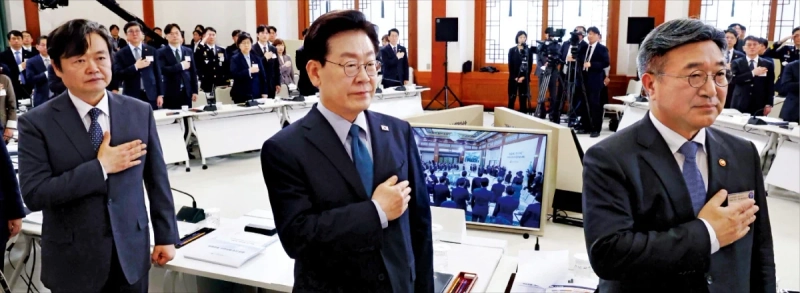
President Lee Jae-myung said on Oct. 28 that South Korea’s proposed mandatory tender offer system, whose passage at a National Assembly plenary session was put on hold after opposition from retail shareholders and institutional investors, may not benefit small investors in the long run if excessive regulation weakens corporate restructuring and saps capital-market vitality. Within the government, the remarks were seen as backing the current version of the bill agreed by the ruling and opposition parties.
In a post on X, formerly Twitter, Lee wrote that while the principle of equality among shareholders is important, it may not ultimately help retail investors if excessive regulation undermines corporate restructuring and the vitality of the capital market. He added that now is the time to seek broad input on how far the mandatory purchase ratio should go and how to meaningfully align the interests of controlling and minority shareholders.
The post appeared aimed at gathering views as debate intensified between the asset-management industry, which favors proportional purchases based on ownership stakes, and retail investors seeking mandatory purchases of 100% of shares. After laying out both sides’ arguments and limitations in detail, Lee asked what would constitute a reasonable balance.
Last month, the ruling and opposition parties approved an amendment to the Capital Markets Act at the National Assembly’s Political Affairs Committee that would require an acquirer in a merger or acquisition to buy 50% plus one share of the issued stock. The measure was one of Lee’s presidential campaign pledges and is intended to let retail shareholders also benefit from the control premium that has typically gone to controlling shareholders.
Lee’s references to concerns such as curbing corporate restructuring and healthy M&A activity, as well as hurting market vitality through excessive regulation, are being interpreted as support for moving the pending measure forward. Under the proportional-purchase approach favored by some in the asset-management industry, a controlling shareholder could end up unable to sell the full stake.
If lawmakers instead accept retail investors’ demand to require the purchase of 100% of shares, acquisition costs would balloon. That could make M&A more difficult and weaken stock-market dynamism. It would also make it harder to privatize HMM and Korea Aerospace Industries Ltd., or KAI.
The Financial Services Commission recently told the National Assembly that the amendment should be passed in its original form, according to people familiar with the matter. The regulator’s view is that a compromise bill crafted by both parties after hearing from various stakeholders, and already passed at the standing committee level, should not be changed at the plenary session.
“A new system needs to be introduced first,” a ruling party official said. “The ruling party’s view is that the mandatory purchase ratio should be raised after the system is in place.” Because Lee called for additional input, the bill is expected to go through further steps such as a parliamentary debate forum before being brought to a vote.
Kim Hyung-kyu and Han Jae-young, Korea Economic Daily reporters khk@hankyung.com

Korea Economic Daily
hankyung@bloomingbit.ioThe Korea Economic Daily Global is a digital media where latest news on Korean companies, industries, and financial markets.