SK Hynix Investors Cheer as CEO Kwak Takes Call, Unveils 20,000-Won-Per-Share Dividend [Kang Kyung-ju's Tech X]
Summary
- SK Hynix said it posted third-quarter revenue of 104.6155 trillion won and operating profit of 83.3338 trillion won, delivering an earnings surprise.
- The company said it would halt its review of a Solidigm IPO and pay a special dividend using gains from its Kioxia investment, including a 20,000-won-per-share dividend.
- SK Hynix said it plans about 100 trillion won in shareholder returns for the fiscal year, including more than 60 trillion won in share buybacks and cancellations.
Forecast Trend Report by Period


'Kwak No-jung showed a different side': SK Hynix retail investors give thumbs-up
Kwak makes first direct appearance on earnings conference call since taking office
Explains halt to Solidigm IPO review and shareholder return plan
Shareholders praise move, citing clear basis for management decisions
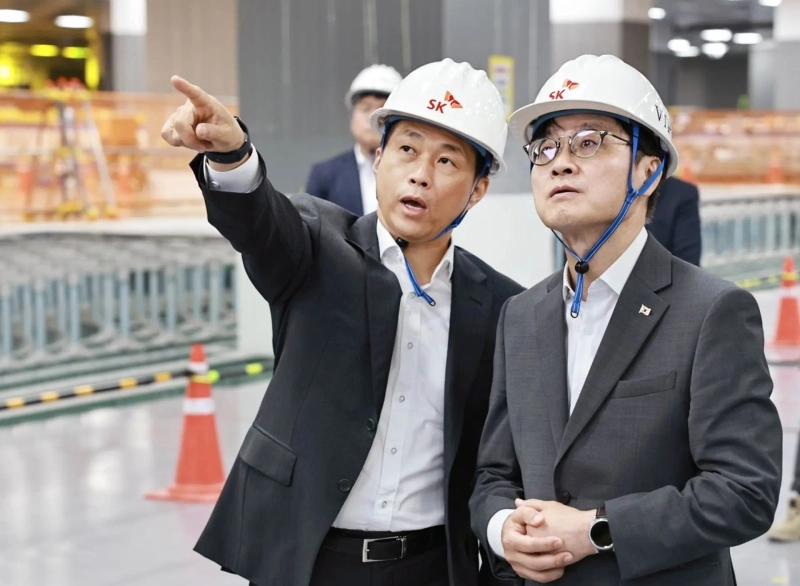
SK Hynix Chief Executive Officer Kwak No-jung appeared on the company’s earnings conference call for the first time since taking office. Unlike the previous quarter, when shareholders were frustrated by formulaic answers from the company, Kwak directly explained everything from the reasons for halting a planned initial public offering of Solidigm to returning gains from the company’s Kioxia investment and plans for share buybacks and cancellations. Shareholders welcomed the move, saying SK Hynix’s investor relations had changed because top management clearly laid out the basis for key decisions and its capital-allocation principles.
SK Hynix said on Oct. 28 that it posted third-quarter revenue of 104.6155 trillion won, operating profit of 83.3338 trillion won and net profit of 39.7756 trillion won. Its operating margin reached 80%, while net margin was 38%. Revenue topped 100 trillion won for the first time, and revenue and operating profit rose 32% and 38% from the previous quarter, respectively. The results amounted to an earnings surprise, driven by surging demand for memory chips amid expanding global investment in artificial intelligence. The average analyst estimate for operating profit had been about 77 trillion won.
By product, D-RAM growth was driven by the full-scale ramp-up of sixth-generation high-bandwidth memory, or HBM4, shipments and a sharp increase in server DDR5 sales. In NAND flash, sales of 321-layer enterprise solid-state drives expanded, extending growth across high-value products for data centers. The balance sheet also improved. Cash and cash equivalents stood at 114.5 trillion won at the end of the third quarter, up 26.5 trillion won from the previous quarter, while borrowings fell 2.8 trillion won to 15.8 trillion won. Net cash increased to 98.7 trillion won.
Still, what drew the most attention from shareholders was not the earnings but Kwak’s detailed explanation of company policy. On the conference call, Kwak said he wanted to address directly the company’s decision on a Solidigm listing, which had drawn strong market attention. After considering volatility in financial markets and a correction in semiconductor shares, the company decided to halt its review of a Solidigm IPO.
He said SK Hynix had expected a Solidigm IPO to ease its investment burden by tapping outside capital and to expand room for shareholder returns. The company will pursue investment in Solidigm and financing plans in ways that support the corporate value of both Solidigm and SK Hynix, as well as shareholder value.
SK Hynix disclosed on Oct. 23 that it would stop reviewing both a pre-IPO financing round and an IPO for Solidigm. Concerns had spread that listing the unit could damage shareholder value at the parent because of an overlapping listing. At the time, SK Hynix said it needed to reassess whether a Solidigm IPO would benefit existing shareholders, given capital-market conditions and share-price moves.
Kwak also laid out a plan to return gains from the Kioxia investment through a special dividend. He said gains realized this year from the Kioxia investment would be returned to shareholders as a special dividend. He added that the company has long made it a principle to share most of the proceeds with shareholders when strategic investments bear fruit.
SK Hynix realized gains from the investment in June, when Bain Capital sold its stake in Kioxia and the company fully recovered its fund contribution. In 2018, SK Hynix joined a Bain-led consortium and invested a total of 395 billion yen in Kioxia, then known as Toshiba Memory, through a mix of fund contributions and purchases of convertible bonds. Industry estimates put the profit from the fund investment at about 20 trillion won.
SK Hynix said it would first pay about 7 trillion won of those Kioxia investment gains as a special dividend in the third quarter, equal to 10,000 won a share. The rest will be included in the year-end dividend after this year’s investment gains are finalized. The total amount to be returned through the special dividend has not yet been set. Added to a 10,000-won-per-share dividend reflecting improved operating performance, the third-quarter dividend was set at 20,000 won a share, or about 14 trillion won in total.
Including the third-quarter dividend, SK Hynix is pursuing about 100 trillion won in shareholder returns for the fiscal year. That includes more than 30 trillion won in cash dividends and more than 60 trillion won in share buybacks and cancellations. First- and second-quarter dividends came to about 265.8 billion won and 273.3 billion won, respectively, for a total of about 539.1 billion won. Based on the annual cash-dividend target, and excluding first-half dividends and this latest roughly 14 trillion won payout, the additional fourth-quarter dividend is estimated at more than 15 trillion won.
The plan for more than 60 trillion won in share buybacks and cancellations includes the 40 trillion won announced in August. That buyback was completed last week and is set to be canceled soon. On Oct. 28, the board also approved an additional 20 trillion won in share repurchases. Of that amount, 10 trillion won will be canceled in full for shareholder returns, while the remaining roughly 10 trillion won will be used for employee compensation. Shares acquired for employee compensation are excluded from the annual shareholder-return total. Given the annual target, the company is expected to announce at least another 10 trillion won in share buybacks and cancellations in the fourth quarter.
The company has also nearly reached the financial-soundness target it presented at its shareholder meeting in March. At the time, Kwak said SK Hynix aimed to secure 100 trillion won in net cash to ensure stable funding for investments needed for future growth. At the end of the third quarter, SK Hynix held 114.5 trillion won in cash and cash equivalents and had 15.8 trillion won in borrowings. Net cash, calculated by subtracting borrowings from cash and cash equivalents, stood at 98.7 trillion won, up 29.3 trillion won from the previous quarter.
In his closing remarks on the conference call, Kwak said the rewards shared with shareholders should grow as the business expands and investment gains accumulate. He said the shareholder return plan announced that day reflected that principle. He added that the company would continue to build trust in its future growth through steady earnings and share the results with shareholders.
One shareholder who said he listened closely to the conference call praised the change in tone. During the previous quarter’s earnings call, the company had repeatedly said only that matters were under review, under discussion or not yet decided, without presenting conclusions or a concrete timetable on key issues, the shareholder said. The investor added that it was disappointing for a company at the top of the global semiconductor industry. This time, however, top management directly explained everything from the reasons for halting the Solidigm listing to the special dividend and the share buyback and cancellation plan.
Another shareholder said the call was meaningful because it went beyond presenting figures and laid out the company’s capital-allocation principles and direction for shareholder returns. Hearing the chief executive directly explain the decision to halt the Solidigm IPO and the policy for returning profits from the Kioxia investment made it easier to understand the basis for management’s decisions, the investor said.
The shareholder added that it was also positive to hear Kwak explain major issues in a specific and consistent tone. For shareholders, the investor said, it is just as important as strong earnings that management accurately understands the company’s business and financial position and clearly presents future plans. Those points were much clearer than before. The stock also reacted. According to Epic AI, an AI-based investment information platform, SK Hynix closed regular trading on Oct. 28 at 1.487 million won, up 10.89% from the previous session.
Kang Kyung-ju, Hankyung.com reporter memory@hankyung.com

Korea Economic Daily
hankyung@bloomingbit.ioThe Korea Economic Daily Global is a digital media where latest news on Korean companies, industries, and financial markets.