Warsh Holds Fed Rate at 3.75%-4% Despite High Inflation; December Hike Bets Grow
Summary
- The Federal Reserve held its benchmark interest rate at 3.75% to 4%, increasing the likelihood of a rate hike at the December FOMC meeting.
- The FOMC said U.S. economic activity is expanding at a strong pace and reaffirmed its priority on price stability over employment.
- Warsh said policy uncertainty persists, citing a reduction in the number of FOMC rate decisions starting next year, ongoing discussions on balance-sheet runoff, and an 80% probability of a 0.25 percentage-point increase in December.
Forecast Trend Report by Period


Fed Pauses Rate-Hike Campaign Ahead of U.S. Midterm Elections
'Need More Data Before Setting Policy Path'
Rate Decisions to Be Cut From Eight a Year to Seven, Then Six
'I’m More Interested in the Korean Economy Than You Think'
Calls BOK Governor Shin 'a Very Capable Person'
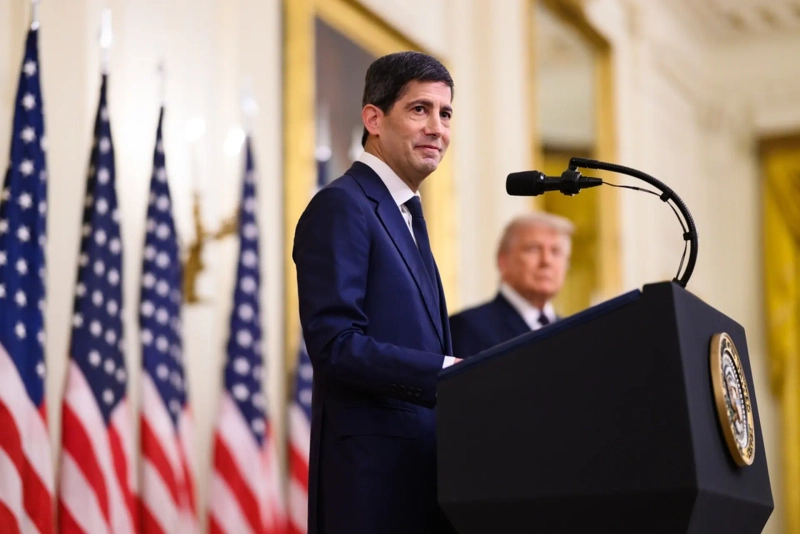
The Federal Reserve left its benchmark interest rate unchanged at 3.75% to 4% at the Oct. 28 Federal Open Market Committee meeting. After raising rates by 0.25 percentage point last month, the central bank paused its run of increases. Fed Chair Kevin Warsh said at a press conference that the FOMC would gradually reduce the number of rate decisions starting next year.
'U.S. Economy Expanding at a Strong Pace'
The decision to hold rates steady was approved by 10 of the FOMC's 12 members. Fed Governor Lisa Cook and Cleveland Fed President Beth Hammack supported another 0.25 percentage-point increase. In its policy statement, the committee said U.S. economic activity was "expanding at a strong pace." That was a stronger formulation than the "solid pace" used in the September statement.
The Fed also offered an upbeat assessment of the broader economy. It said domestic spending continues to recover despite elevated geopolitical uncertainty, while productivity growth remains strong and capital investment solid. The committee also said job gains are keeping pace with labor-supply growth, leaving the unemployment rate little changed. The language underscored the Fed's focus on price stability over employment and fed market expectations for a rate increase at the December FOMC meeting.
Still, the statement newly added language saying that "the accumulation of additional information" would help determine the policy stance. The change indicated the Fed would calibrate its next move after reviewing a broader set of economic and inflation data. Warsh said the recent rise in short-term inflation expectations reflected consumers closely watching current conditions. Over a longer horizon, most households, businesses and financial markets remain confident that the central bank will achieve price stability, he added.
Warsh also announced changes to the Fed's policy process, including FOMC meetings with no rate decision starting next year. The committee now meets eight times annually, and he said that remains an appropriate number. But there is no need to set rates at every meeting, he said. One of the eight meetings next year will be devoted solely to broader monetary-policy strategy, with no vote on interest rates and no policy statement. By 2028, the number of meetings with rate decisions will be reduced to six.
Warsh Signals Interest in South Korea's Economy
Market reaction was muted. U.S. stocks closed slightly lower as weak earnings from Google parent Alphabet weighed on sentiment. The 10-year Treasury yield briefly fell below 5% after the Fed's decision before returning to around that level. Some criticism also emerged over the decision to leave rates unchanged ahead of the Nov. 3 U.S. midterm elections. The probability of a 0.25 percentage-point increase at the December FOMC meeting rose to about 80%.
Warsh also drew notice by expressing deep interest in South Korea's economy, which is closely tied to the semiconductor industry. Responding to a Korea Economic Daily question about the impact of balance-sheet reduction on overseas dollar-funding markets, including South Korea's, and on institutions holding U.S. Treasuries, Warsh said he is "more interested in the Korean economy than you think."
He explained that much of the supply chain linked to the recent rapid growth in the technology sector comes from South Korea and Japan, with some from Singapore. He added that conditions in the South Korean economy help show what kinds of goods are headed to the U.S. His remarks suggested that growth in artificial intelligence and trends in U.S. capital spending are closely intertwined with developments in South Korea.
Warsh also spoke about his ties with Shin Hyun-song, governor of the Bank of Korea. "He is a very capable person and a good friend," Warsh said. "I'm glad he has that job." He recalled that the two had extensive discussions 20 years ago during the global financial crisis about how central banks could use their balance sheets. On balance-sheet reduction, Warsh said a dedicated task force is handling the issue and will deliver its conclusions and recommendations to the FOMC early in the first quarter of next year.
Washington=Lee Sang-eun / New York=Hwang Jung-su, Korea Economic Daily correspondents selee@hankyung.com

Korea Economic Daily
hankyung@bloomingbit.ioThe Korea Economic Daily Global is a digital media where latest news on Korean companies, industries, and financial markets.