Samsung Electronics Falls 4% Despite Reaffirming Up to $79.2 Billion Shareholder Return Plan
Summary
- Samsung Electronics said it had reaffirmed a shareholder return plan worth as much as 110 trillion won ($79.2 billion), but investor disappointment grew because it did not provide a specific timeline or the size of any treasury share cancellation.
- Samsung Electronics fell 4.13% and Samsung Electronics preferred shares lost 3.26%, showing that expectations for shareholder returns failed to lift the stock price.
- By contrast, SK Hynix began its share buyback immediately and closed 2.62% higher, while foreign investors were net buyers of SK Hynix and net sellers of Samsung Electronics and Samsung Electronics preferred shares.
Forecast Trend Report by Period


No Change From Previously Announced Amount
Treasury Share Cancellation and Other Details to Be Unveiled in January
Samsung Electronics Co. shares tumbled more than 4% after the company reaffirmed on a conference call a shareholder return plan worth as much as 110 trillion won ($79.2 billion). Investors were disappointed because the update included neither a detailed timeline nor the size of any treasury share cancellation. The Kospi index also fell back below 6,000 after just one day.
On Oct. 29, Samsung Electronics said, as it released final third-quarter results, that 55 trillion won to 75 trillion won ($39.6 billion to $54.0 billion) remained available for shareholder returns. Combined with regular first-half dividends of about 5 trillion won ($3.6 billion) and a third-quarter dividend confirmed that day of 30 trillion won ($21.6 billion), total shareholder returns would reach as much as 110 trillion won, matching the level the company had previously indicated. The third-quarter dividend was 4,601 won per common share.
But the company did not provide a specific schedule or details on additional shareholder returns. Samsung Electronics said it was holding in-depth discussions on new shareholder return measures for next year and beyond to achieve both sustained growth and stronger shareholder value. It also said it planned to buy back and cancel a substantial amount of treasury stock alongside cash dividends. Addressing the recent price gap between common and preferred shares, the company added that it would actively consider adjusting the proportion of preferred shares in any buyback and cancellation to reflect market conditions.
Samsung's reaffirmation of a large shareholder return plan was not enough to satisfy investors. The announced amount matched what the market already knew, and the company also maintained its decision to disclose specific measures, including treasury share cancellations, in January.
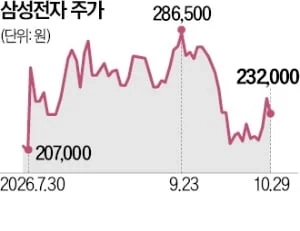
The stock's moves on Oct. 29 reflected that disappointment with the conference call. Samsung Electronics closed down 4.13% at 232,000 won. The shares had risen nearly 3% early in the session to as high as 249,000 won on hopes that shareholder returns could be increased or brought forward. But they reversed course around the start of the 10 a.m. conference call and at one point fell as much as 6% intraday. Samsung Electronics preferred shares closed down 3.26% at 183,900 won.
The move contrasted with SK Hynix Inc., which began buying back shares immediately on Oct. 29 after announcing its shareholder return plan the previous day. SK Hynix rose 2.62% to close at 1.526 million won. Foreign investors bought a net 448.3 billion won ($323 million) of SK Hynix shares, while selling a net 139.4 billion won ($100 million) of Samsung Electronics and 213.4 billion won ($154 million) of Samsung Electronics preferred shares.
The Kospi failed to hold the 6,000 level as Samsung Electronics, the market's largest company by market capitalization, slumped. The benchmark closed down 1.24% at 5,937.66. The Kosdaq also fell 2.34%.
Kang Jin-kyu, Hankyung.com reporter josep@hankyung.com

Korea Economic Daily
hankyung@bloomingbit.ioThe Korea Economic Daily Global is a digital media where latest news on Korean companies, industries, and financial markets.