Voters in 10 US States to Decide on Data Center Curbs, Threatening Amazon Investment
Summary
- Referendums in 10 US states on whether to impose limits on AI data center development could affect related companies.
- If rules are tightened, delays in data center construction could hurt revenue at semiconductor and power equipment companies.
- Some, however, say stricter rules would ultimately have little impact because developers are likely to move projects to other regions.
Forecast Trend Report by Period


Referendums on New Approvals Set for Election Day
Majorities of Democratic and Republican Voters Oppose
Chip Sales at Risk if Projects Are Delayed
Nov. 3, when the US holds its midterm elections, will also be a key date for companies tied to the artificial intelligence supply chain. Voters in 10 states are set to weigh restrictions on AI data center development. If they opt for tighter rules, delays to data center construction could hit companies tied to semiconductors and power equipment.
Reuters and other media outlets reported on Oct. 29 that at least 41 ballot measures on data center development will go before voters in 38 localities across 10 states on Nov. 3. Ohio, one of the fastest-growing states for data center construction in the US, accounts for 21 of the measures.
The main proposals would limit construction scale as well as electricity and water use. Sunbury and Piqua, Ohio, will decide whether to ban new data centers with power demand exceeding 25 megawatts. Emporia, Kansas, has put forward a measure to prohibit facilities with power demand above 10 megawatts or daily water use of about 380,000 liters. Edgewater, Florida, will vote on a plan to bar the approval, construction, expansion and operation of new data centers.
Public opinion points to a high chance that many of the measures will pass. A survey by the University of Pennsylvania's Annenberg Public Policy Center found that 69% of Democratic supporters and 54% of Republican supporters opposed data center construction in their communities. In six referendums held through Oct. 28, measures favoring development limits prevailed in every case. Residents are worried that the costs and disruption they would bear outweigh the economic benefits for local communities.
That could affect large projects by Amazon and Meta. Amazon is pursuing a $2 billion data center project in Sunbury. In Piqua, where Meta is planning a facility, requests have been made for phased electricity supply of as much as 140 megawatts through 2033.
Project delays could also weigh on chipmakers' revenue. Deloitte said in a February report that if data center construction delays tied to permitting issues drag on, the semiconductor industry's results in 2027 and 2028 could be weaker than originally forecast. Memory and advanced packaging could be hit especially hard.
Others see the fallout as limited. Barron Fung, research vice president at market research firm Dell'Oro Group, said stricter rules on data center construction would more likely prompt developers to move projects elsewhere than abandon them altogether.
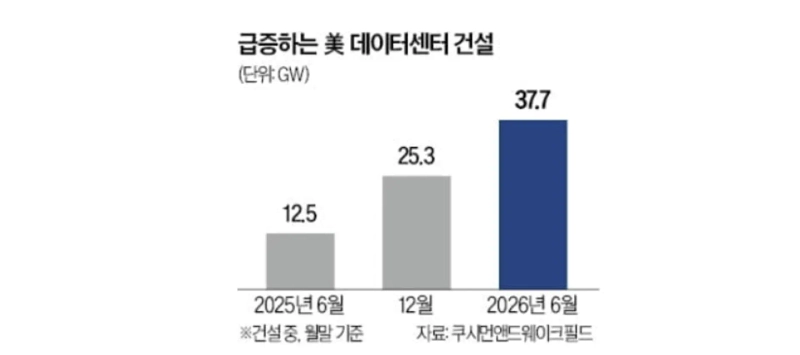
Data center construction continues to expand across the US. Real estate consulting firm Cushman & Wakefield said the power capacity of data centers under construction in the country, measured in gigawatts, rose 48% in the first half of this year from the previous six months.
Son Ju-hyung, Hankyung.com reporter handbro@hankyung.com

Korea Economic Daily
hankyung@bloomingbit.ioThe Korea Economic Daily Global is a digital media where latest news on Korean companies, industries, and financial markets.