Three Days Before US Midterms, Trump Risks a ‘Super Lame Duck’ Phase: Washington Now
Summary
- If the Democratic Party retakes both the House and Senate in the US midterm elections, President Trump’s grip on government could weaken, undermining momentum across economic and foreign policy, including relations with allies and tariff policy.
- If Congress strengthens its control over the budget and appointments, uncertainty could grow around weapons support for Ukraine and Taiwan, the Alaska LNG project, shipbuilding reconstruction through MASGA and other policies linked to South Korea.
- If Democrats’ advantage in the governor’s races materializes, federal decisions on mail-in and early voting rules and immigration enforcement could face limits at the state level, increasing risks for future elections and policy execution.
Forecast Trend Report by Period


If control of Congress changes hands
Budget and appointments could become repeated obstacles
Even joint South Korea-US projects may be affected
The US midterm elections that will determine President Donald Trump’s grip on government are now three days away. Democrats are widely expected to retake the House, and forecasts are increasingly pointing to a possible Senate flip as well. Trump’s repeated visits to Texas and Kansas, long considered Republican strongholds, are themselves being seen as a sign of anxiety within the party.
If Democrats deliver a decisive showing in this election, Trump stands to enter another lame-duck phase after a similar stretch in his first term. Cracks could also begin to emerge more clearly between the president and Republican lawmakers who have so far largely moved in lockstep with him. That would threaten momentum across the economic and foreign-policy agenda he has driven, including ties with allies, major wars and tariff policy.
◆ Will the Senate Flip to Democrats?
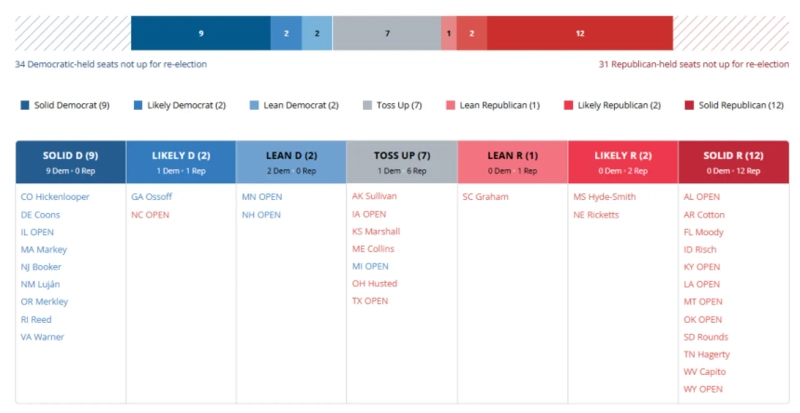
Major election forecasters including Cook Political Report said on October 29 that control of the Senate will likely be decided by seven battleground races still within the margin of error. The most closely watched states are Alaska, Ohio, Iowa, Michigan, Texas, Kansas and Maine. Because one North Carolina seat now held by Republicans is all but certain to flip to Democrats, the party would need to win just three of those seven races to take the chamber, 51 seats to 49.
The Democratic upswing that gathered force last month has not faded in the closing stretch of the campaign. Major polls are showing a further tilt toward Democrats ahead of Election Day. In the generic House ballot, Democrats lead by 8 to 9 percentage points depending on the pollster. RealClearPolitics showed Democrats ahead by 8.2 points, Fifty Plus One by 9 points and Decision Desk HQ by 8.1 points.
That has fueled analysis that Democratic support may have been underestimated this year, unlike in the presidential election two years ago. On betting platforms including Kalshi and Polymarket, the implied probability of Democrats retaking the Senate climbed as high as 68%. Trump rejected that view. Campaigning in South Carolina, he said, “They didn’t do polls. They made up numbers.”
◆ Budget and Appointment Headwinds Ahead
Trump is not expected to make a 180-degree turn on policies such as tariffs or a war with Iran based on the midterm result alone. But if Republican lawmakers, who have largely acted as rubber stamps under his tight control since he took office, begin speaking out more openly, the administration’s agenda will be harder to carry out at the pace it once did.
Trump’s approval rating, already down in the low 30% range, is another factor that could prompt Republican lawmakers to keep their distance. ABC reported that his net approval rating is the lowest for any president heading into a midterm election since World War II.
Congress’s strongest tools for constraining the executive branch are the budget and personnel appointments. Trump used the first-year budget reconciliation process and what he called the “One Big Beautiful Bill Act,” or OBBBA, to secure funding for major policy priorities. That option is now set to become far harder to use. It may become more difficult for him to build projects such as the Golden Dome or a “Golden Fleet” into the defense budget. Spending tied to weapons support for Ukraine, arms sales to Taiwan and the costs of a war with Iran is also set to come under closer congressional scrutiny. Policies linked to South Korea, including the Alaska liquefied natural gas project and shipbuilding reconstruction through MASGA, may also face greater uncertainty.
The chances are also increasing that key appointments could remain vacant for extended periods. Democrats are already discussing the impeachment of Defense Secretary Pete Hegseth. That raises the prospect of a replay of Trump’s first administration, when frequent personnel changes and internal power struggles fueled turmoil and sapped momentum from the governing agenda.
◆ Democrats Also Lead in Governor’s Races
Democrats also hold a clear advantage in gubernatorial races. Cook Political Report said the party could win a majority of governorships, at least 26, for the first time since 2010. Governors do not directly shape federal policymaking in the way Congress does. Even so, it would be a painful setback for Republicans, who had hoped to push more aggressive gerrymandering ahead of the next presidential election in two years.
Governors and state legislatures also wield significant influence over rules for mail voting and early voting, disputes over election results and the enforcement of immigration crackdowns. That means even when decisions are made at the federal level, implementation at the state level may not proceed smoothly. If Trump’s grip weakens, the odds also rise that major federal courts and the Supreme Court could put the brakes on what the article describes as overly aggressive Republican agenda-setting.
Still, expectations for Democrats to retake both chambers of Congress have risen enough that any other outcome could deal a fresh blow to the party leadership, whose standing is already shaky, and trigger infighting. NBC said even a narrow Democratic House victory would “increase the risk of losing it back again in the 2028 election.”
Lee Sang-eun, Washington correspondent, Hankyung.com, selee@hankyung.com

Korea Economic Daily
hankyung@bloomingbit.ioThe Korea Economic Daily Global is a digital media where latest news on Korean companies, industries, and financial markets.