SOXL, a Favorite of Korean Retail Traders, Plunges 25%; Wall Street Waits for Rebound Signal
Summary
- A record wave of money flowed into leveraged SOXL, and Intel’s plunge combined with leveraged ETF rebalancing selling to deepen losses in semiconductor and technology stocks.
- Morgan Stanley said the correction is 80%-90% complete despite worsening FCF deterioration at AI companies and heavy fundraising needs, while maintaining its S&P 500 year-end target of 8,000.
- Brokerages in South Korea and abroad said November could be a buying month, citing the U.S. midterm elections, a lower probability of a Fed rate hike, and ongoing deleveraging, while adding that investors still need to watch for variables because further declines remain possible.
Forecast Trend Report by Period


Doubts grow over the lag between Big Tech earnings and cash returns
3x semiconductor leverage drew dip buyers
and deepened the selloff
Hedge funds cut positions the most in a decade
Morgan Stanley says the correction is 80%-90% complete
DS Securities says November is a month to buy, but adds
that further losses remain possible
What investors need to watch for a rebound
The U.S. stock bought most heavily by South Korean investors in October was SOXL, a leveraged exchange-traded fund that tracks three times the daily return of a semiconductor index. The fund, which attracted money from investors betting on a rebound, plunged 24.75% in a single session on Oct. 30.
The Philadelphia Semiconductor Index fell 7.2% that day. The Nasdaq dropped 2.86%, and the S&P 500 lost 1.82%. The slide came after the Kospi had already tumbled 3.5%.
Intel delivered the biggest shock. The company warned that PC demand was weakening because of memory shortages and surging prices, and that server CPU supply was being constrained by a shortage of advanced package substrates. Its shares sank 28.6%, the biggest one-day drop in the company’s history. The rout followed Alphabet’s $500 billion one-day loss in market value and Amazon’s report of a free-cash-flow deficit that had widened more than fivefold, turning the session into a Black Friday for mega-cap tech.
There is little doubt that the latest round of Big Tech earnings revived questions about the durability and profitability of AI spending. But fundamentals alone did not explain the scale of the selloff. Leveraged ETFs that drew fresh money on every dip also triggered mechanical selling as prices fell, pushing down the underlying shares in another episode of the market’s tail wagging the dog. The pattern echoed the sharp selloff seen in South Korea in July.
Doubts flare again over when AI investment will pay back
Even in the disappointing Big Tech results, there was little evidence that AI demand had cracked. Google Cloud revenue rose 103%, Microsoft Azure grew 48%, and Amazon Web Services climbed 39%, its fastest growth rate in five years. AWS said a large share of its capacity through 2028 was already sold out, and projected growth of more than 40% in both 2027 and 2028, well above Wall Street consensus of 35% and 30%.
JPMorgan projects Google Cloud revenue will surpass Alphabet’s search business, now its largest source of revenue, by the first half of 2028. Microsoft Chief Executive Officer Satya Nadella said he had never been more confident in long-term investment returns, citing the demand the company is seeing, the competitiveness of its products and efficiency gains across the business.
The problem is the lag between demand and the point at which it turns into revenue and cash. Capital spending must come first. Then comes the wait to secure power and equipment, deliver services to customers and collect payment. As investment rises, so does the funding needed to bridge that gap.
Amazon’s free cash flow deficit over the past 12 months widened to $42.4 billion from $7.6 billion, based on second-quarter figures. Microsoft, the only company in the group to remain free-cash-flow positive, still saw FCF fall 27% from a year earlier. As more companies spend more on capital investment than they bring in from their core operations, access to outside financing is becoming more important.
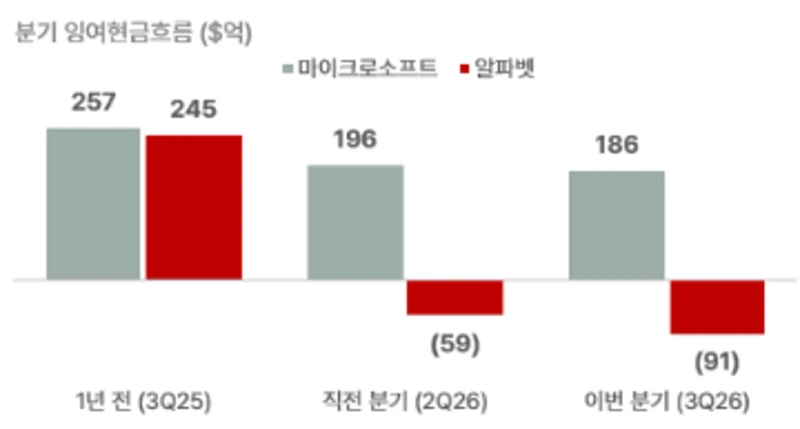
Alphabet’s sharp decline was also driven by free cash flow that came in weaker than the market expected, at negative $9.1 billion. That was compounded by a paradox at the center of its AI push: the more it leans into AI, the more its biggest cash cow, search, comes under pressure. Google Search revenue growth slowed to 12% from 17% in the second quarter, missing even the lowered market bar of 13.5%. The company also acknowledged that advertising monetization in AI Mode is lower than in traditional search.
Alphabet said the deterioration in free cash flow was temporary and reflected inventory building as orders for tensor processing units piled up. The market showed little patience. JPMorgan wrote that the episode underscored how narrow the market’s margin for error becomes when hyperscalers are spending hundreds of billions of dollars on AI infrastructure, free cash flow has turned negative, and core-business results also disappoint.
Signs of tighter funding conditions are appearing elsewhere. The Financial Times reported that OpenAI cut its fundraising target to $20 billion from $30 billion after some investors reduced their commitments, and lowered its valuation target to $1.25 trillion from $1.4 trillion. Blackstone told investors it expects Anthropic to receive a speculative-grade credit rating near the top of junk territory, in the BB range, after it goes public. That marked a step down from its earlier expectation that the company could reach investment grade, or BBB-, before 2027.
When the tail wags the dog
Selling pressure on already vulnerable technology stocks was amplified by leveraged ETFs. Bloomberg reported that a record $7 billion flowed into SOXL this month. That means money kept piling into triple-leveraged bets on a semiconductor rebound every time the market dipped. Using a different methodology, Korea Securities Depository said South Korean investors’ net purchases of SOXL in October reached $2.96785 billion on a settlement basis.
Leveraged ETFs are structured to sell more on days when their underlying index falls. They need to reset their exposure near the close each day. A 3x ETF would need to cut exposure by more than 40% of assets on a day when the index drops 7%. That can lead to futures selling or hedge adjustments by swap counterparties, adding to downside pressure in a falling market.
Oct. 30 was exactly that kind of day. Intel is also the second-largest holding in major semiconductor ETFs. Tier One Alpha said during the session that Intel’s plunge could spread selling across the broader index through SOXL rebalancing. By the close, estimated rebalancing-related selling from leveraged ETFs topped $40 billion, including $19.2 billion tied to semiconductor indexes and $14.6 billion tied to the Nasdaq 100. On Wall Street, traders said those flows deepened declines in the underlying shares and left some tech-focused funds nursing heavy losses.
Hedge fund losses and risk reduction were already underway before that day’s crash. JPMorgan’s client data showed hedge funds had lost 3.3% this month through last week, and long-short funds had their worst relative performance against the market since early 2021. Steno Research said gross exposure at equity long-short hedge funds had fallen 7.8% from its peak as of Oct. 27. That was the biggest position reduction since the data series began in 2016. When investors crowded into the same names cut risk at the same time, selling can feed on itself regardless of underlying corporate value.
Seen another way, part of the latest selloff reflected positioning rather than fundamentals. The equal-weight S&P 500 ETF fell just 0.8% that day, far less than the headline index, which is heavily influenced by mega-cap technology stocks. Over the full month of October, the equal-weight index was still up nearly 5%. That suggests this was less a collapse in the broader equity market than a withdrawal of money from a crowded corner of it. Once excessive leverage is cleared out, that kind of selling pressure can fade.
Morgan Stanley says the correction is 80%-90% complete; three hurdles remain
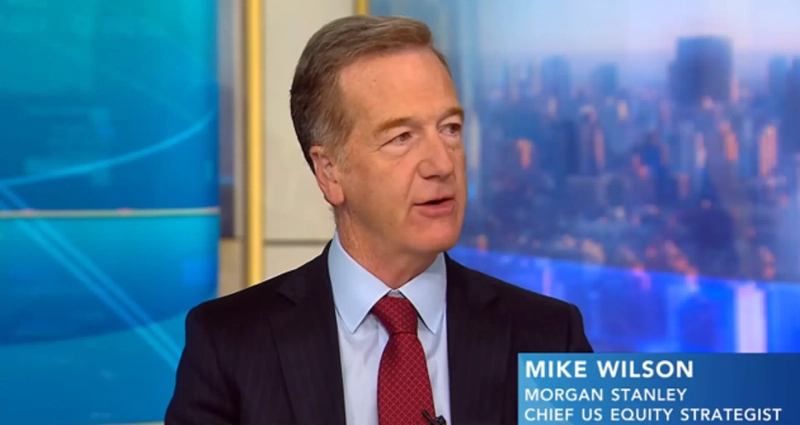
Mike Wilson, Morgan Stanley’s chief investment officer, has made a similar case for why the correction may be in its late stages. In an interview on Oct. 27, before Alphabet reported earnings, he said the pullback that began in June was 80% to 90% complete.
He stopped short of calling a bottom. Investor sentiment had not yet reached an extreme, and a final leg lower could still hit the large-cap stocks that had held up until now. On Oct. 26, he said the Philadelphia Semiconductor Index could fall another 10% to 15% by mid-November, and put S&P 500 support at 7,100 to 7,200. That is 5% to 6% below the Oct. 30 close of 7,580.07. Part of that warning became reality just three days later.
Even so, Morgan Stanley has kept its year-end S&P 500 target at 8,000. The firm’s view is that corporate earnings remain solid and interest rates are stabilizing lower, so an extreme deterioration in sentiment could turn into a buying opportunity.
Wilson pointed to three events that could trigger a rebound: the end of the midterm elections, the market’s absorption of remaining AI fundraising supply, and a signal of easier liquidity from the Federal Reserve or the Treasury Department.
He said the market’s process of digesting bond and equity issuance from AI companies is roughly in the seventh or eighth inning. More supply could still jolt the market if additional fundraising comes, but Morgan Stanley sees the overall amount as absorbable. One example was Meta’s recent $22.5 billion common-stock sale, which drew orders five times the amount on offer and led the company to increase the deal size by 10%.
Liquidity is what Wilson is watching most closely. If stress in credit markets worsens at a time of high rates and strong funding demand, he believes the Fed or the Treasury could respond.
His historical comparison is 2018. That year, the Fed was still tightening, and after the November midterm elections the S&P 500 plunged nearly 15% by Christmas Eve. In January of the following year, then-Fed Chair Jerome Powell strongly signaled the end of the tightening cycle in an effort to calm markets. Stocks then surged.
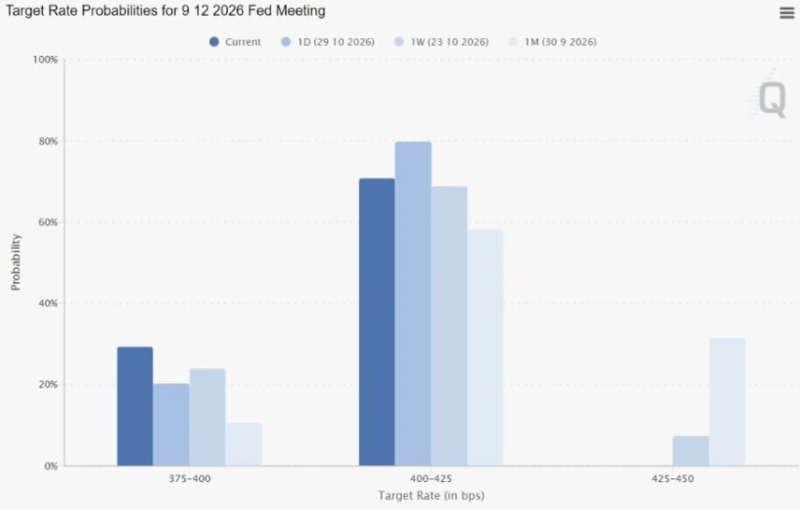
Wilson argues that something similar could happen again, though he does not know what form it would take. At the Federal Open Market Committee meeting on Oct. 28, Fed Chair Kevin Warsh again suggested caution on further rate increases, saying policymakers should not throw sand into the engine of growth. After the Oct. 30 equity selloff, the probability of a December Fed rate increase implied by fed funds futures fell to 70% from 84%.
What the midterm elections could mean for markets
Many investors are waiting for the U.S. midterm elections on Nov. 3. On Wall Street, the dominant view is that even a Democratic sweep of both chambers would have only a limited market impact. Much of that outcome is already priced in. On prediction markets, the odds of Democrats taking the House are above 90%, while their chances of winning the Senate are in the mid-60% range.
Morgan Stanley’s policy team said that even if the opposition wins the midterms, overturning a presidential veto would require a two-thirds majority, which looks difficult. If President Donald Trump uses his veto power, it would be hard to reverse the broad direction of policy on tariffs, tax cuts and deregulation. The team also said that even under a Democratic victory, a full halt to AI data-center regulation concerns is unlikely because of competition with China.
In a market that may already reflect a worst-case scenario, the end of the election itself could be positive. Scott Rubner, head of equity and equity-derivatives strategy at Citadel Securities, said on Oct. 22 that most institutional clients are delaying purchases because they see the midterms as a clearing event for uncertainty. Historical data also support that view. BlackRock said the S&P 500’s average six-month return after midterm elections since 1970, including dividends, has been 14.1%, more than double the 5.7% average in non-election years.
History, though, is only history. JPMorgan said in its outlook last week that a post-election rally would require strong Big Tech earnings. So far, the results have not been good enough.
Iran remains another variable. The Wall Street Journal reported that the U.S. had told Gulf states to prepare for a short, intense military operation after the election. On Oct. 30, front-month Brent crude climbed to $117.6 a barrel, near this year’s high, after news that a tanker had been attacked in the Strait of Hormuz. If oil rises again, inflation worries and expectations for additional tightening could increase, raising funding pressure once more on companies pouring money into AI.
If the Middle East stabilizes instead, the war premium in oil could unwind and deliver the kind of clearing event the market has been waiting for.
Further downside is possible; what to watch for a rebound
South Korean brokerages are also starting to call for a reversal. Yang Hyung-mo, head of investment strategy at DS Securities, said on Oct. 31 that November is a month to buy, citing easing pressure from margin trading in South Korea and more stable U.S. interest rates. He said the U.S. midterm elections, Nvidia earnings, Anthropic’s listing and the completion in December of Zhongxin’s review of the Texas power grid would also support stocks. In his view, peak fear has largely passed and the bear market is nearing its end.
Even he struck a cautious note. Memory prices could further hurt demand, and the possibility of another Iranian strike after the election remains. More downside is still possible. Given the selloff in U.S. stocks on Oct. 30 and losses at some funds amplified by leveraged ETFs, investors should also prepare for the risk that foreigners in urgent need of cash could dump more South Korean stocks on Nov. 2.
Strong AI demand and the extent of the deleveraging already seen offer reasons to expect a turn. But easing selling pressure and a recovery in buying are two different processes. Investors need to watch, step by step, how any conflict involving Iran evolves around the election, whether lower rates remain stable, whether the implied probability of a December Fed hike keeps falling, and whether the unwind in leverage is nearing completion and daily losses in semiconductor stocks begin to shrink. For now, big investors are waiting carefully for a clearer signal that uncertainty is lifting before they move again.
Bin Nansae, Hankyung.com reporter binthere@hankyung.com

Korea Economic Daily
hankyung@bloomingbit.ioThe Korea Economic Daily Global is a digital media where latest news on Korean companies, industries, and financial markets.