South Korea’s Exports Set to Top $1 Trillion in Mid-November as AI Chip Demand Surges
Summary
- A surge in semiconductor demand driven by expanding investment in artificial intelligence helped lift October exports, making annual $1 trillion in exports by mid-November all but certain, the government said.
- October semiconductor exports, memory chip prices, computer exports, and wireless communication device exports all rose sharply, extending strength across related categories.
- October’s trade balance posted a $42.5 billion surplus, topping $40 billion for a second straight month, while the cumulative trade surplus for January through October also widened sharply.
Forecast Trend Report by Period


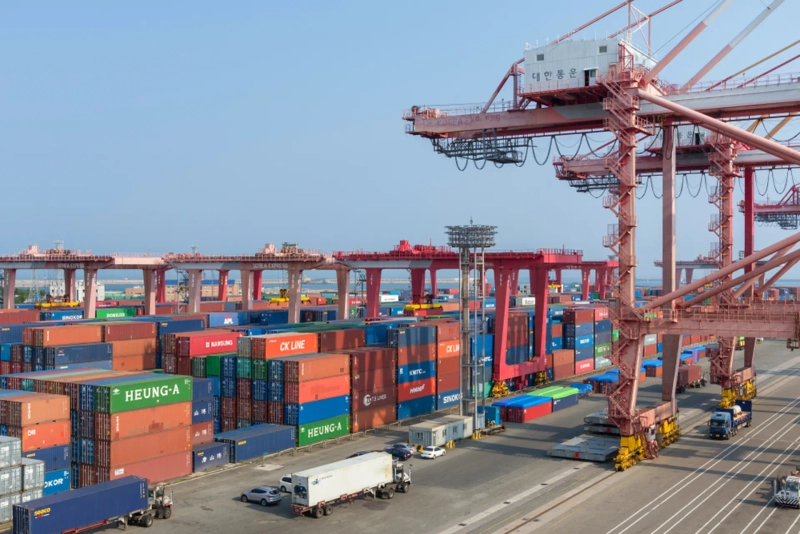
South Korea’s exports posted their second-highest monthly total on record as booming semiconductor demand driven by increased investment in artificial intelligence lifted shipments. Cumulative exports for January through October surpassed $900 billion for the first time. Annual exports are now all but certain to top $1 trillion by mid-November.
The Ministry of Trade, Industry and Energy said on Nov. 1 that exports rose 93.7% from a year earlier to $115.28 billion in October. That followed $121.1 billion in September, marking a second straight month above $110 billion. October was the second-highest monthly export total on record after September. Average daily exports, adjusted for the number of working days, climbed 76% to $5.24 billion, staying above $5 billion for a second straight month.
Semiconductors led the gains. Chip exports surged 259.4% from a year earlier to $56.44 billion in October. Prices and shipment volumes both stayed high as global big tech companies continued facility investment to secure leadership in the AI industry. Semiconductor exports topped $50 billion for a second consecutive month. October marked the second-highest monthly chip export figure on record after September’s $60.3 billion.
Memory chip prices also continued to rise. The fixed price for DDR5 16Gb climbed to $50 in October from $40 in June. The price of 128Gb NAND flash rose to $30.6 from $28.8 over the same period.
Stronger investment in server infrastructure also boosted computer exports. Those shipments jumped 496.6% from a year earlier to $5.85 billion in October, helped by increased demand for server solid-state drives. Wireless communication device exports rose 6.7%, extending gains to a 12th straight month on the back of Apple’s new product launch and solid smartphone sales at Samsung Electronics.
Most of South Korea’s other major export categories also increased. Exports rose in 18 of the country’s top 20 export items. Auto exports gained 18.1% to $6.55 billion, the highest for any October on record. More working days due to the shift in the timing of the Chuseok holiday and strong hybrid vehicle exports supported the increase. Electrical equipment exports rose 74% to $1.99 billion as demand increased for transformers, wires and cables used in AI data centers, setting a new monthly record.
Exports of cosmetics, agricultural and fisheries products, and bio-health goods also reached record highs for October. Cosmetics exports rose 57.5% to $1.44 billion, agricultural and fisheries product exports climbed 11.6% to $1.11 billion, and bio-health exports increased 30.2% to $1.53 billion.
By region, exports increased in seven of South Korea’s nine major markets. Exports to China rose 133.6% to $26.98 billion, driven by semiconductors, petrochemicals, wireless communication devices and general machinery. Exports to the US climbed 185.8% to $24.9 billion as AI-related items including semiconductors, computers and electrical equipment advanced along with autos and steel. Exports to the Association of Southeast Asian Nations rose 128% to $21.33 billion, topping $20 billion for a second straight month.
Imports rose 36% from a year earlier to $72.78 billion in October. Energy imports increased 63.1% to $16.49 billion as international oil prices climbed. Crude oil import volumes fell 6.3%, but the value of those imports rose 51.9% as prices jumped 62%.
The trade surplus came to $42.5 billion, topping $40 billion for a second straight month after September. The cumulative trade surplus for January through October reached $294.9 billion, up $239.1 billion from the same period a year earlier.
Kim Ri-an, Hankyung.com reporter knra@hankyung.com

Korea Economic Daily
hankyung@bloomingbit.ioThe Korea Economic Daily Global is a digital media where latest news on Korean companies, industries, and financial markets.