Democratic ‘Blue Wave’ Gains Momentum in US Midterms, Stirring Fears AI Boom Could Cool: Washington Now
Summary
- The prospect of a blue wave in the midterm elections is coming into sharper focus, raising expectations of a Democratic landslide.
- JPMorgan’s Market Intelligence team said a blue wave would leave the S&P 500 index in a range from a 0.25% decline to a 0.5% gain.
- JPMorgan said the S&P 500 index could rise 0.5% to 1% if Democrats take the House and Republicans control the Senate.
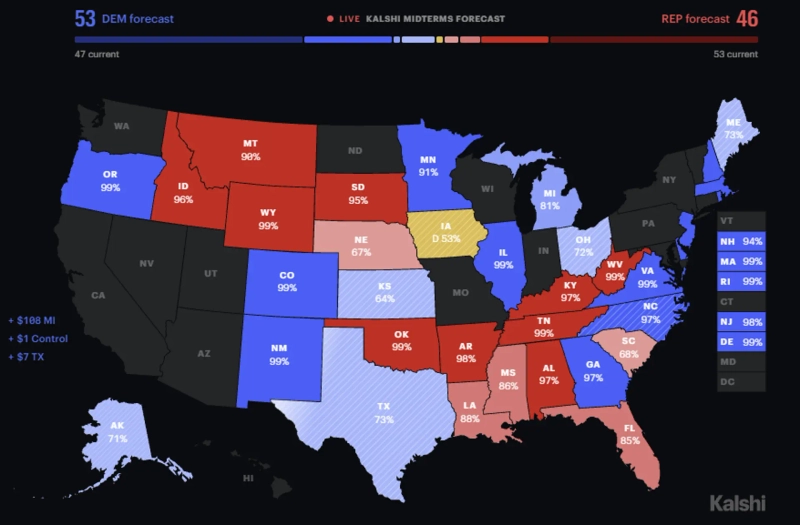
Forecast Trend Report by Period


“Gas was in the $2-a-gallon range last year. Now it’s in the $4 range. I don’t know what has gotten better since Donald Trump took office, but I know what has gotten worse,” said Rhianna King, 34.
“I didn’t vote two years ago, but I think I have to this time. I’ll probably vote Democratic,” said Miguel Rogers, 42.
The U.S. midterm elections, which will shape the second half of President Donald Trump’s term, began on Nov. 3. Many voters interviewed in and around polling places brought up inflation, especially gasoline prices. Expectations for the “red wave” that helped Republicans sweep the presidential, Senate and House races two years ago have faded. In its place is frustration over the war with Iran and fuel costs.
The broader U.S. economy is still performing well. On Oct. 28, the Federal Reserve left interest rates unchanged at its Federal Open Market Committee meeting and described the economy as showing “strong growth,” upgrading its September wording of “solid growth.” The unemployment rate, at 4.2%, remains low. Business investment is rising, and jobs are still being created steadily.
Many voters, however, do not feel those headline indicators in their daily lives. For them, rising prices and the resulting loss of affordability matter far more than corporate capital spending. In a Financial Times poll conducted with Focaldata from Oct. 30 to Nov. 1 among 2,163 respondents, 68% said they were dissatisfied with Trump’s handling of inflation and the cost of living. The margin of error was plus or minus 2.5 percentage points.
The shift in sentiment is more visible in rural areas than in cities. That is especially painful news for Republicans because it is emerging in deep-red regions that once formed the core of Trump’s support. The family of Jeff Freiser, who runs a 4,000-square-meter farm in Kansas, told CBS they had paid $514,625 more for fertilizer than a year earlier, $187,000 more for diesel, and another $10,000 for parts such as farm equipment because of steel tariffs.
At the same time, income shrank by $325,000 as the trade war hurt agricultural exports. Freiser said many farmers are angry. With no certainty the farm can survive through next year, his father has decided to vote Democratic for the first time in his life. That helps explain why Democratic Senate candidate Adam Hamilton, a megachurch pastor in Kansas, is running neck and neck with Republican incumbent Roger Marshall within the margin of error. Republicans risk losing even longtime strongholds such as Kansas, Ohio, Iowa and Texas in this election.
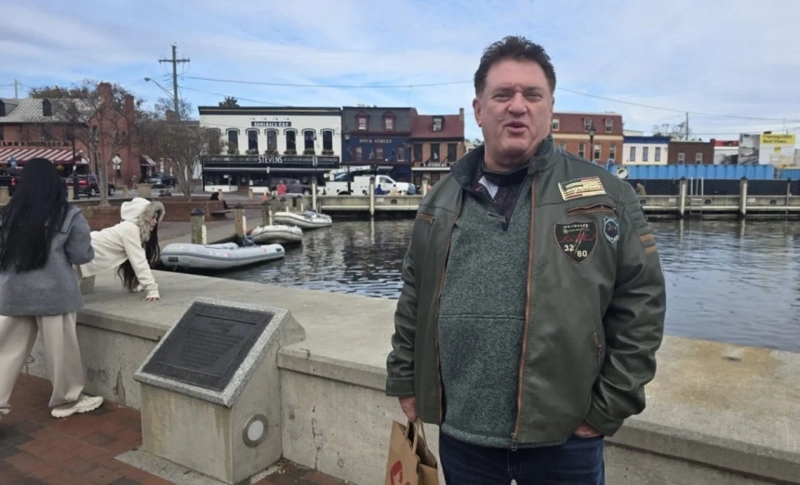
Support for Trump has not disappeared. Tim Abigail, 64, a Dallas native interviewed in Annapolis, Maryland, said he supports Trump’s deregulation policies and is satisfied with retirement because the stock market has broadly risen. He added that he would not withdraw his support for Republicans, in part because he sees growing support for socialism among younger voters.
By contrast, Helen Nenichka, 65, a North Carolina resident, voiced support for the cultural and economic values championed by Trump and the Republican Party. She repeatedly cited Trump’s promise to reduce government debt and said he would put the U.S. “back in its proper place economically and politically.”
A surge in early voting is also lifting Democratic hopes for a blue wave. Early turnout has risen at least 25% from four years ago. That kind of jump is typically viewed as favorable for Democrats. Axios reported on Nov. 3 that nearly every major indicator points to a Democratic landslide in the midterms and that the threat of a “blue tsunami” is rolling toward Trump’s Washington.
A blue wave in the midterms could be less positive for stocks. Citing Zerohedge, JPMorgan’s Market Intelligence team said a Democratic sweep would leave the S&P 500 anywhere from down 0.25% to up 0.5%. The team said some selling could emerge on concerns over tighter regulation of artificial intelligence and the risk of investigations into big-tech executives who donated to the Trump administration.
By contrast, JPMorgan said the S&P 500 could rise 0.5% to 1% if Democrats win the House and Republicans hold the Senate. Congress could still deadlock over next year’s budget, but the report said the fallout from a federal government shutdown may be limited and concerns over efforts to impeach Trump would also ease.
Fairfax, Virginia/Annapolis, Maryland — Lee Sang-eun, correspondent
Washington — Lee Sang-eun, correspondent selee@hankyung.com

Korea Economic Daily
hankyung@bloomingbit.ioThe Korea Economic Daily Global is a digital media where latest news on Korean companies, industries, and financial markets.