[Exclusive] South Korea Weighs Large US Treasury Purchases to Ease Trade Pressure and Build Reserves
Summary
- The government and the Bank of Korea are pushing large-scale purchases of US Treasuries in a bid to expand foreign-exchange reserves while also acting as a white knight for the US government.
- Officials said the plan is designed to use the fall in the won-dollar exchange rate and the surge in US Treasury yields to secure annual interest income of more than 5% and gain leverage in trade negotiations.
- They said becoming a major holder of US Treasuries is aimed at strengthening the economic alliance with Washington, including greater leverage in tariff and US investment talks and a possible restart of discussions on a Korea-US currency swap.
Forecast Trend Report by Period


South Korea to Step In as a White Knight, Buying US Treasuries in Size
Falling Won-Dollar Rate, Lower Treasury Prices Open Window to Build FX Buffer
US Gets Funding Relief, South Korea Gains Leverage in Trade Talks
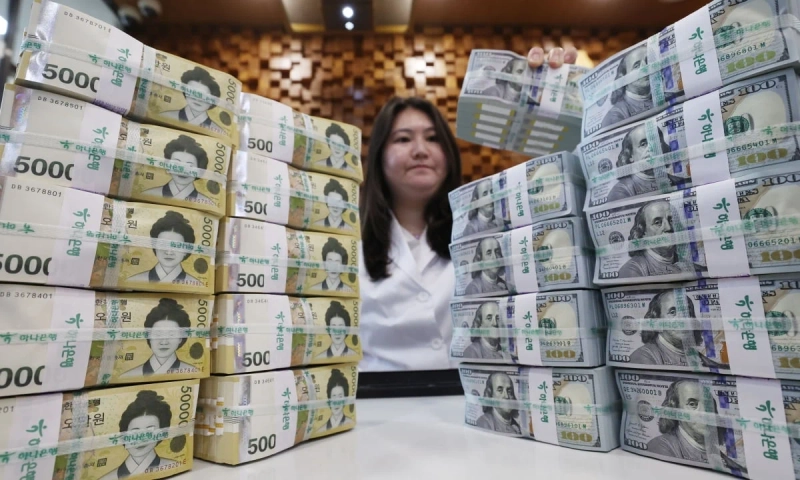
South Korea is pursuing a plan to buy large amounts of long-term US Treasuries. The idea is to snap up Treasuries after prices fell and yields rose on concerns over US fiscal deficits and inflation, while boosting the country’s foreign-exchange reserves. The move is also seen as a package deal aimed at deepening the economic alliance with the US and easing trade pressure.
On November 5, people in the financial investment industry said the government and the Bank of Korea had recently proposed the idea to the US, which responded favorably. The two sides also held in-depth discussions on Treasury purchases at a 2+2 meeting of finance ministries and central banks in Bangkok on October 16. Lee Hyoung-il, deputy prime minister and finance minister, Bank of Korea Governor Shin Hyun-song, Federal Reserve Chair Kevin Warsh and Deputy Treasury Secretary Francis Brook met there in an unusual gathering while attending the International Monetary Fund and World Bank annual meetings.
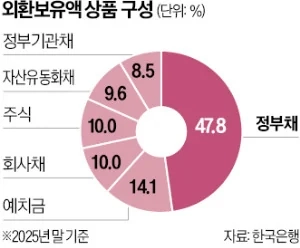
The exact size of the purchases has not been set. Still, South Korea is expected to buy enough US Treasuries to raise its foreign-exchange reserves, which stood at $443.1 billion at the end of October, by a meaningful amount. The total is projected to reach at least tens of billions of dollars.
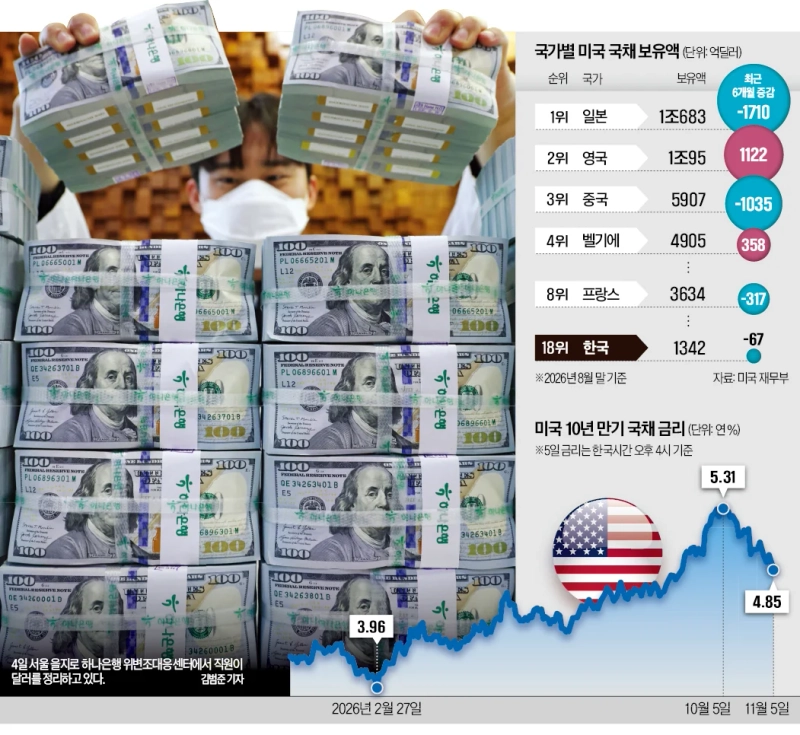
As of the end of August, South Korea held about $134.2 billion of US Treasuries, ranking 18th globally.
The government turned to large-scale Treasury purchases after this year’s period of won weakness underscored the need to replenish foreign-exchange reserves. The won fell to around 1,560 per dollar, showing excessive one-way pressure, but authorities could not intervene aggressively because of concern that reserves might drop below the psychological $400 billion threshold. Officials appear to have concluded that the second half, with the won-dollar rate falling sharply and yields rising, offers a good chance to buy US Treasuries without a heavy price burden.
The proposal is one Washington is likely to welcome. Rising Treasury yields are increasing the US government’s interest burden and weighing on the real economy. Major holders such as Japan and European countries are in a position to sell US Treasuries to defend their own currencies, so South Korea’s purchases could provide meaningful support for prices.
Stepping In as a White Knight for the US, Deepening the Korea-US Economic Alliance
Using Monthly Treasury Auctions to Raise Bargaining Power in US Investment Talks
South Korea’s decision to buy long-term US Treasuries in size appears aimed at two goals at once: increasing foreign-exchange reserves while strengthening its leverage with Washington. The plan is to position itself as a friendly partner to the US as it grapples with surging yields, while securing a lever to navigate trade pressure that could continue after the US midterm elections.
Gaining an FX Backstop and Diplomatic Leverage
South Korea’s foreign-exchange reserves have remained in the $400 billion range for more than eight years since first topping $400 billion in June 2018. They stood at $443.16 billion at the end of October. After the won traded above 1,560 per dollar in the first half, momentum reportedly grew within the foreign-exchange authorities in favor of building reserves. Officials concluded that now, with the won-dollar rate down in the 1,300 won range, is an opportunity to increase holdings by buying US Treasuries. Elevated yields also mean the bonds could generate annual interest income of more than 5%.
There is also a view that becoming a major holder of US Treasuries would improve South Korea’s leverage in tariff and US investment negotiations. If South Korea rises from its current 18th place among Treasury holders, it could, in a worst-case scenario, hold the option of selling Treasuries in response. In particular, some expect three major investment projects in the US could come under pressure after the midterm elections, strengthening Seoul’s hand as alternative investment destinations are considered.
South Korea could also use Treasury purchases as leverage to restart discussions on a Korea-US currency swap line. After the October 16 2+2 meeting in Bangkok between the two countries’ finance and monetary authorities, Lee Hyoung-il told reporters that “a Korea-US currency swap is necessary because it serves as a solid safety net for South Korea’s foreign-exchange market.” He added that the issue was not a shortage of foreign-currency liquidity, but the need for a currency-swap arrangement on the level of advanced economies now that South Korea’s economy has grown. The Fed has standing swap lines with the European Union, Japan, the UK, Canada and Switzerland.
Eyeing a Rescue Role as US Yields Surge
South Korea’s Treasury purchases could come as welcome relief for the US. The yield on the 10-year Treasury rose from 3.96% at the end of February to as high as 5.31% in early October. It is now trading around 4.85%. As Treasury yields rise, the US government’s interest burden grows as it struggles with a massive fiscal deficit. Borrowing costs for households and businesses also climb as mortgage rates and other linked rates rise. The US Treasury has recently even pursued buybacks, but that was not enough to calm supply-demand concerns in the market.
An exodus from US Treasuries by major countries is also continuing. According to the US Treasury Department, the top 10 foreign holders of Treasuries sold $131.5 billion over the past six months. In that environment, the emergence of South Korea as a large source of demand could provide significant support for stability in the Treasury market.
South Korea is reviewing a plan to participate in monthly US Treasury auctions through indirect bids. In Treasury auctions, the share of indirect bids is one gauge of demand from overseas central banks. At the end of September, weak demand in a US three-year Treasury auction produced a tail of more than 0.03 percentage point, meaning the awarded yield came in above the pre-auction level. The share of indirect bids also fell by nearly 10 percentage points. That drop confirmed weaker demand for US Treasuries and helped drive the 10-year yield higher.
The foreign-exchange authorities plan to secure funds for Treasury purchases in a way that affects the won-dollar exchange rate as little as possible. One option under review is buying dollars earned by exporters in the over-the-counter market rather than in Seoul’s foreign-exchange market. When the won is rising sharply, authorities could also use won liquidity accumulated from previous dollar sales made to defend the exchange rate.
Shim Sung-mi / Kim Ik-hwan / Jeong Young-hyo, Korea Economic Daily reporters smshim@hankyung.com

Korea Economic Daily
hankyung@bloomingbit.ioThe Korea Economic Daily Global is a digital media where latest news on Korean companies, industries, and financial markets.