PiCK
Fed ‘Big Step’ Fears and Strategy’s MSCI Removal Put Bitcoin’s $73,000 Support to the Test
Summary
- Downside pressure on Bitcoin is building as fears of additional rate hikes by the U.S. Federal Reserve and Strategy’s removal from MSCI indexes weigh on the market.
- A lack of fresh liquidity is compounding the pressure, with net outflows from spot Bitcoin ETFs, a decline in stablecoin supply, and worsening investor sentiment.
- Analysts said support around $73,000 will be a key near-term test, and that the risk of further declines remains until Bitcoin recovers the $76,000 to $80,000 range.
Forecast Trend Report by Period



Bitcoin is coming under heavier downside pressure as concerns over additional Federal Reserve tightening coincide with Strategy’s removal from MSCI indexes. Outflows from spot exchange-traded funds are continuing, and analysts view support in the $73,000 range as a key near-term dividing line. Even if the token rebounds, they say the risk of another decline remains until it regains levels above $76,000.
As of 5:50 p.m. on November 12, Bitcoin was trading at $73,563 on Binance’s USDT market, down about 0.5% from a day earlier. On Upbit, it was changing hands at about $71,900. The kimchi premium, which measures the price gap between overseas and domestic exchanges, stood at 1.12%.
Fed ‘Big Step’ Back in Focus as Markets Watch December Tightening
Recent calls from within the Fed for further rate increases have shifted market focus to how aggressive the next round of tightening could be. Talk of a “big step” — a 0.5 percentage-point increase in December — has begun to surface, adding to downside pressure on global equities and digital assets.
TradingView data on November 12 showed the yield on the two-year U.S. Treasury rising to about 4.77%, while the 10-year yield climbed to around 4.99%, close to the 5% mark. Higher Treasury yields can reduce the appeal of risk assets such as stocks and Bitcoin. The rise in the policy-sensitive two-year yield is also reviving concerns that more tightening may lie ahead.
Fed officials have continued to strike a hawkish tone. Governor Christopher Waller said a 0.5 percentage-point increase in December should be considered if October core consumer prices rise around 0.3% or more from the prior month. Dallas Fed President Lorie Logan argued that at least two additional quarter-point hikes are needed under the current economic outlook. Vice Chair for Supervision Michelle Bowman also said inflation pressures are proving more persistent than expected.
Markets are not yet treating a big step as the base case. Even so, rate futures now price in a quarter-point increase in December as the main scenario, while beginning to reflect some odds of a half-point move as well. With the possibility of a big step no longer effectively at zero, caution over further tightening is rising.
Bitcoin Weakens for a Sixth Week as Volatility Rises and Flows Stay Soft
U.S.-listed spot Bitcoin ETFs recorded net outflows of $1.2817 billion during the week of November 2-6. After posting a fifth straight weekly decline last week, Bitcoin has remained under pressure this week. ETF outflows and weakened sentiment following the Binance hack are adding to supply-and-demand headwinds. Recent rebounds are still being treated cautiously, with traders not yet prepared to call a trend reversal.
Strategy, the world’s largest corporate holder of Bitcoin, is also facing a new overhang after its removal from MSCI indexes. MSCI said in its regular index review that it will exclude Strategy from major indexes, with the change taking effect after the close on November 30. That could trigger selling by passive funds that track MSCI benchmarks. The index removal does not directly mean Strategy will sell Bitcoin.
Bitfinex said Bitcoin has traded below the average cost basis for short-term holders for four straight days. In most similar historical cases, the token recovered that level within two weeks. When the recovery took longer, later lows were substantially deeper. Whether the current decline proves to be a simple correction or develops into a more prolonged adjustment should become clearer later this month.
As downside pressure builds, volatility is also expanding again. Swissblock said Bitcoin remains in a weak stretch and downside volatility is picking up, though the market has so far absorbed selling pressure relatively steadily. The recent uptrend has lost momentum, and further weakness should be watched if its risk index continues to rise.
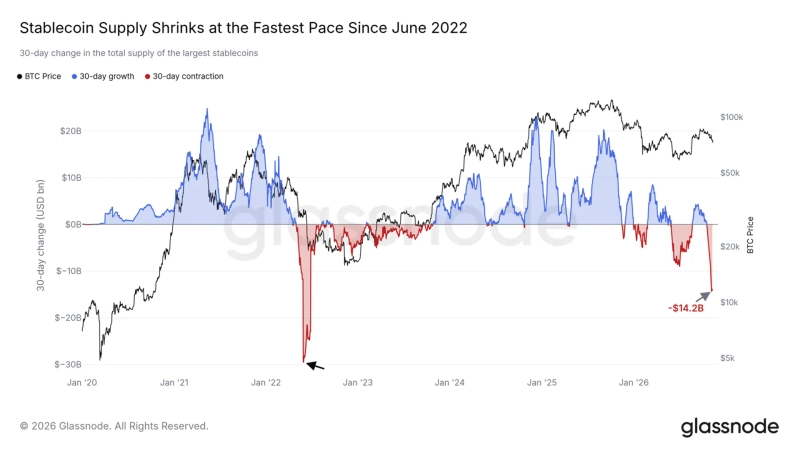
Fresh capital to support a rebound also appears limited. Glassnode said the supply of major stablecoins fell by about $14.2 billion over the past 30 days, the fastest contraction since June 2022. The firm added that funds are also leaving spot Bitcoin ETFs and U.S. investor demand. Some large wallets have been buying, but that activity has yet to spread across the broader market. With new money still scarce, it said, confirmation of a rebound may take time.
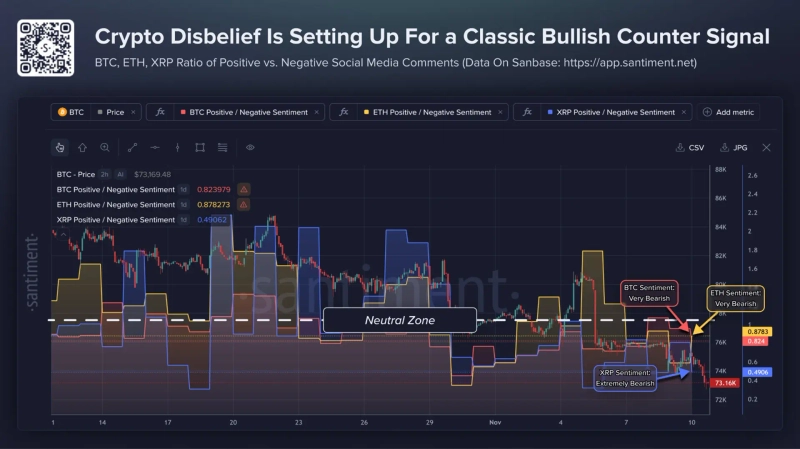
Retail sentiment has also grown more pessimistic. Santiment said bearish views are outweighing bullish ones on social media posts related to Bitcoin, Ether and XRP. Such periods of pronounced pessimism are worth watching from a contrarian perspective, it added. A recovery above $79,000 in Bitcoin could signal that prices are beginning to move against prevailing sentiment.
Meanwhile, Nansen data on November 12 showed market-sell volume exceeded market-buy volume in Hyperliquid’s Bitcoin perpetual futures market over both the past seven days and the past 24 hours. At the same time, the net short position held by the group Nansen classifies as “smart traders,” based on trading performance and other metrics, has shrunk from the end of last month. That suggests short-term selling pressure remains in place, while some professional investors have scaled back bets on further declines.
Bitcoin Tests $73,000 Support; Trend Reversal Seen Only Above $80,000
Analysts say downside pressure may persist even if Bitcoin stages a short-term rebound, at least until it decisively reclaims the $76,000 to $80,000 range.
They identify $73,500 and $80,000 as the key levels. Alex Kuptsikevich, chief market analyst at FxPro, said Bitcoin has posted only a modest rebound and it is still too early to call a clear bullish reversal. A drop below $73,500 would increase the odds that the decline continues. A move above $80,000 would be needed to confirm a trend reversal.
Pressure on the downside may intensify as Bitcoin approaches the $70,000 mark. Julien Pineda, a market analyst at Forex.com, said $70,000 is the most important psychological support level in the near term, and a slide to that zone could also weaken the medium- to long-term uptrend. To sustain any rebound, Bitcoin needs to hold $73,200 and then break above $76,500. The dollar index is also holding above 102 and hovering near this year’s highs, which could limit Bitcoin’s rebound.
Bitfinex also said Bitcoin may remain rangebound for now between $72,350 and $79,400, with a bias toward the lower end of that band. Selling pressure could emerge in the $75,900 to $77,500 zone. If that supply is absorbed, Bitcoin could then try to re-enter the $77,000 to $80,000 range.
Kang Min-seung, Bloomingbit reporter, minriver@bloomingbit.io

Minseung Kang
minriver@bloomingbit.ioBlockchain journalist | Writer of Trade Now & Altcoin Now, must-read content for investors.