‘Jensen Huang Risk’ Hammers AI Supply-Chain Stocks as Nvidia-Tied Shares Reel
Summary
- The issue of a possible dismissal of Nvidia CEO Jensen Huang sent global AI value-chain stocks and ETFs holding Nvidia broadly lower.
- Shares diverged by company, with SK Hynix and Samsung Electro-Mechanics, both highly exposed to Nvidia HBM demand, falling while more diversified Samsung Electronics rose.
- Brokerages said the broader AI investment trend is likely to remain intact, with potential gains for rivals including AMD, Broadcom, Marvell and Alphabet, while domestic memory demand is unlikely to suffer a major blow.
Forecast Trend Report by Period


AI Value-Chain Stocks Stumble on ‘Jensen Huang Risk’
Share Performance Diverges With Nvidia Exposure
SK Hynix -2%·Samsung Electro-Mechanics -4%
ETFs Holding Nvidia Also Weaken
‘AI Investment Trend Unlikely to Break’
Rivals Including AMD May Benefit
The possibility that Nvidia CEO Jensen Huang could be ousted sent global artificial intelligence value-chain stocks lower. Asian markets, led by South Korea and Taiwan and followed by Japan and China, also fell. In Seoul, SK Hynix declined while Samsung Electronics edged higher, highlighting a split among AI-linked shares.
Kospi Turns Lower After Nvidia Slides in After-Hours Trading
The Kospi closed down 0.61% at 5,342.73 on Nov. 12. The benchmark rose as high as 5,458.84 early in the session, nearing 5,500, before reversing in the afternoon. The pullback followed a New York Times report on a second extramarital relationship involving Huang and a company executive, followed by a Wall Street Journal report that Nvidia’s board was preparing for his dismissal. Nvidia fell 8.61% in after-hours trading on Nov. 11, dropping to $158.78, its lowest level this year. Profit-taking after a recent rebound and unstable flows tied to options expiration also weighed on South Korean equities. The Kosdaq closed down 1.22% at 696.53.
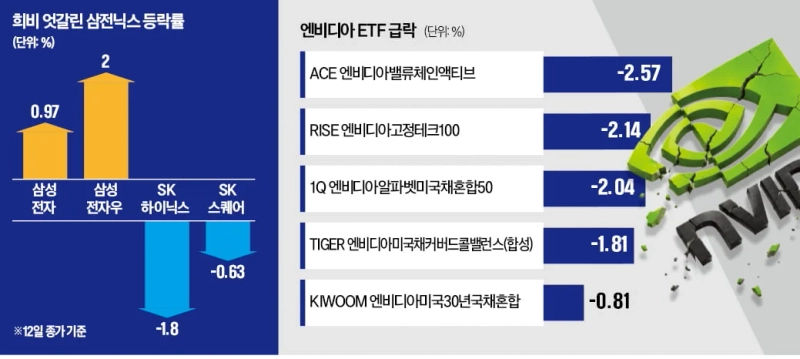
Among main-board stocks, companies with greater exposure to the Nvidia ecosystem posted steeper losses. The divergence between memory-chip makers Samsung Electronics and SK Hynix was especially notable. SK Hynix fell 1.80% to 1.254 million won, while SK Square slipped 0.63% to 791,000 won.
Samsung Electronics, by contrast, rose 0.97% to 208,000 won, while Samsung Electronics preferred shares gained 2.0% to 168,300 won. The market view was that SK Hynix is more sensitive to uncertainty around Nvidia because high-bandwidth memory sales for Nvidia account for a larger share of its business. Samsung Electronics was seen as less exposed because its operations are spread across commodity memory, foundry services and smartphones.
AI substrate stocks also swung sharply. Samsung Electro-Mechanics fell 4.01%. ISU Petasys rose 2.56%, Daeduck Electronics gained 2.52% and Simmtech added 1.89%, but all three ended the day 5% to 7% below their intraday highs.
Exchange-traded funds with heavy Nvidia exposure also declined across the board, including ACE Nvidia Value Chain Active, down 2.57%, and RISE Nvidia Growth Tech 100, down 2.14%. Other Asian markets were also hit by the Nvidia news. Taiwan’s Taiex fell 2.63%.
AI Demand Holds Up, Creating Openings for Rivals
Brokerages said Huang’s removal could disrupt the “circular finance” model that has supported AI infrastructure investment under Nvidia’s leadership. The structure refers to Nvidia taking equity stakes in customers such as neo-cloud providers or offering guarantees, with those customers then using the funds to buy Nvidia graphics processing units. Because the approach was pushed strongly by Huang, its future could hinge on who succeeds him.
Even so, most on Wall Street and in Seoul see little chance that the broader AI investment trend will reverse. The more likely outcome is a shift in winners rather than a contraction in the investment cycle. Kwon Soon-ho, an analyst at Daishin Securities, said AMD rose 13% and Broadcom gained 6% while Nvidia shares fell after Nov. 9. In his view, that reflects expectations that Nvidia demand could shift to alternative suppliers rather than a deterioration in overall demand. Mirae Asset Securities named AMD, Broadcom, Marvell and Alphabet as potential beneficiaries.
South Korean memory-chip makers that count Nvidia as a major customer are also not seen taking a major hit. Kim Young-geon, an analyst at Mirae Asset Securities, said the amount of HBM used in custom AI chips ordered by big tech companies is also rising. A supply-chain reshuffle, he added, would not necessarily translate into weaker memory demand.
Kang Jin-kyu, Hankyung.com reporter josep@hankyung.com

Korea Economic Daily
hankyung@bloomingbit.ioThe Korea Economic Daily Global is a digital media where latest news on Korean companies, industries, and financial markets.