PiCK
South Korea on Edge Over Jensen Huang Shock Despite Nvidia ‘Kkanbu’ Alliance Gains
Summary
- A change in Nvidia’s CEO is a key variable for the direction of its HBM, GPU and AI accelerator businesses, as well as the possibility of revisions to long-term supply agreements (LTAs) with Korean companies.
- Demand could weaken for Korean chipmakers such as Samsung Electronics and SK Hynix if development and investment in next-generation HBM4 and AI chips slow under a new management team.
- Hyundai Motor Group, LG Group and Naver, which have formed an AI alliance with Nvidia, are closely watching for delays to joint projects and uncertainty over investment and GPU supply.
Forecast Trend Report by Period


‘Kkanbu’ Alliance Wobbles as Samsung, SK Hynix HBM Supply Plans Face Uncertainty
Korean Companies Tied to Nvidia Watch for Fallout
Near-Term Impact Likely Limited
Whether New Management Changes Strategy Is the Key Variable
Long-Term Contract Revisions Can’t Be Ruled Out
Hyundai Motor, LG and Naver Also on Alert
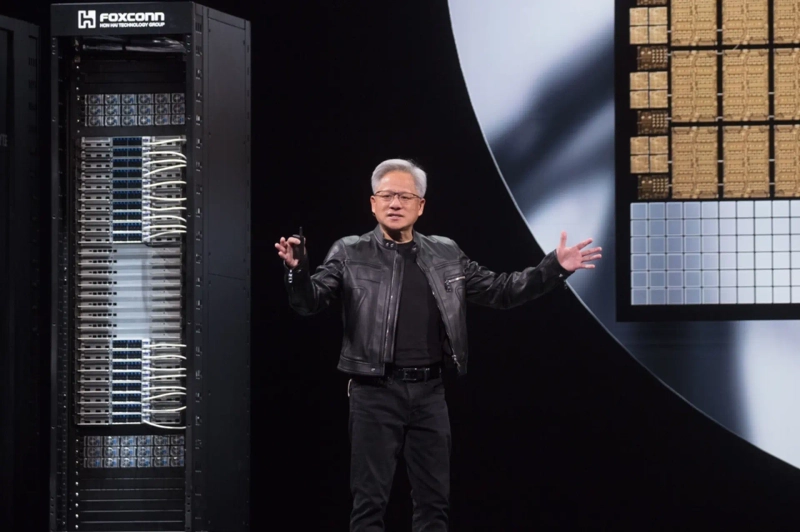
"Korean companies still hold a firm advantage in the high-bandwidth memory supply chain, so the immediate hit may be limited. But Jensen Huang has had such outsized influence over the artificial intelligence industry that any slowdown in next-generation AI chip development or investment could also affect Korean industry."
That was how a senior semiconductor industry official described the situation on Nov. 12 after Huang was effectively pushed to the brink of dismissal. As a leadership change at Nvidia comes into view, Korean companies with AI ties to the US chipmaker — including Samsung Electronics Co., SK Hynix Inc., Hyundai Motor Group, LG Group and Naver Corp. — are closely watching for fallout. Huang visited South Korea in October 2025 and held what local media called a "kkanbu meeting" with Samsung Chairman Jay Y. Lee and Hyundai Motor Group Executive Chair Euisun Chung. He returned in June 2026 and expanded cooperation with Korean companies across multiple fronts. The biggest variable is whether a new Nvidia chief executive would change the company’s existing business direction, including GPU supply.
Focus on Next-Generation HBM Shipments and Possible LTA Revisions
Memory chips are the area most directly exposed. Nvidia is the largest customer for Samsung Electronics and SK Hynix. Both have been supplying HBM for Nvidia’s AI accelerators. Nvidia’s Vera Rubin AI accelerator, set for release in the second half of 2026, will also use sixth-generation HBM4.
The immediate shock to the two companies is expected to be limited. They have already signed multi-year long-term agreements, and Nvidia also needs to secure HBM3E and HBM4 to mass-produce its accelerators. There are also few realistic alternatives to replace those suppliers immediately.
The bigger variable is the medium- to long-term roadmap from 2027 onward. Nvidia typically releases new accelerators on a one-year cycle and has steadily upgraded HBM specifications alongside them. If a new management team revises product development schedules and AI accelerator production plans, orders for new HBM could shrink. Existing LTAs may also be revised. Lee Jong-hwan, a professor in the Department of System Semiconductor Engineering at Sangmyung University, said it would be difficult for a new CEO to sustain the same aggressive investment and management style as Huang. He added that because Huang has led the expansion of the AI semiconductor ecosystem, growth across the broader ecosystem could slow under his successor. Some in the industry also say SK Hynix could be hit harder if a new CEO reshuffles suppliers, given that about 25% of its sales depend on Nvidia.
Still, there is also a view that a leadership change at Nvidia would not be entirely negative for Korea’s memory industry. Overall memory demand should remain solid as long as Big Tech continues investing in AI infrastructure. Lee Byung-hoon, a professor in the Department of Semiconductor Engineering at POSTECH, said the broader push to expand the AI ecosystem itself is unlikely to be seriously shaken. With Big Tech still spending on AI, Nvidia has little reason to cut supply aggressively, and demand for Korean semiconductors should continue. Some also expect that if Nvidia’s market dominance eases, faster development of in-house AI chips by Google and Amazon, along with market-share gains by Advanced Micro Devices Inc., could create an opening for Korean suppliers to diversify their customer base.
AI Infrastructure Companies Also Brace for Impact
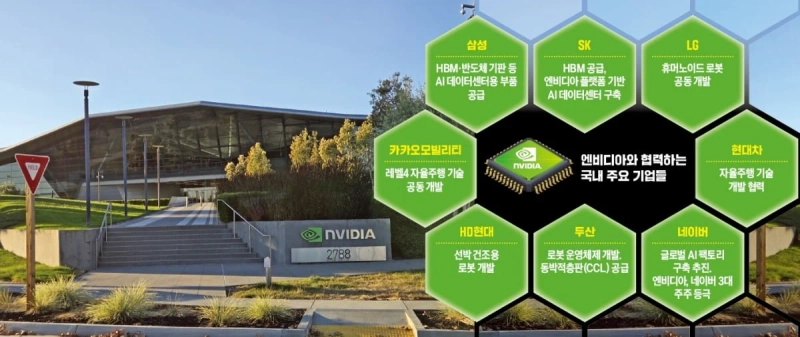
Other Korean companies that have expanded cooperation with Nvidia in AI businesses beyond semiconductors — including robotics, autonomous driving and data centers — are also on alert. If Nvidia adjusts its business strategy, the pace of joint projects may have to slow.
Hyundai Motor Group is developing autonomous driving, smart factory and robotics technologies using 50,000 Blackwell GPUs. LG Electronics Inc. is developing humanoid robots based on Nvidia’s Isaac GR00T platform. Because those physical AI alliances were built around Huang’s rapport with the heads of the two groups, some worry that a leadership change could delay decision-making and alter investment and support terms.
Naver, which counts Nvidia as its third-largest shareholder, is also closely watching the construction schedule for its Sejong AI Factory and whether it can secure more than 60,000 GPUs on time. Other companies are doing the same, including Samsung Electro-Mechanics Co., which is expanding AI package substrate capacity; Doosan Group, which supplies copper clad laminate, or CCL; and LS Electric Co., which is developing power equipment for Nvidia. All are sensitive to any change in Nvidia’s production plans.
Kim Chae-yeon and Won Jong-hwan, Hankyung.com reporters why29@hankyung.com

Korea Economic Daily
hankyung@bloomingbit.ioThe Korea Economic Daily Global is a digital media where latest news on Korean companies, industries, and financial markets.