Microsoft Global Outage Halts Work at South Korean Companies
Summary
- A widespread outage hit Microsoft’s MS365, Outlook and Teams, paralyzing operations at global companies.
- The disruption was especially severe for foreign subsidiaries and global companies with heavy email dependence, with some switching to paper documents and Google Gmail to keep work moving.
- Microsoft said an infrastructure overload caused the problem and that it was not a cyberattack. The company is carrying out recovery work, including restarting servers, but has not said when services will be fully restored.
Forecast Trend Report by Period


Service disruptions reported in 74 countries
MS365, Outlook and Teams fail
Foreign firms hit hard by email dependence
Urgent documents printed and handled by hand
Some U.S. companies delay earnings releases
Microsoft’s workplace services, including MS365, Outlook and Teams, suffered a large-scale outage. The disruption began in the U.S. and affected operations at South Korean companies, delaying email traffic and forcing cancellations of meetings with overseas offices. Employees resorted to paper documents or alternative services such as Google to stay in touch.
◇Companies Pull Out Paper Documents
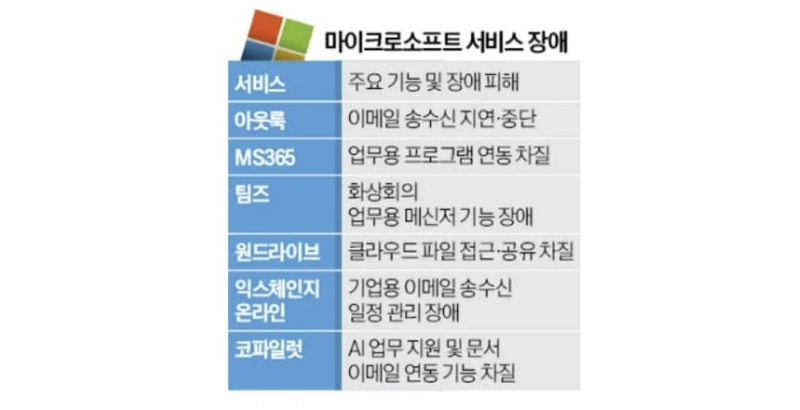
According to industry officials on Nov. 13, a major South Korean conglomerate sent an emergency notice to employees saying services were unavailable because of a global Microsoft outage. The company said the disruption affected Outlook, Teams and the AI work tool Copilot, as well as document-sharing, collaboration and data-analysis tools.
Some employees printed online documents for review. One employee said staff were printing materials for inspection and even underlining them by hand. Performance reports also had to be written manually instead of being handled through Copilot.
At companies working with overseas offices, scheduled meetings were scrapped. Kim Sang-woo, 28, who works on the export team at small business SH Korea, said a video meeting with the company’s U.S. team on Teams had been canceled. He said work-related communication was continuing through Google Gmail. An employee at a foreign consulting firm who asked not to be named said meetings with teams in Singapore and Hong Kong were also canceled. Work left unfinished on Nov. 13 would likely have to be dealt with over the weekend, the employee added.
The damage was concentrated among global companies. An official at the South Korean unit of a European pharmaceutical company said work on Nov. 13 had been completely paralyzed and no instructions had come from headquarters. An employee at another foreign airline said global companies that process work by email had been hit especially hard.
The extent of the disruption varied depending on the services each company used and their access environment. Some companies regained access to Outlook or Teams later in the afternoon. Others saw delays only in sending and receiving email, while Teams and Copilot continued to operate normally.
◇Microsoft Says Infrastructure Overload Crippled Servers
According to Reuters and other media outlets, reports of the outage began at about 2 a.m. on Nov. 13 in South Korea, just after noon on Nov. 12 in the U.S. On outage-tracking site Downdetector, complaints related to Outlook in the U.S. briefly exceeded 138,000 at about 3 a.m. Korea time on Nov. 13. Within an hour, the number of countries and territories reporting problems had risen to 74.
The problem centered on Exchange Online, Microsoft’s corporate email and calendar service. Users had trouble sending and receiving email and loading inboxes. Microsoft said not all MS365 functions were down and that features not reliant on Exchange Online were operating normally.
The disruption also affected overseas government agencies and major corporate schedules. Problems were reported at the U.S. House of Representatives, the Japanese government’s shared information-technology platform, and Australian intelligence agencies and federal police. U.S. electric-truck maker Workhorse Group postponed its third-quarter earnings release planned for Nov. 12 to Nov. 16. OpenAI and Anthropic also said connection features that pull Microsoft emails and work materials into their AI services were disrupted.
Microsoft said it had confirmed that some servers stopped responding after a core processing system on part of its infrastructure became overloaded. The company said the problem was not caused by a rise in external traffic and that it had found no signs of a cyberattack. Microsoft restarted servers and rerouted access paths as part of recovery efforts, but as of the afternoon of Nov. 13 had not provided a timeline for a full return to normal.
Ra Hyun-jin, Hankyung.com reporter raraland@hankyung.com
Lee So-yi, Hankyung.com reporter claire@hankyung.com

Korea Economic Daily
hankyung@bloomingbit.ioThe Korea Economic Daily Global is a digital media where latest news on Korean companies, industries, and financial markets.