Jensen Huang’s 33-Year Nvidia Era Ends; Bill Gates, Steve Jobs Cases Offer Clues to What’s Next
Summary
- Analysts said Jensen Huang’s resignation is unlikely to significantly damage Nvidia’s fundamentals.
- They said Nvidia has already entered the Vera Rubin cycle, secured its supply chain, and locked in its product roadmap through 2028, limiting uncertainty.
- They added that Nvidia’s setback is highlighting potential beneficiaries in the anti-Nvidia camp, including AMD, Broadcom, Samsung Electronics, and Isu Petasys.
Forecast Trend Report by Period


"Past examples of Bill Gates and Steve Jobs suggest Nvidia will keep running smoothly"
"Already in the Vera Rubin cycle, with a roadmap set through 2028"
"Samsung Electronics and Isu Petasys stand out on prospects of gains for the anti-Nvidia camp"
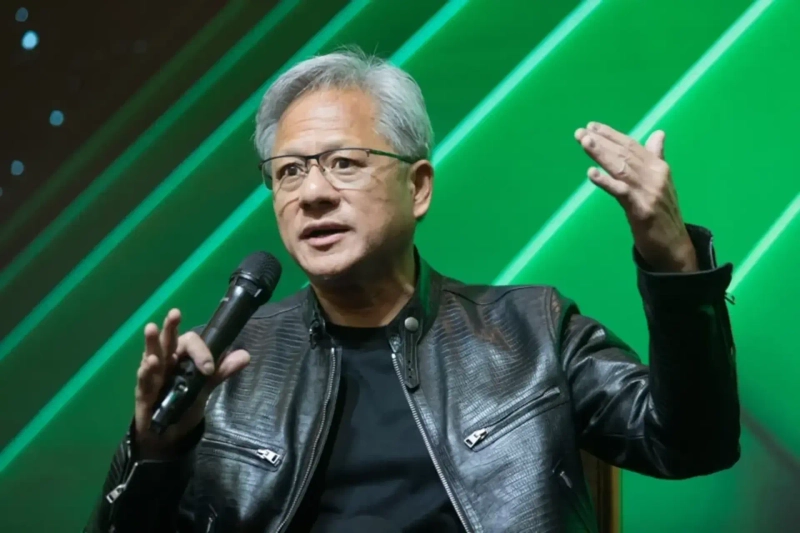
Jensen Huang stepped down as Nvidia chief executive officer after an affair scandal escalated into a national security issue. Analysts said the episode is unlikely to inflict major damage on the company’s fundamentals.
Reuters and other foreign media reported on November 13 that Huang, who had been embroiled in the scandal, resigned a day earlier as Nvidia’s CEO. Nvidia’s board said in a statement that Huang would step down immediately as president, chief executive and director. The move ends his 33-year run at the company he co-founded in 1993.
The board appointed Chief Financial Officer and Executive Vice President Colette Kress as interim CEO. She will serve until a permanent successor is named while retaining her existing roles.
Nvidia is the biggest customer of Samsung Electronics and SK Hynix. Both companies supply high-bandwidth memory, or HBM, for Nvidia’s AI accelerators. Nvidia’s Vera Rubin AI accelerator, launched in the second half of this year, also uses sixth-generation HBM4.
Huang met separately in South Korea last year and this year with Samsung Electronics Chairman Jay Y. Lee and SK Group Chairman Chey Tae-won, deepening cooperation. That raised concerns that a leadership change at Nvidia could affect the two companies’ semiconductor sales plans.
Moon Joon-ho, an analyst at Samsung Securities, said an investigation into alleged violations of China export controls remains a potential risk. Calls for tighter export restrictions have resurfaced, he said. Nvidia’s direct exposure to China has fallen sharply, but questions about indirect shipments through other parts of Asia have persisted.
Even so, experts said the issue does not undermine Nvidia’s intrinsic value, citing Microsoft after Bill Gates left day-to-day management and Apple after Steve Jobs died.
Gates, Microsoft’s founder, handed the presidency he had held for 25 years to then-No. 2 executive Steve Ballmer in 2000 so he could focus on technology development. In 2008, he left frontline management entirely to devote himself to the Bill & Melinda Gates Foundation. He remained on the board as major shareholders grew uneasy about the founder’s departure. In 2020, he also gave up his board seat after the board investigated a past extramarital relationship with an employee.
Jobs, Apple’s former CEO, was forced out in 1985 after an internal power struggle and failed new technology launches. He returned in 2000 and went on to a storied tenure before dying in 2011 after battling pancreatic cancer. Apple then passed leadership to Tim Cook, who ran the company for 15 years until stepping down as chief executive in September. During that period, Apple quadrupled revenue to $416 billion from $108 billion and expanded its market capitalization to $4 trillion from $35 million.
Moon said Huang, Nvidia’s co-founder, laid out an AI vision even before ChatGPT emerged and pursued new strategies through integrated solution design and value-chain investments. The leadership vacuum, he said, recalls the moment Jobs left Apple.
Still, Nvidia has already entered the Vera Rubin cycle and secured its supply chain. Its product roadmap is also set through 2028, limiting the chances that Huang’s resignation alone will create an unexpected disruption.
Han Ji-young, an analyst at Kiwoom Securities, said the risk of a major operational setback over the next one to two years is low because mass-production schedules for Vera Rubin, Nvidia’s next-generation product, and supply contracts with key customers have largely been fixed.
Even if uncertainty tied to Huang’s departure triggers temporary selling pressure in suppliers such as SK Hynix, there is no need to interpret that as damage to the broader trend, Han said.
He added that investors still need to watch whether a new management team adjusts volume allocations among suppliers or the schedule for joint development of next-generation products. More than the management change itself, the key variable is whether existing supply contracts and product launch schedules are altered.
Some analysts also see Nvidia’s troubles benefiting AMD’s graphics processing units and Google’s tensor processing units. Nvidia shares fell 11% last week, while AMD and Broadcom rose 30% and 24%, respectively.
Looking at past cases, Moon said Samsung Electronics, through HBM, and Isu Petasys, through TPU exposure, are among the companies with greater leverage to Nvidia rivals. Their long supply histories mean they have already joined competitors’ supply chains, which could prove a differentiating factor.
Noh Jung-dong, Hankyung.com reporter dong2@hankyung.com

Korea Economic Daily
hankyung@bloomingbit.ioThe Korea Economic Daily Global is a digital media where latest news on Korean companies, industries, and financial markets.