PiCK
Nvidia Without Jensen Huang Eases AI Investment Fears With Earnings Beat, Higher Outlook
Summary
- Nvidia said third-quarter revenue rose 103% from a year earlier and EPS topped Wall Street estimates.
- Nvidia said it raised its revenue growth outlook for the fourth quarter and fiscal 2028 even excluding China data-center revenue.
- Nvidia said purchase commitments for components and production capacity rose 40% to $390 billion, boosting expectations for improved conditions at suppliers including Samsung Electronics and SK Hynix.
Forecast Trend Report by Period


Third-Quarter Results Beat Estimates
Raises Next Year Guidance Even Excluding China
Kospi Rises 2% to Reclaim 5,000
The leather-jacketed rock star was gone. In his place stood a blonde woman in a tweed suit.
Nvidia Corp., appearing before investors for the first time in its 33-year history without co-founder Jensen Huang, delivered better-than-expected results and a stronger growth outlook on Nov. 17 under interim Chief Executive Officer Colette Kress. South Korea’s Kospi index climbed back above 5,000 after just one session as heavyweight chip stocks led a relief rally.
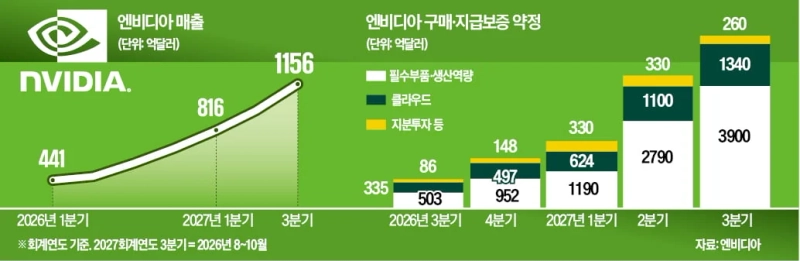
Nvidia said revenue for the third quarter of fiscal 2027, covering August to October 2026, rose 103% from a year earlier to $115.8 billion. That exceeded the market forecast of $109.1 billion by more than $5 billion. Earnings per share came in at $2.68, above Wall Street’s estimate of $2.47.
The main takeaway from the results was the higher growth outlook. Nvidia projected fourth-quarter revenue of $130 billion for the period from November 2026 to January 2027, topping the market estimate of $125.1 billion. It also raised its fiscal 2028 revenue growth forecast to 75% from 70%. The company said that guidance does not include any contribution from China data-center computing revenue, which totaled $2.4 billion in the third quarter.
The U.S. Commerce Department has announced new export controls, Kress said, but demand still far exceeds supply and results should remain solid.
Nvidia said it will maintain existing financing commitments tied to customer funding, including for neocloud operators, while reviewing new transactions more closely. The move reflected concern over both circular-finance risk and tighter funding conditions. JPMorgan described it as “a delicate balance.” Hanwha Investment & Securities said the odds of new support may be lower than when Huang was chief executive.
Shares of Samsung Electronics Co. and SK Hynix Inc. rose 2.3% and 4.2%, respectively. The Kospi closed up 1.99% at 5,067.44, while the Kosdaq gained 1.96% to 662.81.
Nvidia Says It Will Screen Investee Companies More Strictly as Its ‘AI Central Bank’ Role Shrinks
Quarterly Revenue Hits Record $115.8 Billion as Standalone Era Begins in Earnest
“AI demand hasn’t gone away.”
That was tech investor Dan Ives’s assessment of Nvidia’s quarterly earnings release on Nov. 17, the company’s first without Jensen Huang. Interim CEO Kress signaled a pullback in vendor financing for AI infrastructure companies, a strategy Huang had championed, while raising the company’s revenue growth outlook. The view in the market is that Nvidia, now without the leather jacket, has begun to stand on its own.
Steady Even Without Jensen Huang
Nvidia on Nov. 17 reported fiscal third-quarter results that topped market estimates and raised its fiscal 2028 revenue growth forecast, covering January 2027 to January 2028, to 75% from 70% in the prior quarter. Kress said the previous quarter’s 70% growth outlook had been constrained by supply-chain limits and that the latest forecast reflects additional volumes the company can now deliver to customers. The figure excludes China data-center revenue.
The impact of the launch of the next-generation Vera Rubin GPU is also beginning to build. Vera Rubin, Nvidia’s AI chip succeeding Blackwell, began shipping in earnest this quarter. Kress said it was off to an explosive start and that the company’s ambition is greater than ever.
Nvidia also stepped up purchases of components needed to make products including Vera Rubin and expanded manufacturing-capacity commitments. Purchase obligations for essential components and production capacity rose 40% from the prior quarter to $390 billion, up from $279 billion. That reflected multiyear long-term memory supply agreements. The move is being read as a sign that Samsung Electronics and SK Hynix have secured substantial HBM orders for years ahead. Vera Rubin uses HBM4, the sixth-generation high-bandwidth memory supplied by the two companies, as well as the low-power memory module SOCAMM 2.
Recent concerns over a pullback in AI investment following the Jensen Huang scandal have grown, but demand in the market for memory from Samsung Electronics and SK Hynix remains strong, an industry official said. The person added that policy uncertainty abroad could slow the pace of AI investment growth somewhat, but a sharp reversal in industry conditions appears unlikely for now. Other Nvidia suppliers also got some relief. Samsung Electro-Mechanics said on Nov. 17 that it had signed an additional semiconductor substrate contract with Nvidia and that the company is reviewing further funding support.
‘Future Investments, Guarantees to Be Evaluated More Strictly’
Nvidia’s role as a financial backstop for the AI ecosystem, powered by its huge cash flow, appears set to shrink. On AI infrastructure investment, Kress said the company will evaluate future investments, commitments and guarantees more strictly as the market matures and additional sources of capital become available. The remark was interpreted as a signal that Nvidia plans to scale back the circular financing Huang used to help build the AI ecosystem by recycling the company’s cash flow into customers.
Support for neocloud operators that buy Nvidia GPUs and lease them out is therefore likely to become harder to obtain. Kress said funding will go first to neocloud companies that have already secured power, land and buildings. The implication is that operators without physical infrastructure will be excluded. Nvidia also plans to check whether neocloud operators with speculative-grade credit ratings of BB or lower have actually signed contracts to sell or lease computing capacity to customers.
The shift comes as some neocloud firms struggle to raise capital and face management strain. Tesla CEO Elon Musk last month compared neocloud operators to guppies and said more than 200 companies would die off.
In the market, some see Kress as beginning an accounting diet, pulling back on the AI-ecosystem investments Huang had expanded. Kress, a finance executive by background, is known to have opposed internally the growing scale of circular financing.
Binnan Sae and Noh Yoo-jung, reporters, with Kim In-yeob, Silicon Valley correspondent, Hankyung.com binthere@hankyung.com

Korea Economic Daily
hankyung@bloomingbit.ioThe Korea Economic Daily Global is a digital media where latest news on Korean companies, industries, and financial markets.