Trump and Xi to Meet in Shenzhen as Semiconductor, Rare-Earth Disputes Take Center Stage
Summary
- The US and Chinese leaders are set to square off over technology tensions centered on AI semiconductors and rare-earth supply chains.
- The US Commerce Department announced restrictions on China's remote access to advanced AI semiconductors from companies including Nvidia, as well as tighter controls on indirect chip exports through Southeast Asia.
- China is poised to push back against the US by leveraging its rare-earth supply chain, while also stressing its support for free trade and the multilateral trading system.
Forecast Trend Report by Period


US-China-Russia summit on Nov. 19
Ukraine war talks also on the table
Kim Jong Un could make surprise China visit
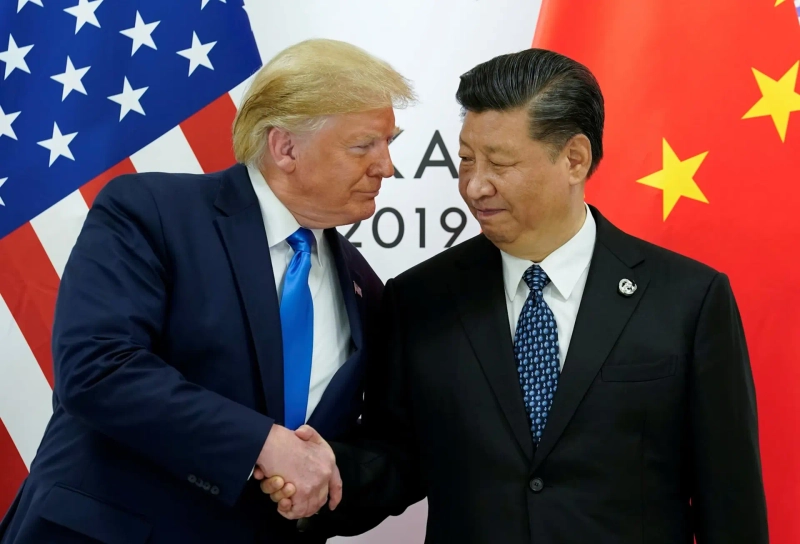
US President Donald Trump and Chinese President Xi Jinping are to meet in Shenzhen, China. The meeting comes two months after their summit in Washington in September. Including their meeting in Beijing in May, it will be their third summit this year.
On Nov. 19, the two leaders will hold bilateral talks before being joined by Russian President Vladimir Putin for what would be the first trilateral summit among the US, China and Russia. The agenda is set to span economic and security issues, from artificial intelligence semiconductors and rare-earth supply chains to nuclear arms reduction and the war in Ukraine.
The Asia-Pacific Economic Cooperation summit opened in Shenzhen on Nov. 18. Leaders from 21 member economies, including the US, China and South Korea, are attending. The theme of this year's meeting is building an Asia-Pacific community and shared prosperity. It is China's first time hosting an APEC leaders' meeting since the 2014 summit in Beijing.
Xi delivered a keynote speech at the APEC CEO Summit on Nov. 18, stressing the importance of multilateral cooperation and free trade. "The international landscape is marked by intertwined change and disorder, the global economy lacks growth momentum, and unilateralism and protectionism are on the rise," Xi said. He added that "openness brings progress, while closure inevitably leads to backwardness" and called for firmly safeguarding the rules-based multilateral trading system centered on the World Trade Organization. The remarks amounted to criticism of the Trump administration's tariff policy while underscoring China's image as a defender of free trade and the multilateral trading system.
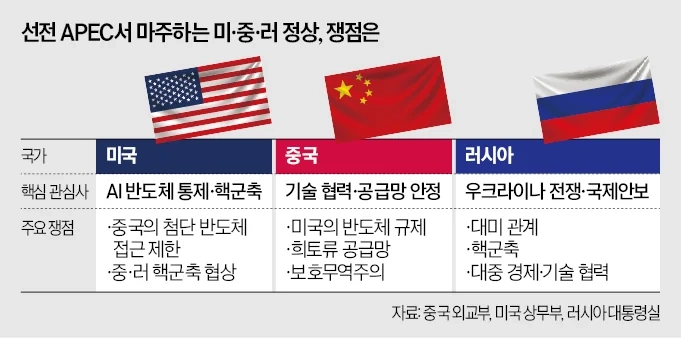
Technology tensions are the biggest economic issue hanging over the US-China summit. The Bureau of Industry and Security at the US Commerce Department announced ahead of Trump's Asia trip that it would restrict China's remote access to advanced AI semiconductors from companies including Nvidia. It also said it would tighten controls on indirect chip exports routed through Southeast Asian countries. China, in turn, stands to respond through its rare-earth supply chain. That sets up a clash on Nov. 19, with the US and China wielding semiconductors and rare earths as leverage, respectively.
At the subsequent US-China-Russia summit, security issues are likely to dominate, including nuclear arms cuts, the war involving Iran and the war in Ukraine. Trump has expressed willingness to discuss nuclear arms reduction with China and Russia. China, however, has taken a cautious stance, arguing that its nuclear arsenal remains far smaller than that of the US and others. There is also interest in how far talks on ending the war in Ukraine can proceed without European parties present.
The Korean Peninsula could also be on the trilateral agenda. Some have raised concerns that any statement could effectively tolerate North Korea's possession of nuclear weapons.
The possibility of a surprise visit to China by North Korean leader Kim Jong Un also remains. Trump and administration officials have repeatedly indicated they could meet Kim in China. The Kremlin has also said that if Kim attends APEC, he could meet Putin.
Kim Eun-jung, Beijing correspondent, Korea Economic Daily kej@hankyung.com

Korea Economic Daily
hankyung@bloomingbit.ioThe Korea Economic Daily Global is a digital media where latest news on Korean companies, industries, and financial markets.