US Moves to Block Chinese AI Infrastructure Parts Imports Despite Big Tech Opposition
Summary
- The US is moving to restrict imports of optical transceivers and other core data-center components made in China, raising expectations of a windfall for related industries in the US and South Korea.
- Replacing Chinese equipment could take as long as 10 years, and fears are growing that a possible export ban on indium phosphide (InP) could delay US data-center construction.
- News of the planned curbs sent shares of US optical communications equipment makers and South Korean optical communications companies sharply higher, reflecting expectations for tighter restrictions on imports of Chinese-made equipment.
Forecast Trend Report by Period


Curbs Proposed on Optical Transceivers, Other Data-Center Essentials
FCC Says China Could Use Chinese-Made Gear
To Steal Data and Install Malware
Big Tech Says Replacing Equipment Could Take 10 Years
And Fears Retaliation Such as Raw-Material Export Controls
South Korean Industry Eyes Potential Windfall
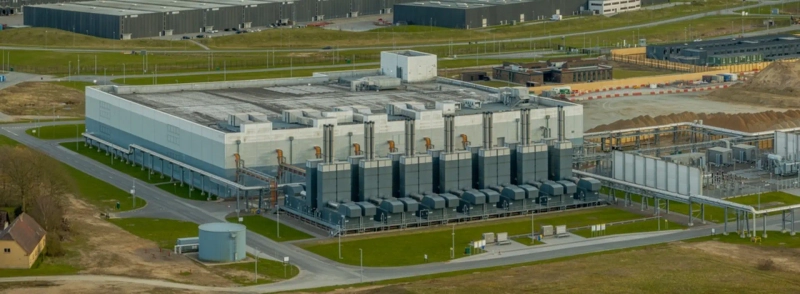
The Trump administration is pushing to restrict imports of Chinese-made components and equipment used in data centers, despite opposition from Microsoft, Google and other major technology companies. China dominates the market for parts such as optical transceivers, raising the prospect of gains for US suppliers as well as South Korean companies. The move is also fueling concern that it could increase data-center construction costs and make equipment procurement more difficult for major US technology firms.
Big Tech Fears Blowback
Reuters reported on November 17 that the Federal Communications Commission is preparing measures that would block new models of Chinese-made optical transceivers from being imported into the US on national security grounds. Optical transceivers are core communications components that allow data to move through fiber-optic cables inside data centers at the speed of light. Reuters said China hawks in the US fear Beijing could use Chinese-made transceivers to steal data from American data centers, install malware and disrupt services.
The US technology industry is opposing the proposed restrictions. Earlier this year, Microsoft, Amazon, Google, Meta, CoreWeave and Cisco, among other companies tied to data centers, met White House officials to deliver a joint message of opposition. Executives from those companies told the White House that replacing Chinese optical communications equipment and complying with new regulatory requirements could take as long as 10 years.
Big tech companies also fear China could retaliate by banning exports of indium phosphide, or InP. The material is essential for US companies seeking to make their own optical transceivers. If imports of Chinese finished products are restricted and supplies of materials needed for alternative production are also cut off, procurement of key parts for data-center construction could be severely disrupted.
US Suppliers' Shares Jump
The Chinese Embassy in Washington said that day it firmly opposes what it described as the excessive expansion of the national security concept by the US.
A White House official pushed back, saying other FCC actions banning foreign-made equipment from China and elsewhere had already driven billions of dollars of investment into US manufacturing and created thousands of jobs. The article said related curbs are expected to tighten further following allegations involving a Chinese woman accused of spying and an affair involving former Nvidia Chief Executive Officer Jensen Huang. Bloomberg reported that Nvidia halted China shipments of its Hopper-series data-center semiconductors that day. The company made the move on its own despite having received US government approval to sell the products, the report said, amid controversy tied to Huang.
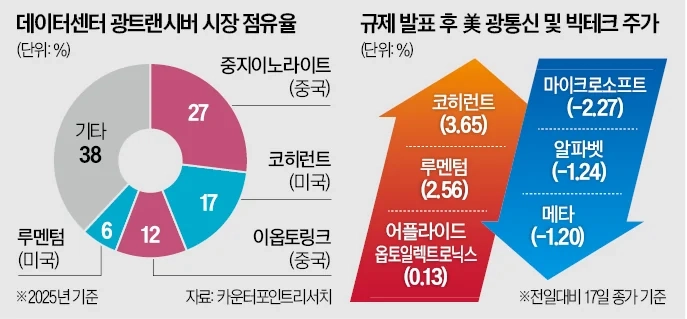
Shares of US optical communications equipment makers rose across the board after news of the planned curbs on optical transceivers. Coherent climbed 3.65% in New York trading and jumped another 7.16% in after-hours trading. Lumentum and Applied Optoelectronics also rose 2.56% and 0.13%, respectively, on the Nasdaq. Investors are betting US companies could emerge as alternative suppliers if imports of Chinese-made equipment are restricted.
China holds the largest share of the global optical transceiver market. Counterpoint Research said Chinese companies including Zhongji Innolight and Eoptolink account for about two-thirds of the global market. Major US hyperscale data-center operators, including big tech companies, are also customers of those Chinese suppliers. Zhongji Innolight is on a US Defense Department list of companies classified as linked to the Chinese military.
South Korean optical communications equipment makers could also have a better chance of winning US customers. On November 18, Oi Solution and Daehan Optical Communication surged 11.38% and 2.09%, respectively, on the Kosdaq. Some in the industry also fear that if Chinese retaliation delays US data-center construction, South Korean electronics makers including Samsung Electronics, which makes server DRAM chips, could be hurt.
Kim Dong-hyun, Hankyung.com reporter 3code@hankyung.com

Korea Economic Daily
hankyung@bloomingbit.ioThe Korea Economic Daily Global is a digital media where latest news on Korean companies, industries, and financial markets.