PiCK
Trump-Xi-Putin Summit Reflects Clashing Agendas as Washington Doubts Any ‘Second Yalta’
Summary
- The US said it wants progress on arms control, especially on capping nuclear arsenals with China included after the New START treaty expired.
- China stressed that its number of nuclear weapons is smaller, called for the US and Russia to cut first and for the UK and France to join any framework, and said the goal of the summit is to safeguard world peace.
- Russia is seeking to use the meeting as a chance to end the war in Ukraine on terms favorable to Moscow and to present itself as being on equal footing with the US and China.
Forecast Trend Report by Period


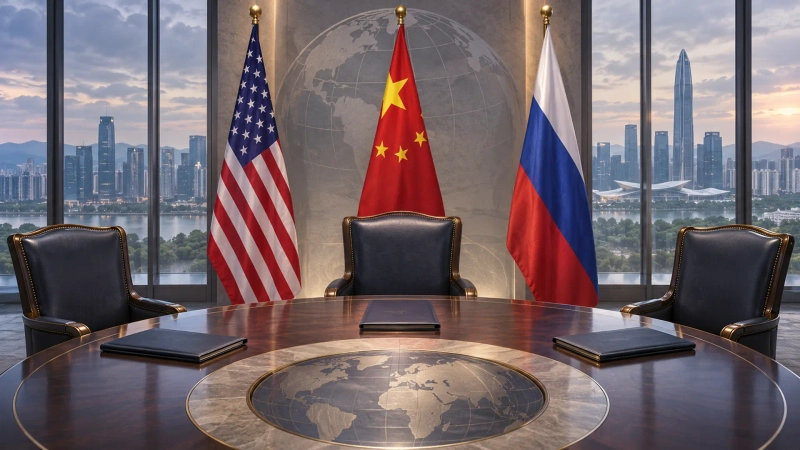
At 2:30 p.m. in Shenzhen, or 3:30 p.m. in South Korea, the leaders of the US, China and Russia are set to sit down together.
A three-way meeting among the three leaders is highly unusual. China, Russia and North Korea have met together before, but a gathering that includes a US president with the Chinese and Russian leaders carries symbolic weight.
The three leaders appear to be arriving with sharply different objectives. US President Donald Trump wants progress on arms control, specifically on efforts to cap nuclear arsenals with China included. The New START treaty, the nuclear arms-control pact between the US and Russia, expired in February this year. Trump has repeatedly said he expects progress on the issue and wants to leave a historic legacy.
Chinese President Xi Jinping, however, does not appear eager to engage in such talks. China’s nuclear arsenal is estimated at roughly one-fifth to one-tenth the size of those of the US and Russia. Beijing has argued that Washington and Moscow should reduce their stockpiles first, and that any broader framework should include countries such as the UK and France, not just China. China has said the summit’s goal is to “safeguard world peace.” In Washington, many view the gathering itself as a political show rather than a venue for detailed or substantive agreements.
Russian President Vladimir Putin, by contrast, wants to use the meeting as an opportunity to end the war in Ukraine on terms favorable to Moscow. He appears intent on casting the event as a modern-day Yalta, the 1945 conference where the leaders of the US, the UK and the Soviet Union decided the fate of smaller countries. Ukrainian President Volodymyr Zelenskiy has voiced that concern, saying he does not want “Yalta 2, 3 or 4.”
Even if the summit produces no concrete progress on Ukraine, Russia could still claim a major success by appearing on equal footing with the US and China despite its much weaker economic power.
Still, the prevailing view in Washington is that the meeting is unlikely to become a Yalta-style turning point that divides the world into spheres of influence. In the past, the great powers had a common enemy in Nazi Germany. Now, the three leaders lack a clear shared agenda on which they could reach broad agreement. The short preparation period for the summit also lowers the odds of any such grand bargain.
Even so, some concern remains. If the US appears willing to abandon Ukraine for the sake of convenience, that could send the wrong signal on Taiwan and North Korea, Washington officials and analysts warn.
Lee Sang-eun, Washington correspondent, Hankyung.com, selee@hankyung.com

Korea Economic Daily
hankyung@bloomingbit.ioThe Korea Economic Daily Global is a digital media where latest news on Korean companies, industries, and financial markets.