Xi Sets Out Four Principles at First US-China-Russia Summit, Urges Nuclear-Free World
Summary
- Xi said a full ban and complete elimination of nuclear weapons, the prevention of nuclear war, and compliance with the Nuclear Non-Proliferation Treaty, or NPT, are essential.
- Xi said China, the United States and Russia must not pursue decoupling or sever industrial and supply chains, while stressing stronger economic and trade cooperation and mutual benefit.
- Xi said the three countries should work together on stable energy industrial and supply chains and the political and diplomatic resolution of international conflicts as the world faces challenges to energy security.
Forecast Trend Report by Period


Xi Says Nuclear Arms Are the Sword of Damocles Hanging Over Humanity, Urges Their Complete Elimination
Xi Says US, China and Russia Must Avoid Decoupling and Supply-Chain Ruptures, Proposes Nuclear Disarmament and Economic Cooperation
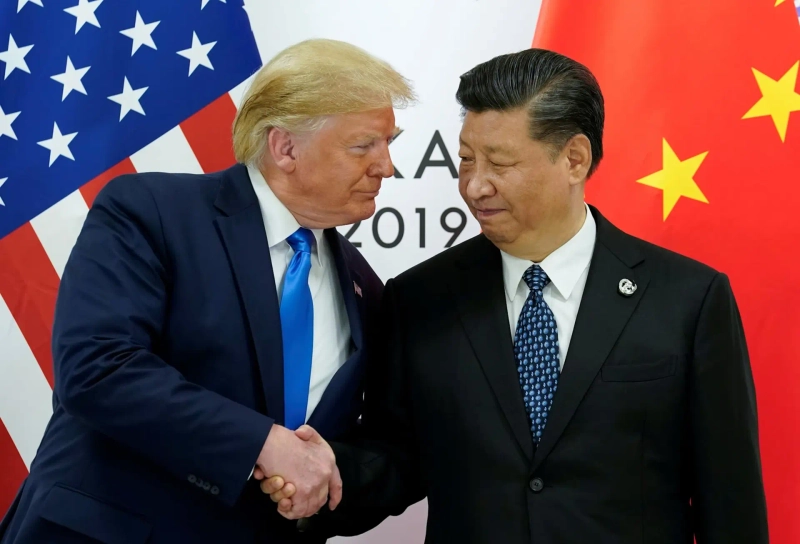
Chinese President Xi Jinping urged the United States and Russia to support a full ban and complete elimination of nuclear weapons, saying the ultimate goal should be a world free of nuclear arms.
He also said China, the United States and Russia should use their economic complementarities to deepen trade cooperation and prevent a split in industrial and supply chains. Xi laid out four principles for proper relations among major powers: mutual respect, peaceful coexistence, win-win cooperation, and dialogue and negotiation. At a meeting that brought together the leaders of the world’s three largest nuclear powers, he called for joint action on nuclear disarmament, economic cooperation and the resolution of international conflicts.
Xinhua News Agency reported on Nov. 19 that Xi met US President Donald Trump and Russian President Vladimir Putin in Shenzhen, Guangdong province, that afternoon for a three-way summit, where he proposed four principles for coexistence among major powers and for world peace.
The most closely watched part of his remarks was his call to abolish nuclear weapons. Stressing the importance of peaceful coexistence, Xi said nuclear weapons are “like the Sword of Damocles hanging over humanity” and should be fully banned and completely eliminated, with the ultimate aim of building a world without them.
He added that “a nuclear war cannot be won and must never be fought.” He also called for every effort to prevent one and for adherence to the Nuclear Non-Proliferation Treaty, or NPT, to preserve global strategic stability.
Xi also made clear that conflict among major powers is not inevitable. “The Thucydides Trap is by no means an unavoidable destiny,” he said, adding that the outcome depends on the choices major powers make. The Thucydides Trap refers to the risk of conflict between an established hegemon and a rising power.
China, Russia and the United States should be partners and friends, he said, avoiding conflict and confrontation while upholding the bottom line of peaceful coexistence.
On the economy and trade, Xi voiced opposition to decoupling and supply-chain disruption. He said the three countries differ in their development conditions but have strong economic complementarities, allowing them to exchange what they need and offset weaknesses by drawing on their respective strengths.
He also called for abandoning a Cold War mentality and strengthening economic and trade cooperation. The three countries, he said, should combine the strengths of resource powers, manufacturing powers and consumer powers, expand the pie of cooperation and realize mutual benefit. In particular, they should not pursue decoupling or sever industrial and supply chains.
Xi also identified energy security as an area for cooperation. Global energy security is facing severe challenges, he said, and the three countries should strengthen communication and coordination to keep energy industrial and supply chains stable and running smoothly, while safeguarding the security and stability of the global energy market.
On mutual respect, Xi stressed respect for sovereignty, territorial integrity and social systems. China, Russia and the United States have different systems of government, he said, and no country can change another. Those systems were shaped by history and chosen independently by each country’s people.
He added that the three countries should respect one another’s sovereignty and territorial integrity, social systems and development paths, as well as core interests and major concerns. They should not interfere in other countries’ internal affairs. On sensitive issues, he said, they should communicate in advance, think from the other side’s perspective and act prudently. In particular, they must not cross one another’s bottom lines.
On dialogue and negotiation, Xi proposed creating a crisis-management framework among major powers. Differences among them are hard to avoid, he said, but without communication, mutual suspicion can spread and even minor friction can escalate into a major clash.
The three countries should maintain regular high-level exchanges and keep dialogue channels at all levels running smoothly. They should also build systems for crisis communication and prevention to reduce miscalculation, manage differences and prevent friction from intensifying.
Xi also stressed diplomatic solutions to international conflicts, including the war in Ukraine. The international community expects major powers to play a more active role in mediating for peace and promoting negotiations, he said. China, Russia and the United States should continue pushing parties to conflicts to sit down at the negotiating table and begin talks. Disputes should be resolved through political and diplomatic means.
Kim Eun-jung, Beijing correspondent, Korea Economic Daily, kej@hankyung.com

Korea Economic Daily
hankyung@bloomingbit.ioThe Korea Economic Daily Global is a digital media where latest news on Korean companies, industries, and financial markets.