PiCK
AI Boom Nearing a Peak? Wall Street Sees Global Profit Growth Halving Next Year
Summary
- Forecasts for companies in the MSCI World Index, as well as estimates from Goldman Sachs and Barclays, suggest global corporate earnings growth will slow sharply next year from this year.
- As growth in AI capital spending is forecast to peak in the first half of next year and then cool, rising depreciation and interest costs could weigh on the performance of semiconductor companies and related firms.
- Even so, Wall Street is maintaining its bullish outlook for the US S&P 500 Index and AI-related stocks, citing continued share-price gains and more attractive valuations.
Forecast Trend Report by Period


Wall Street Says Profit Growth Is Slowing as AI-Fueled Expansion Loses Steam
Data-Center Investment Growth to Moderate
Depreciation and Interest Costs Are Snowballing
US and Asian Companies With Heavy Chip Exposure Seen Taking a Hit
Wall Street Still Expects Stocks to Rise

Wall Street expects global corporate profit growth next year to slow to roughly half this year’s pace. The view suggests the breakneck expansion fueled by surging investment in artificial intelligence is starting to lose momentum. Spending on infrastructure such as Big Tech data centers will still rise in absolute terms, but the pace of increase is set to moderate while interest costs climb, curbing earnings growth.
AI Capital-Spending Growth Nears a Peak
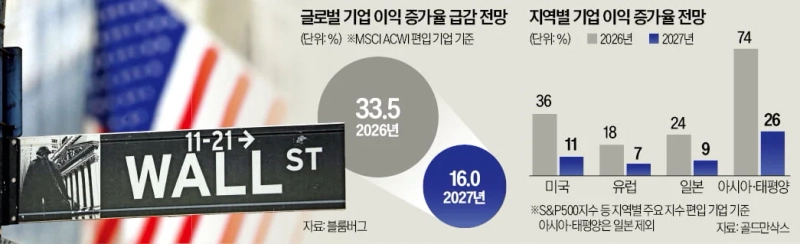
According to Bloomberg data cited by the Financial Times on November 19, companies in the MSCI All Country World Index are projected to post profit growth of 16% next year. That is 17.5 percentage points lower than this year’s forecast of 33.5%. The gauge tracks major listed companies around the world.
Global stocks hit record highs this year despite the war in the Middle East and concerns over higher interest rates, supported by strong earnings from US Big Tech and other companies. Wall Street now sees that pace of profit expansion as difficult to sustain next year.
Goldman Sachs also forecasts earnings growth at major US companies slowing to 11% next year from 36% this year. Peter Oppenheimer, Goldman Sachs’ chief global equity strategist, told the FT that corporate earnings growth would slow sharply across major regions. Barclays likewise projects US corporate earnings growth easing to 15% next year after running above 30% this year.
Asian Companies Face a Sharper Earnings Slowdown
The slowdown is likely to be steeper in Asia. Goldman Sachs forecasts earnings growth of 74% this year and 26% next year for major companies in Asia-Pacific excluding Japan. South Korea’s Samsung Electronics and SK Hynix, along with Taiwan’s TSMC, account for a large share of the regional economy. That leaves the region more exposed to shifts in AI capital spending, resulting in a bigger slowdown in earnings growth. Japan is also unlikely to avoid a deceleration. Goldman Sachs sees earnings growth at major Japanese companies slowing to 9% next year from 24% this year.
A lower earnings growth rate does not mean profits will decline. It means results may keep improving, but not at the pace seen this year.
One reason for the projected slowdown next year is capital spending by large cloud and data-center operators. Their recent investment surge has lifted sales and profits for semiconductor and memory companies in the US and Asia. Spending will keep rising, but at a slower pace, which could affect the rate of earnings growth for suppliers of related equipment and components.
Goldman Sachs forecasts global AI investment increasing to $1.8 trillion next year from $1.1 trillion this year, a rise of 63.6%. The bank said expanding hardware spending would drive the increase. It expects global AI capital-spending growth to peak in the first half of next year and then cool.
Depreciation and Interest Costs Are Rising
Costs generated by investments already made are also set to affect future profits. Spending on equipment such as servers and data centers is recognized over time through depreciation. As those assets increase, so can the expenses recorded later on income statements. More investment can lift revenue for equipment suppliers, but companies that own the facilities bear the related costs if those assets fail to generate returns. Oppenheimer said depreciation tied to physical AI assets would weigh on earnings and that the impact of higher interest costs would start to show.
This year, the war involving Iran pushed up energy prices, lifting inflation and expectations for rate increases and in turn raising borrowing costs for companies and governments. Venu Krishna, Barclays’ head of US equity strategy, said AI-related stocks, a core driver of the US market’s outperformance over the past four years, are approaching a difficult test. Financing has become more complicated for large cloud companies, he added, and their greater reliance on borrowing has made them more sensitive to market shifts.
Still, Wall Street is maintaining its bullish view on stocks. The FT said many analysts expect the S&P 500 Index to rise again next year after posting double-digit annual gains in each of the past three years. It cited the recent selloff in technology shares, which has brought valuations down to more attractive levels.
Kim Ju-wan, Hankyung.com reporter kjwan@hankyung.com

Korea Economic Daily
hankyung@bloomingbit.ioThe Korea Economic Daily Global is a digital media where latest news on Korean companies, industries, and financial markets.