PiCK
Anthropic IPO Ends, but Fed Tightening Still Weighs as Bitcoin Eyes High-$50,000s: Trade Now
Summary
- Analysts said Bitcoin could extend its correction toward $58,000-$59,000 if it fails to reclaim $62,000-$62,500.
- They said U.S. spot Bitcoin ETFs have posted net outflows for weeks, while a 4.2% drop in stablecoin supply points to weak spot demand and reduced buying power.
- The market sees the outlook for a rebound hinging on expectations for additional Fed tightening, deleveraging, and whether Bitcoin can reclaim the $66,000-$68,000 and $76,000-$82,000 ranges.
Forecast Trend Report by Period



Anthropic’s initial public offering has wrapped up, but there is still no clear sign of money returning to the Bitcoin market. Bitcoin has slipped back below $62,000 as expectations for further Federal Reserve tightening combine with spot exchange-traded fund outflows and weak spot demand. Analysts say that if the cryptocurrency fails to quickly reclaim the $62,000 to $62,500 range, a deeper pullback toward $58,000 to $59,000 could follow. A recovery above $66,000, by contrast, would help ease near-term bearish pressure.
As of 4:01 p.m. on Nov. 20, Bitcoin was trading at $61,524 on Binance’s USDT market, down 2.78% from a day earlier. On Upbit, it was trading at about 84.16 million won, or about $60,900. The kimchi premium, the gap between prices on domestic and overseas exchanges, stood at about 1.56%.
Anthropic IPO Ends, but Fed Tightening Concerns Persist
With Anthropic’s listing, widely seen as the biggest IPO event of the year, now complete, some investors had hoped attention tied up in the deal would rotate back into risk assets. But risk appetite remains subdued after Anthropic surrendered much of its early first-day gain and the prospect of additional Fed tightening returned to the fore. There are still no clear signs of fresh inflows into spot Bitcoin ETFs or the spot market.

Anthropic, which listed on Nasdaq on Nov. 19, opened at $111.50, up 34.3% from its IPO price of $83. The stock climbed to around $115 intraday before sliding into the $92 range, then finished the session at $97.17. With large sums committed to the IPO subscription ahead of the debut, markets are watching whether liquidity conditions across risk assets normalize after the listing.
On monetary policy, tightening concerns remain in place. Minutes from the Federal Open Market Committee’s October meeting showed that nearly all participants judged additional rate increases would be needed if the baseline outlook holds. Two participants indicated that if inflation data worsen again, they could consider a hike of more than 25 basis points at the next meeting.
Federal Reserve Governor Christopher Waller has also underscored the case for further tightening. He broadly supports a 25-basis-point increase in December, but has also said a 50-basis-point move should be considered if inflation proves stronger than expected. Interest-rate futures markets are also pricing in a December hike probability in the mid-90% range.

On the external front, the first-ever trilateral summit among the U.S., China and Russia, held on the sidelines of APEC, produced no clear breakthrough. The three leaders agreed to continue talks aimed at reducing nuclear risks and preventing proliferation, but did not reach specific agreements on major issues including the war in Ukraine and Iran. Trump, meanwhile, said he was "not rushing a decision" on whether to launch additional strikes on Iran, signaling the matter could be pushed into next year.
Spot Demand Remains Weak as ETF Outflows and Deleveraging Continue
Money has continued to leave spot Bitcoin ETFs this week after last week’s outflows. U.S. spot Bitcoin ETFs posted total net outflows of $1.065 billion in the week of Nov. 9-13, marking a third straight week of withdrawals. Another $538 million exited the funds between Nov. 16 and Nov. 18, showing that institutional demand has yet to mount a clear recovery.
Recent market data show a sharp increase in loss-taking sales, while fresh demand capable of absorbing that supply remains weak. On-chain analytics firm Glassnode said investors who entered the market more recently are increasingly realizing losses instead of waiting for a recovery. Excluding bargain hunting, overall demand remains sluggish. Glassnode also said stablecoin supply, which serves as sidelined liquidity for digital-asset markets, fell 4.2% over the past 90 days, weakening buying power.
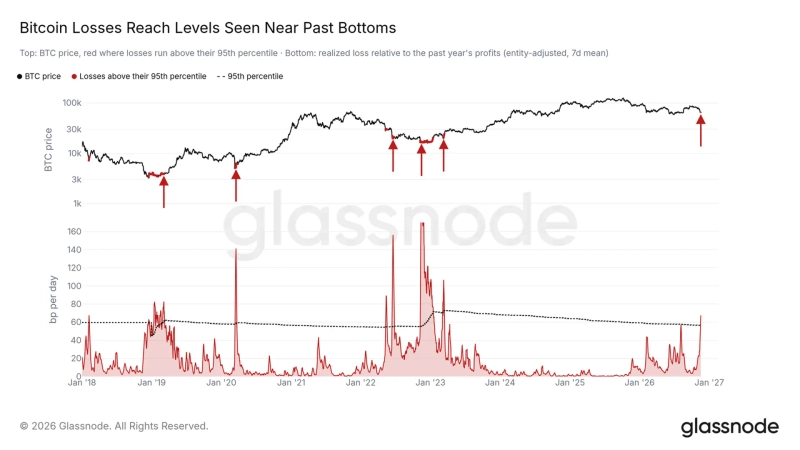
A large share of spot ETF investors are already sitting on losses, and institutional buying has yet to revive. Global digital-asset exchange Bitfinex estimated the weighted average purchase price for net inflows into U.S. spot ETFs in the third quarter at about $78,300. It put the average cost basis for all ETF investors at about $84,870. Bitfinex said spot demand has weakened as many ETF investors have slipped underwater at current prices and much of the third quarter’s net inflows have flowed back out in the fourth quarter.
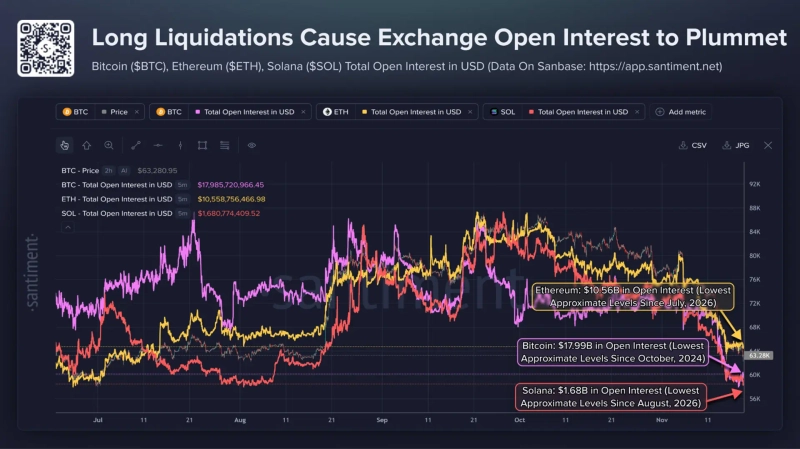
Excess leverage that had built up in the market appears to have been largely flushed out during the correction. On-chain analytics firm Santiment said exchange open interest fell about 20% for Bitcoin, 31% for Ether and 34% for Solana over the past two weeks. With leverage reduced, prices may now be driven more by actual buying and selling flows than by forced liquidations. If open interest stays low while prices stabilize, any eventual rebound could take shape in a more orderly way.
Market participants are still taking a cautious view of the rebound outlook. Bitfire Research said hotter-than-expected inflation, expectations for further Fed tightening, and rising dollar and real yields have weighed on Bitcoin, alongside a correction in tech stocks and ETF outflows. It added that on-chain indicators show much of Bitcoin’s valuation pressure has eased, but a rapid V-shaped rebound is unlikely in the near term because stablecoin liquidity has shrunk and institutions remain cautious ahead of the December FOMC meeting.
Bitcoin Breaks Below $62,000; Next Support Seen in High-$50,000s
With Bitcoin now below $62,000, the market is focused on whether it can quickly reclaim that level. Analysts say a further correction toward $58,000 to $59,000 is possible if the token fails to recover the $62,000 to $62,500 range. A move back above $66,000, on the other hand, could partly ease short-term bearish pressure.
Alex Kuptsikevich, senior market analyst at FxPro, said dip buying has emerged after Bitcoin slid toward $62,000, but the move still does not amount to a clear rebound. In the short term, the key question is whether Bitcoin can quickly recover $62,000. Only a rise to $66,000 would suggest the recent weak trend has partially eased.
There is also a view that downside pressure could intensify now that Bitcoin has slipped below $62,500. Julien Pineda, a market analyst at Forex.com, described $62,500 as a key near-term support level and said the risk of further declines would increase if Bitcoin stays below that price. On any rebound, Bitcoin would first need to retake $66,600. A climb to $72,700 would then be needed before the recent bearish trend could be seen as easing more meaningfully.
With Bitcoin already below $62,000, the next support zone is increasingly seen at $58,000 to $59,000. Coinbase said failure to quickly recover the $62,000 line could lead to a further correction into that range. On the upside, it said the first test is whether Bitcoin can reclaim $66,000 to $68,000. A break above $76,000 could then open the way toward $80,000 to $82,000.
In a more bearish scenario, some analysts see scope for another drop toward $55,000. Alejandro Arrieche, an analyst at FXEmpire, said that if Bitcoin falls below $60,000, it could see a temporary rebound near $57,000 before retesting the $62,000 level. If that rebound fails and the downtrend continues, however, Bitcoin could face another leg lower toward $55,000.
Kang Min-seung, Bloomingbit reporter minriver@bloomingbit.io

Minseung Kang
minriver@bloomingbit.ioBlockchain journalist | Writer of Trade Now & Altcoin Now, must-read content for investors.