PiCK
Wedding, Retirement Savings Halved as Samsung-SK Hynix Selloff Leaves Retail Investors Reeling
Summary
- Samsung Electronics and SK Hynix have lost 2,390 trillion won ($1.72 trillion) in combined market value as their share-price plunge inflicted heavy losses on household assets, including minority investors and retirement savings.
- Record earnings, all-time-low PERs, a 100 trillion won ($72.2 billion) shareholder-return policy and resumed share buybacks have failed to lift the stocks, as worries over the AI investment cycle and the risk of a China-driven decline in semiconductor prices continue to weigh on sentiment.
- With losses amplified by single-stock leveraged ETFs and a demand vacuum caused by large overseas IPOs, investors are looking to January fourth-quarter earnings, semiconductor prices and contract volumes, and additional shareholder-return measures as possible catalysts for a rebound.
Forecast Trend Report by Period


Samsung and SK Hynix Halved... Korea’s Favorite Stocks Turn on Investors
Trapped in a Mistrust Spiral Despite Record Earnings
$1.72 Trillion in Market Value Wiped Out
Even as Profit Forecasts Rise and Bargains Beckon
AI Doubts Deepen as Shares Extend Their Slide
Households That Parked Wedding and Retirement Money Face Strain
This article appeared on Korea Economic Daily’s paid investment platform, Hankyung Premium 9. Subscribers to Hankyung Premium 9 (www.hankyung.com/premium9) can access more stock-investment coverage.
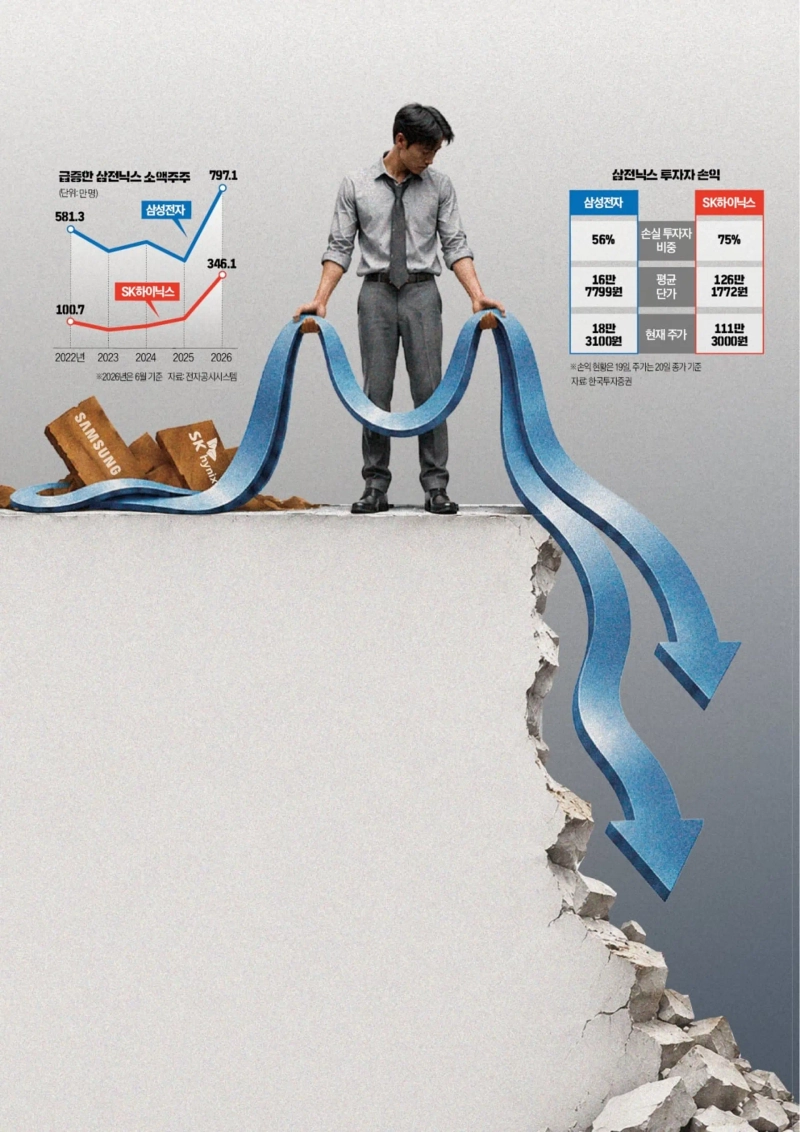
"I was going to sell cleanly once the Kospi hit 10,000 and put the money toward our newlywed home," said Han, 33. "Now? Looking at my account, I may have to postpone the wedding."
Han invested in chip stocks in April, when what retail investors call “Samjeonnix” — Samsung Electronics and SK Hynix — began a sharp rally. As of Nov. 20, his account was showing a 63% loss. He kept averaging down on every dip, convinced the pair would rebound, but his initial 270 million won ($195,000) has shrunk to 100 million won ($72,000).
A steep slump in Samsung Electronics and SK Hynix is eroding household wealth in South Korea. Nvidia’s third-quarter earnings and Anthropic’s listing, both viewed as potential turning points, did little to halt the selloff. Instead, the prospect of weaker chip prices driven by China has revived fears of a semiconductor winter.
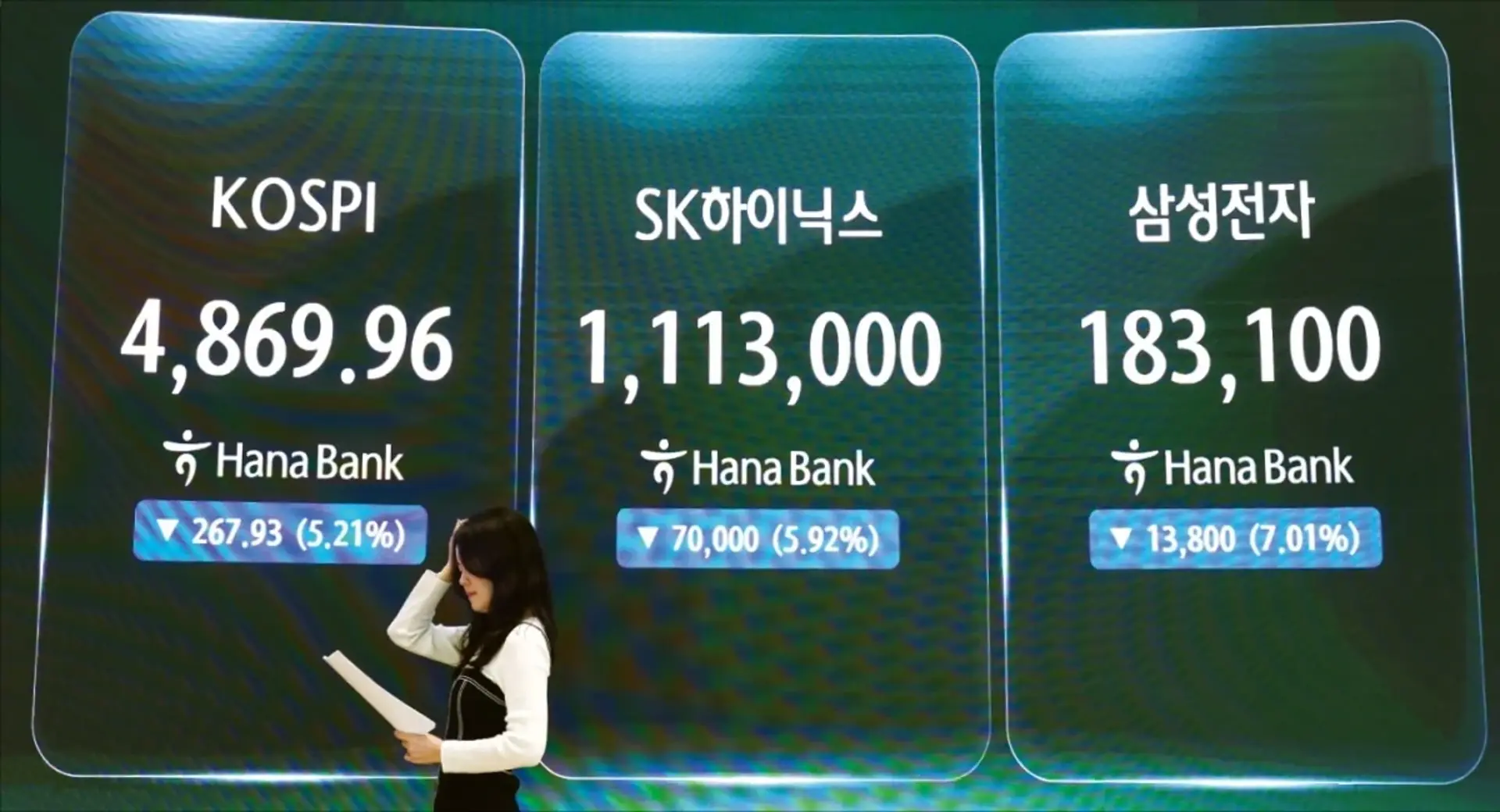
Samsung Electronics closed down 7.01% at 183,100 won, while SK Hynix fell 5.92% to 1.113 million won. Anthropic rose 17% in its first day of US trading overnight, but other artificial intelligence-related shares broadly declined. Investor sentiment toward chipmakers worsened after forecasts emerged that tighter US curbs on indirect semiconductor exports to China could reduce Chinese memory-chip demand and push down NAND prices. The Kospi slid 5.21% to 4,869.96, while Japan’s Nikkei 225 lost 5.06% and Taiwan’s Taiex dropped 6.63%.
At the Nov. 20 close, the combined market capitalization of Samsung Electronics, including preferred shares, and SK Hynix stood at 1,972.9 trillion won ($1.42 trillion). That marked a drop of 2,390 trillion won ($1.72 trillion) from their June peak of 4,363.4 trillion won ($3.15 trillion), meaning that much value vanished in five months. The decline ran counter to earnings expectations: consensus forecasts for the two companies’ combined operating profit next year rose 21.1% to 1,078.3 trillion won ($778 billion) from 890.4 trillion won ($643 billion) over the same period.
The rout in “Samjeonnix” is unsettling a broad swath of the public. As of the end of June, Samsung Electronics had 7,971,242 minority shareholders and SK Hynix had 3,461,526, according to the electronic disclosure system operated by the Financial Supervisory Service. That was 1.9 times and 2.9 times the level at the end of last year, respectively. Korea Investment & Securities said 55% of its Samsung Electronics clients and 75% of its SK Hynix clients were in the red. Citigroup estimates South Korean households will suffer about 563 trillion won ($406 billion) in equity capital losses in the second half.
The pain is not confined to younger investors. Older households nearing retirement also appear to have treated this year’s rally as a last chance, aggressively managing retirement savings. Data that lawmaker Park Sung-hoon of the ruling People Power Party obtained from the Financial Supervisory Service showed 340,156 workers switched their retirement plans to defined-contribution accounts between January and July, up 118.1% from a year earlier.
Samsung and SK Hynix Trade at Barely 2 Times Earnings... Even 1,000 Trillion Won in Profit Can’t Restore Trust
Five Reasons Samsung and SK Hynix Shares Keep Falling
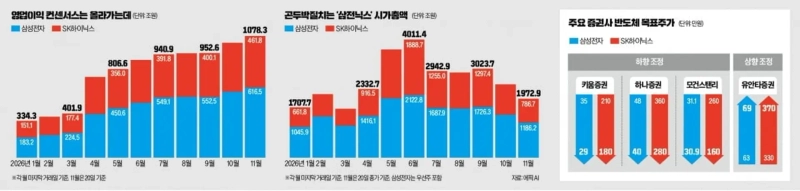
According to EpicAI, Samsung Electronics and SK Hynix were trading at 12-month forward price-to-earnings ratios of 2.58 and 2.14, respectively, on Nov. 20, the lowest levels on record. Both sat more than one full turn below the Kospi’s overall multiple of 3.53.
That extreme undervaluation had, until a month ago, fueled hopes that stronger shareholder returns would spark a rebound. Profit forecasts were holding up, the stocks looked cheap, and investors expected shareholder-return measures to become the trigger for a recovery. But the shares failed to bounce even after Samsung reaffirmed a shareholder-return policy worth 100 trillion won ($72.2 billion) and SK Hynix resumed share buybacks.
Investors then shifted their focus to Nvidia and Anthropic. The bet was that if Nvidia met earnings expectations despite Jensen Huang’s departure and Anthropic pulled off a successful market debut, sentiment around AI plays would recover and restart the semiconductor rally. Instead, even after Nvidia posted strong earnings and Anthropic debuted successfully on US markets, Samsung Electronics and SK Hynix tumbled another 7.01% and 5.92% on Nov. 20 as China-related concerns intensified. Experts cite five main reasons the two stocks still cannot gain traction.
(1) Cracks in Big Tech’s AI Investment Cycle
Samsung Electronics and SK Hynix shares are moving in the opposite direction from profit forecasts. EpicAI data show consensus for the two companies’ combined operating profit next year climbed from 890.4 trillion won ($643 billion) at the end of June, when the stocks were near their highs, to 1,078.3 trillion won ($778 billion) on Nov. 20, when the shares had been cut in half.
The decline in the face of rising earnings estimates suggests investors do not trust those projections. Signs of strain in the AI investment cycle, which began emerging in earnest last month, have heightened anxiety. In particular, questions about the sustainability of spending by neo-cloud company CoreWeave drove up the risk premium and dragged down AI-related stocks broadly.
Concern has also grown that Nvidia’s pace of investment through its circular-financing model could slow after Huang’s resignation.
(2) Even Record Profit Forecasts Aren’t Convincing
Many investors are focused on slowing earnings growth. Combined operating profit for Samsung Electronics and SK Hynix is projected to top 1,000 trillion won next year, but expanding chip supply is expected to trigger price adjustments, causing earnings momentum to fade in the second half.
Kiwoom Securities said in a recent report that Samsung’s operating profit will peak at 142.6 trillion won ($103 billion) in the second quarter of next year before falling to 108 trillion won ($78.1 billion) in the fourth quarter. It expects SK Hynix’s operating profit to decline over the same period to 78.5 trillion won ($56.7 billion) from 107.9 trillion won ($78 billion).
(3) Slowing Earnings Growth Is Undermining Optimism
Another factor deepening concern over chipmakers’ earnings outlook is the possibility of lower prices due to weaker Chinese demand. Taiwan research firm TrendForce on Nov. 19 brought forward its forecast for a decline in NAND flash contract prices to the first quarter of next year from the second quarter.
The reason is tighter US restrictions aimed at blocking indirect exports of AI chips to China. Washington introduced licensing requirements for exports to destinations including Indonesia, making it harder for China to secure AI chips via Southeast Asia.
Chinese cloud companies are already believed to be unable to use memory chips they have stockpiled because they lack graphics processing units. If indirect exports become even harder, demand could weaken further and prices may fall.
(4) War and Rate Anxiety Are Driving Foreign Investors Out
The global macro backdrop is also unfavorable for Korean equities. War in the Middle East has lifted oil prices, and the US has raised interest rates to contain inflation. Some in the market expect the Federal Reserve to deliver a 0.5 percentage-point increase at next month’s Federal Open Market Committee meeting.
As risk aversion deepens, foreign investors are pulling money out of South Korea. The benchmark market, heavily concentrated in semiconductor names, has been hit especially hard as overseas investors cut chip exposure amid uncertainty over earnings. Foreign investors sold 25.978 trillion won ($18.8 billion) of locally listed shares last month.
(5) Leverage and a Demand Vacuum Are Adding Pressure
Single-stock leveraged exchange-traded funds launched at the end of May have compounded losses in retail accounts. Products designed to deliver twice the performance of Samsung and SK Hynix became popular with individual investors and magnified losses during the downturn.
A demand vacuum has also accelerated the market’s slide. Record-sized initial public offerings, including SpaceX in June and Anthropic this month, drew capital overseas and drained buying power from the local market. Some analysts say Samsung and SK Hynix were supported by share repurchases until early October, but the floor gave way after Samsung completed its buyback program.
Investors are now looking to Samsung Electronics’ and SK Hynix’s fourth-quarter earnings, due at the end of January, as the next possible catalyst for a rebound. The thinking is that a relief rally could resume if robust profits are confirmed, next year’s chip prices and contract volumes become clearer, and companies unveil more concrete shareholder-return plans.
Next month’s FOMC meeting and Micron Technology’s earnings are also seen as key events. In the market’s view, even a quarter-point rate increase instead of a half-point move could be enough to calm concerns over rates.
Kang Jin-kyu and Lee Sun-a, Korea Economic Daily reporters josep@hankyung.com

Korea Economic Daily
hankyung@bloomingbit.ioThe Korea Economic Daily Global is a digital media where latest news on Korean companies, industries, and financial markets.